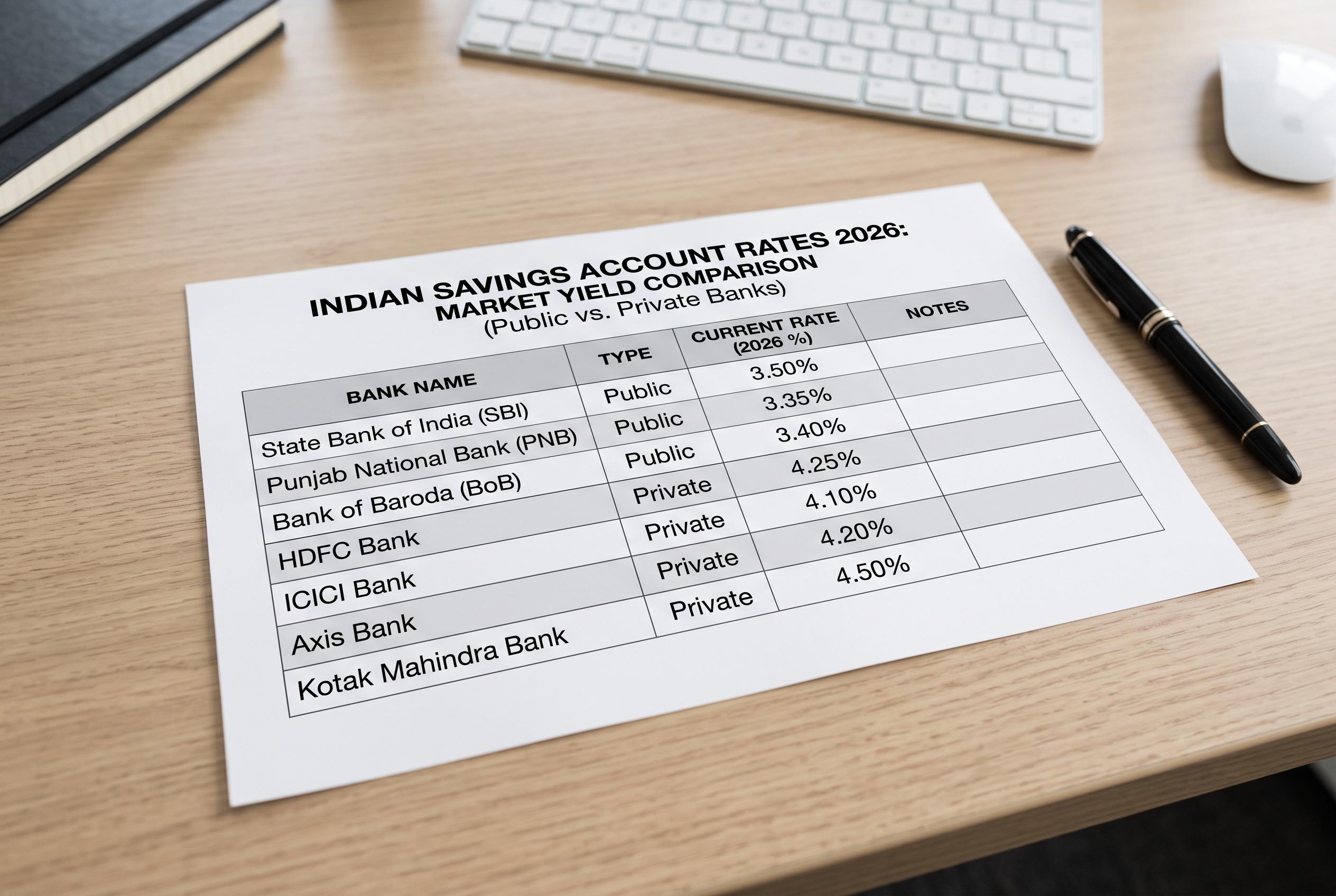

As India’s savings account rates recalibrate in 2026, the disparity between public and private banks grows, prompting savers to reassess where they park their cash amidst varying yields and tiered structures.
Savings account rates in India are moving again in 2026, and the changes matter for anyone who has left cash sitting idle in an old account. The broad trend is not a dramatic nationwide overhaul, but a widening divide between banks that are content with steady retail deposits and those using higher yields to pull in more funds. For savers, that means the rate printed on an account opening form from a few years ago may no longer reflect what is available now.
According to reports on the Reserve Bank of India’s policy stance, the repo rate has been held at 5.25% through April and June 2026, leaving the central bank in a neutral position as it balances inflation against growth. That stability suggests there is no automatic reason for deposit rates to surge or fall in step, but banks are still free to adjust pricing according to their own liquidity needs and competition for deposits. In practice, that leaves savers facing a market shaped less by a single policy move and more by how aggressively each bank wants to attract money.
The most noticeable change is the spread between bank types. Public sector lenders have generally remained conservative, while private banks have become more selective and, in some cases, more heavily tiered. Small finance banks continue to use higher savings rates as a selling point, although those offers often come with conditions on balances or account usage. Federal Bank’s new structure, effective July 16, 2026, shows how far this approach has gone: balances are now split into slabs, with different rates applying at different levels, rather than one flat return for every customer.
That detail matters because headline rates can be misleading. A bank advertising a higher return may only pay it on larger balances, so a customer with a modest emergency fund may receive far less than the top rate suggests. DBS Bank’s savings structure, which took effect in October 2025, follows the same pattern, offering one rate for balances up to ₹2 lakh and a higher one for deposits above that threshold. For everyday savers, the real question is not the biggest number in the brochure but the effective rate on the balance actually held.
The case for reviewing an account is straightforward. Even a small increase can add up over a year, especially for households parking emergency funds or short-term working capital in savings accounts. A better rate, however, is only useful if fees, minimum-balance rules and digital banking quality do not erode the gain. Government-backed small savings schemes also remain competitive, with the Centre keeping rates unchanged for the July-to-September 2026 quarter, including 8.20% for the Senior Citizens Savings Scheme and Sukanya Samriddhi Account Scheme and 7.10% for the Public Provident Fund. Taken together, the message is simple: savings is no longer a set-and-forget product, and 2026 is a good time to compare what your bank is paying with what the market is offering.
Disclaimer: This article is intended to inform and educate, not to recommend or endorse any financial product, investment or strategy. Please consider your own financial circumstances and seek professional advice where appropriate before making financial decisions.