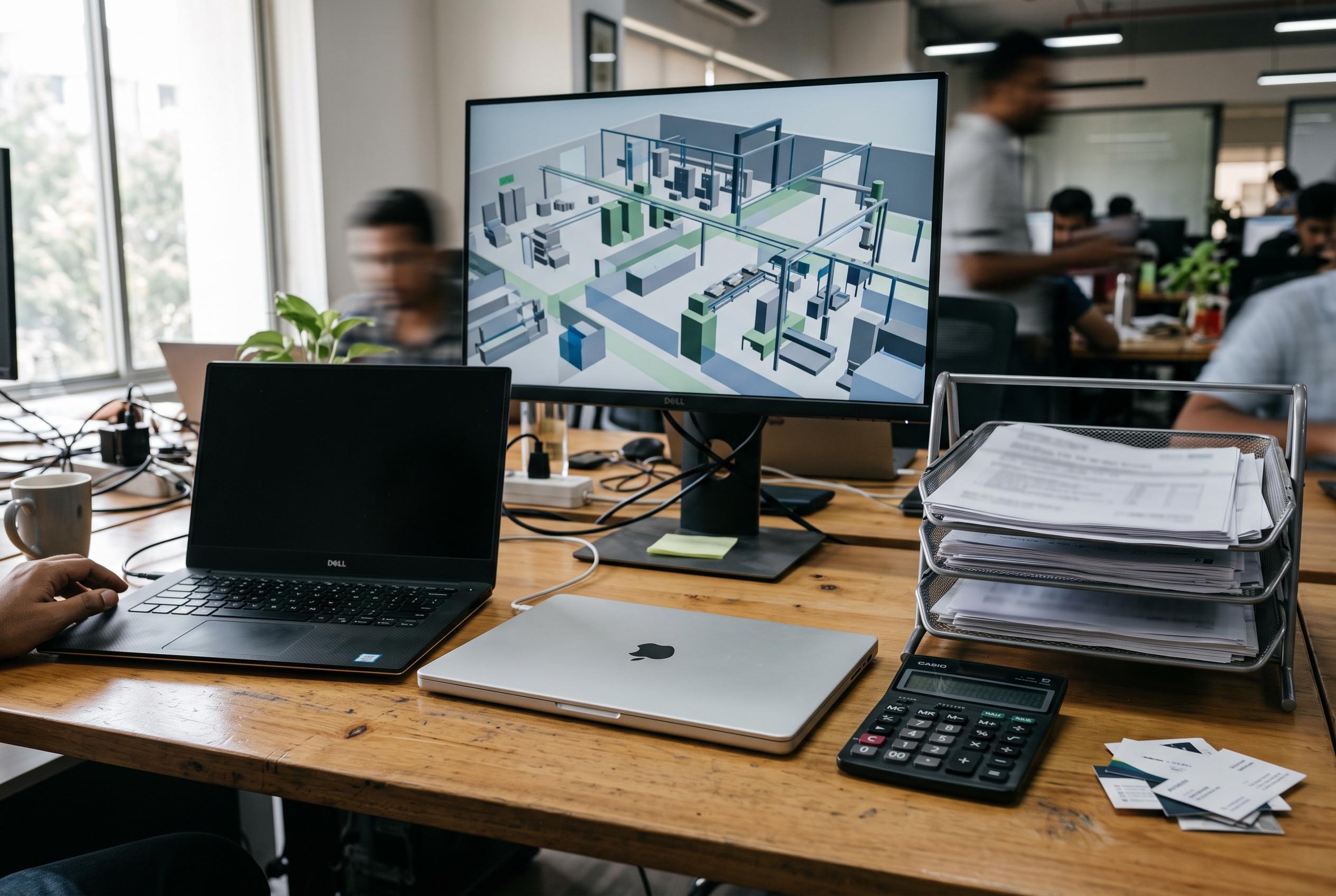

Indian technology companies are increasingly embedding Nvidia’s AI and Metaverse platforms into industrial, healthcare, and enterprise applications, signalling a significant move beyond basic graphics integration towards scalable, industry-specific digital solutions.
Indian technology companies are deepening their ties with Nvidia, moving well beyond simple access to graphics processors and into work on enterprise AI agents, digital twins, robotics, drug discovery and AI-ready infrastructure. The shift points to a broader change in the Indian IT services sector, where firms are increasingly building industry-specific systems on top of Nvidia’s software and computing stack rather than merely integrating third-party tools.
According to Nvidia material from GTC 2026, Tata Consultancy Services is using the company’s platforms in manufacturing and physical AI projects, including Metropolis, Omniverse libraries and NIM. Those tools are being applied to industrial video analysis, digital twin workflows and automated inspection, with TCS also showing work that combines sensing, simulation and decision-making across manufacturing, automotive, telecoms and financial services.
L&T Technology Services is taking a similar approach in industrial automation and healthcare. In an Nvidia GTC 2026 session, the company presented a Lights-Out Factory concept built on Omniverse, Isaac and CUDA-accelerated computing, aimed at moving factories from assisted automation towards more autonomous operations. LTTS has also developed a lung-diagnostics digital twin that uses CT scans to build a three-dimensional view of the lungs for use in respiratory diagnosis, surgical planning and navigation procedures.
Persistent Systems is using Nvidia tools for a more specialised goal: early-stage drug discovery. The company launched a Generative Molecules and Virtual Screening solution in March, built on BioNeMo and the NeMo Agent Toolkit, to help life sciences firms predict protein structures, generate molecules and rank compounds before laboratory testing. That places Persistent’s Nvidia work firmly in computational drug discovery rather than general-purpose generative AI.
Infosys and Tech Mahindra are focusing more on enterprise agents and sovereign AI. Infosys is working with Nvidia AI Enterprise and Nemotron models to build agents that can handle customer service, back-office and productivity tasks, while tying that work to its Topaz AI portfolio. Tech Mahindra is also using Nvidia AI Enterprise for business applications, with greater emphasis this year on agentic AI and systems designed to keep data and workloads within locally controlled infrastructure.
Wipro is broadening its Nvidia partnership across data centres, contact centres and industrial automation. In March, it launched an AI-data centre solution built with Nvidia AI Enterprise, and it is also using NeMo and GPU-accelerated inference for transcription, summaries, knowledge support and automated after-call documentation. Its industrial arm, Wipro PARI, is applying Nvidia infrastructure, Omniverse and Isaac robotics tools in automotive and consumer-sector use cases, while Nvidia also lists the company among partners for sovereign AI factories.
Taken together, the collaborations show how far Indian IT services firms have moved into Nvidia’s industrial AI ecosystem. Nvidia has been expanding Omniverse with new physical AI and digital twin blueprints, and the Indian companies now working with it are using that technology not just for experimentation but for factory simulation, robotics, healthcare and enterprise operations that can be deployed at scale.
Disclaimer: This article is intended to inform and educate, not to recommend or endorse any financial product, investment or strategy. Please consider your own financial circumstances and seek professional advice where appropriate before making financial decisions.