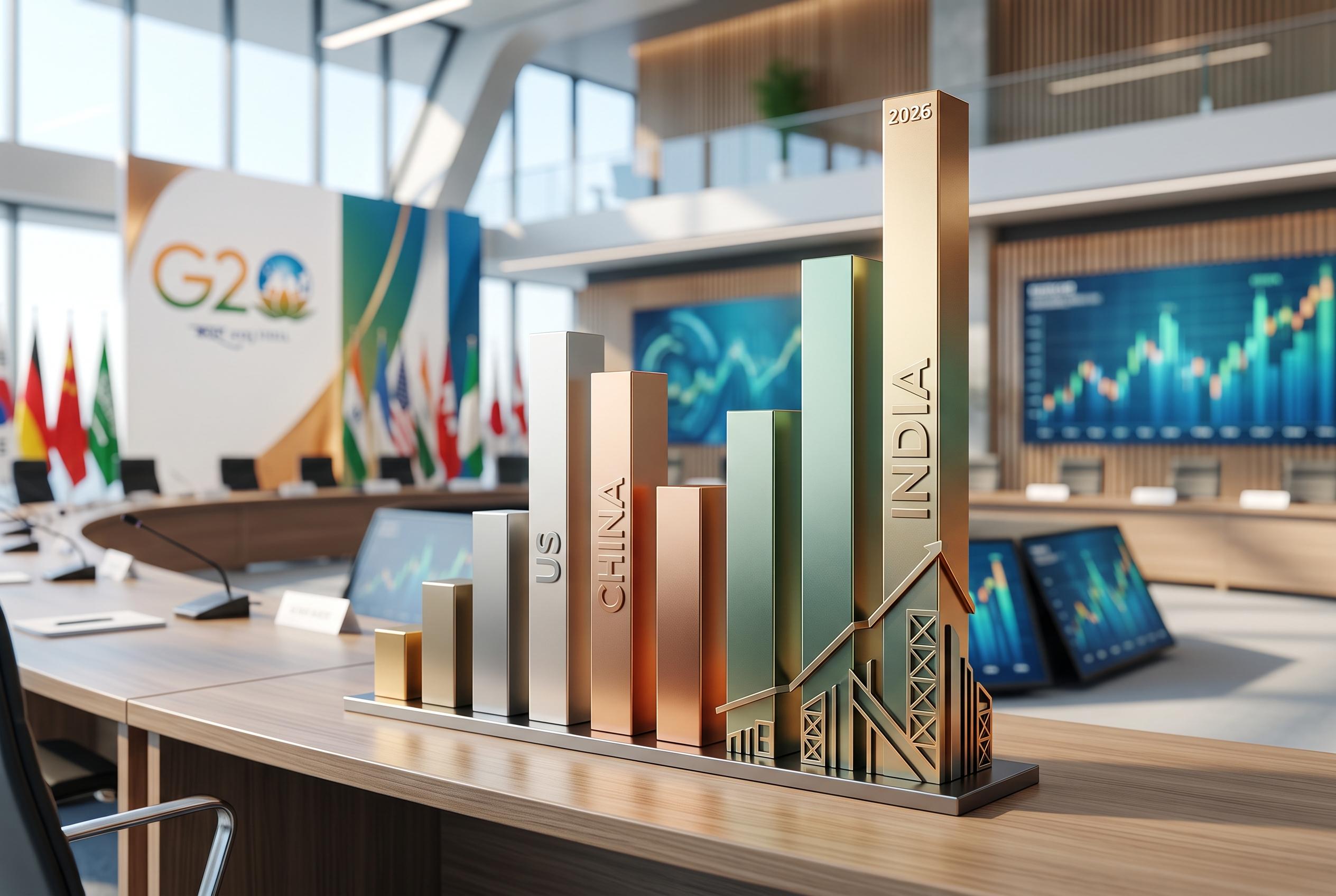

India’s economy has outpaced China and the United States in the G20 growth rankings from 2014 to 2026, driven by infrastructure investment and resilience amid global shocks.
India’s economy has strengthened its position among the world’s largest economies, with new comparisons based on International Monetary Fund, World Economic Outlook and World Bank data showing it outpaced other G20 members over the 2014-2026 period. Business Today reported that India recorded average annual dollar-denominated growth of 6.1% across the period, placing it ahead of China and the United States in the bloc’s growth ranking.
That pace of expansion helped lift the size of the economy to about $4.15 trillion, more than doubling from 2014 levels. The gain has increased India’s weight in the global economy and reinforced its status as one of the main engines of growth among major markets.
The ranking comes against a backdrop of repeated global shocks, including the COVID-19 pandemic, inflation, supply chain disruptions, geopolitical tensions and war, all of which weighed on trade and investment flows. Even so, India continued to expand, supported in part by heavier spending on infrastructure, including a sharp rise in power generation capacity and a fast-growing national highways network, which improved connectivity and logistics. The country has also pushed digital infrastructure, manufacturing and broader investment to widen the base of growth.
The latest comparison also underlines how much the picture has changed over time. Between 2004 and 2014, India’s economy grew more quickly in dollar terms, at an average of 10.9% a year, but still ranked only seventh among the G20. China led that earlier period, and several other large emerging markets also outpaced India. Analysts note that dollar-based growth figures can be influenced by inflation, exchange-rate swings and the starting base, so they do not by themselves capture changes in living standards. Even so, India’s rise to the top of the G20 growth table marks a notable shift in the balance of economic momentum.
Disclaimer: This article is intended to inform and educate, not to recommend or endorse any financial product, investment or strategy. Please consider your own financial circumstances and seek professional advice where appropriate before making financial decisions.