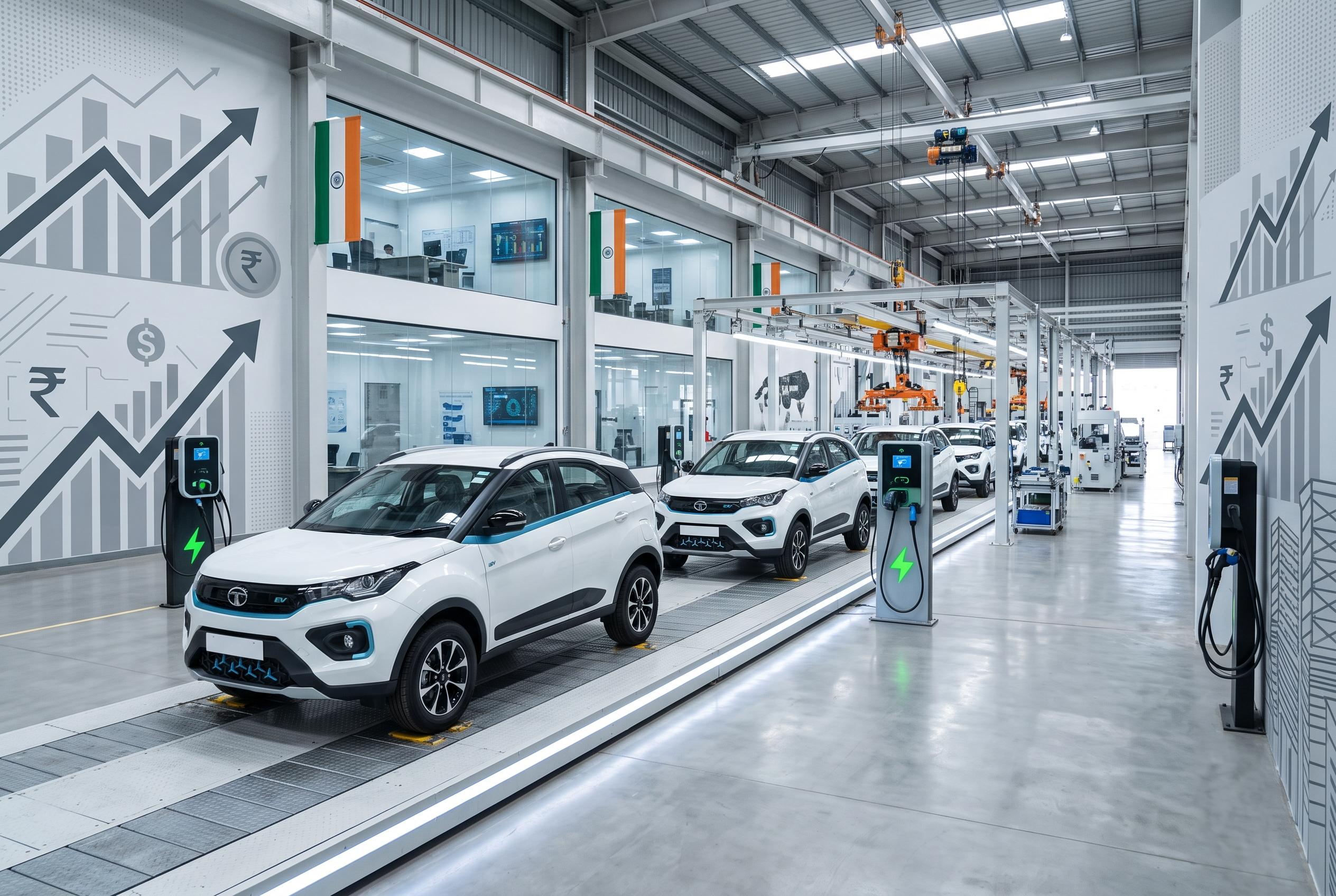

India’s Ministry of Heavy Industries is set to double incentives under the automotive production-linked scheme in FY27, aiming to boost local manufacturing, address charging infrastructure gaps, and improve EV financing amidst ongoing sector challenges.
India’s Ministry of Heavy Industries is preparing a far larger payout under the automotive production-linked incentive scheme in the current financial year, even as it turns to a separate set of fixes for some of the electric vehicle market’s most persistent bottlenecks: weak financing, limited charging economics and the lack of domestic supply for critical components.
A senior ministry official said the government expects to spend about ₹4,700 crore in incentives under the auto PLI scheme in FY27, more than twice the roughly ₹2,322 crore disbursed in the scheme’s first two years. About ₹700 crore has already been released and the rest should follow in the coming months. The broader scheme carries an outlay of ₹25,938 crore and was designed to support manufacturing of electric vehicles and advanced components such as traction motors and angle encoders. The official said actual investment had crossed ₹45,000 crore, above the original target of ₹42,000 crore.
The PLI programme is one of the centrepiece industrial policies for India’s auto sector. According to the heavy industries ministry, the scheme was approved by the Union Cabinet in September 2021 and covers advanced automotive technology products, including battery electric vehicles and hydrogen fuel cell vehicles. Public updates from the ministry and the Press Information Bureau show that 82 applicants had been approved by late 2025 and that incentive payments had started to accelerate as sales targets were met.
Beyond passenger cars and components, the ministry is now trying to solve why electric buses and heavy trucks remain hard to finance. The official said lenders have been hesitant because there is little evidence of a healthy resale market for the vehicles and uncertainty remains over battery life. Where loans are available, interest rates can be much higher than for diesel vehicles. Industry has suggested interest subvention, in effect government support to offset part of the borrowing cost, as one possible answer.
The ministry is also examining the charging side of the problem. Even where heavy-duty chargers exist, the network remains thin and the business case for private operators is still weak, the official said. Ministry of Power guidelines call for bus and truck chargers every 100 kilometres on highways and car chargers every 20 kilometres. In the commercial vehicle market, the scale of the challenge remains stark: fewer than 1,000 electric trucks in the 3.5-tonne to 55-tonne range have been sold in India so far, while smaller trucks have only a 3 per cent to 4 per cent EV penetration rate, according to the official.
The ministry is also broadening its push for domestic manufacturing. Its plan to attract global makers of electric passenger cars has not yet drawn any applicants, and the official suggested that trade deals with Europe and the UK may be giving companies another way to serve the Indian market without committing to local production. By contrast, a tender for sintered rare-earth permanent magnets has received what the ministry described as a very strong response from Indian and overseas firms. The aim is to begin domestic production in roughly 18 months to two years after the tender process is completed, with five beneficiaries to be selected for 6,000 tonnes a year of capacity.
The heavy industries ministry is also trying to seed new demand in niche vehicle categories. Electric ambulances are being promoted under the PM eDrive scheme, with the incentive raised to ₹21 lakh. The official said the ministry has spoken with three or four manufacturers and expects at least one model to be launched around December or January. In a sector where financing, supply chains and consumer confidence remain works in progress, the government’s latest move suggests it is leaning on both subsidies and industrial policy to speed adoption.
Disclaimer: This article is intended to inform and educate, not to recommend or endorse any financial product, investment or strategy. Please consider your own financial circumstances and seek professional advice where appropriate before making financial decisions.