

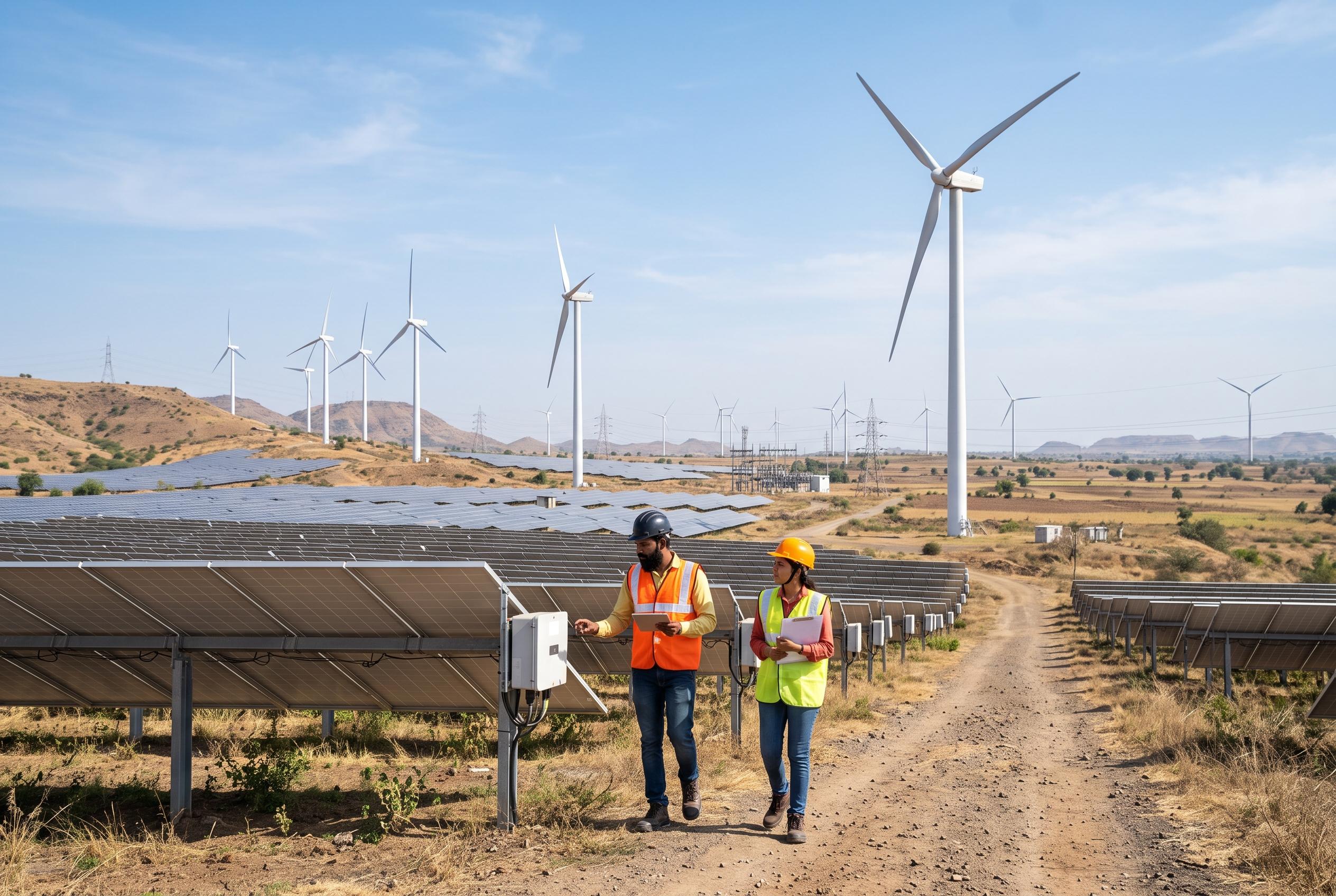

The third phase of India’s Green Energy Corridor programme will support 135GW of renewable power, but states must compete for funding and deliver the infrastructure.
India’s latest push to expand its clean power network marks a significant shift in both scale and design. On September 30, the government cleared the third phase of its Green Energy Corridor programme, setting aside ₹1.86 lakh crore to help move renewable electricity from generation sites into the grid. The Centre will contribute ₹55,000 crore, while state governments are expected to raise or arrange the balance, placing much of the execution burden squarely on their shoulders. According to The Hindu BusinessLine, this is the most ambitious version of the scheme so far, both in cost and reach.
The new phase is built around a far wider mandate than its predecessors. Earlier corridor programmes focused on moving power across a limited set of renewable-rich states and were aimed at inter-state evacuation. By contrast, Green Energy Corridor-III is intended to strengthen intra-state transmission across the country and accommodate up to 135 gigawatts of renewable energy. Moneycontrol reported that the plan includes 51,126 circuit kilometres of transmission lines, 2,28,903 MVA of substation capacity and 50 GWh of battery storage, with completion targeted for FY2032-33. That scale makes the scheme central to India’s broader effort to raise non-fossil fuel capacity to 900 GW by 2035.
One of the most notable features of the programme is the explicit role given to battery storage. The government has proposed ₹6,000 crore in incentives for storage, an unusual step for a transmission scheme and, officials argue, one that could ease pressure on the grid when solar generation falls away after sunset. At a recent briefing in Chennai, New and Renewable Energy Minister Pralhad Joshi described the support as the largest of its kind for the renewable sector anywhere in the world. His remarks underline how strongly the administration is tying storage to the next stage of power-system planning.
Yet the design also raises questions about execution. The scheme will operate in challenge mode, meaning states must compete for central support, and they will also be responsible for implementation. SR Narasimhan, a former head of Grid Controller of India, told BusinessLine that the model could accelerate projects in states that already have clear evacuation plans, but he warned that some governments might rush to propose schemes simply because money is available. He also pointed to a persistent gap between planning for inter-state and intra-state networks, saying the two systems often fail to be coordinated properly. His support for battery energy storage as a “non-wires alternative” reflects a wider debate: whether India should keep building more lines, or compare wires, storage and other options project by project. In that sense, the success of Green Energy Corridor-III will depend not just on money, but on whether states can produce disciplined, integrated plans that match the scale of the renewable build-out ahead.
Disclaimer: This article is intended to inform and educate, not to recommend or endorse any financial product, investment or strategy. Please consider your own financial circumstances and seek professional advice where appropriate before making financial decisions.



