

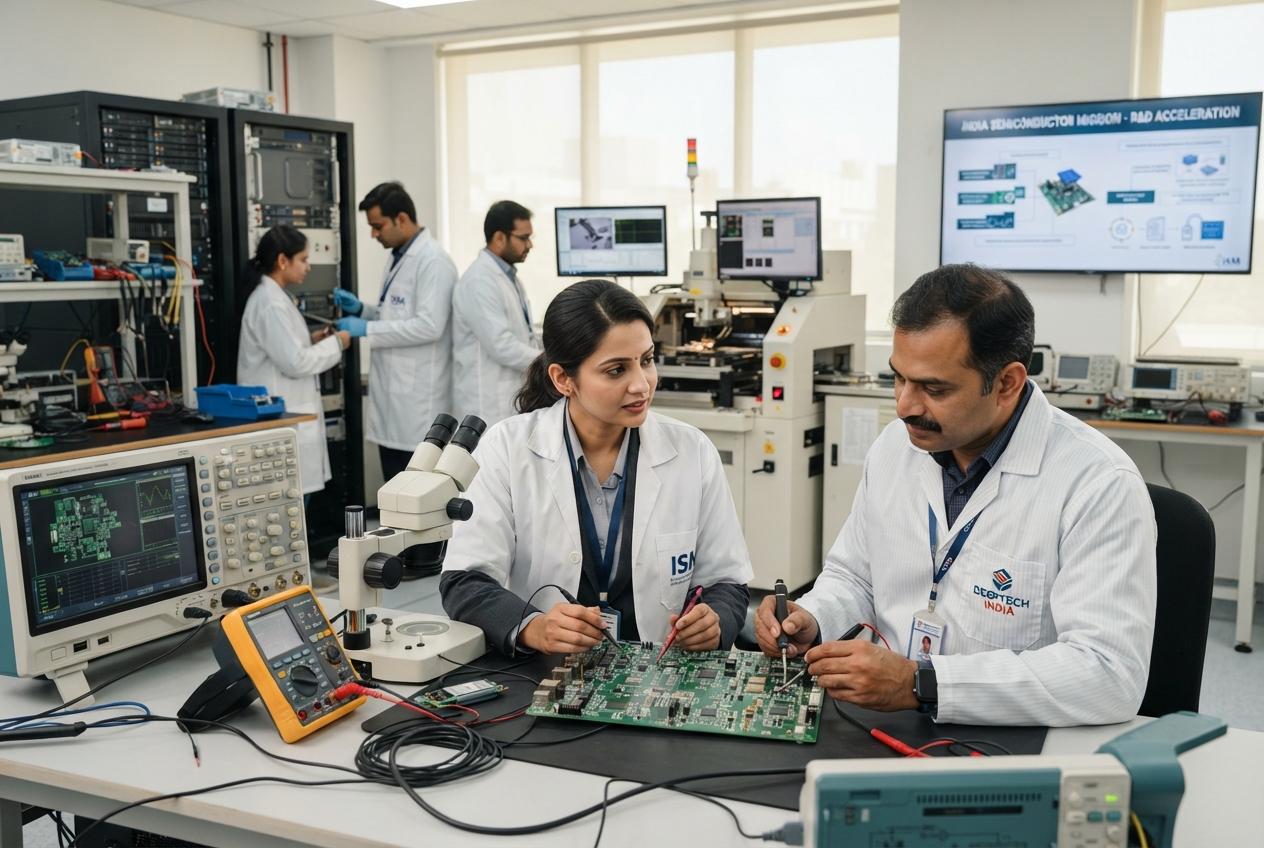

India faces a critical need to bolster its hardware and deep-tech infrastructure as artificial intelligence reshapes the software landscape, with government and industry initiatives aiming to bridge the gap between academia and industry and foster domestic innovation.
India needs to build far stronger hardware capabilities and a more resilient deep-tech base if it wants the next stage of technology-led growth, according to Srikanth Velamakanni, vice-chairman of Nasscom. Speaking at a Nasscom event on Thursday, he said the era of easy software wins was fading as artificial intelligence and agentic AI made coding simpler and software easier to produce, leaving the country to look beyond services and into products, systems and underlying infrastructure.
The warning fits a broader shift in India’s start-up market. Data compiled by Statista show deep-tech funding rose to $1.6 billion in 2025 from $1.1 billion in 2023, but the number of funding rounds fell to 274 from 350 over the same period, suggesting investors are backing fewer bets and demanding stronger proof of commercial potential. Business Today has also noted that much of India’s technology stack still depends on hardware and electronics developed elsewhere, reinforcing the case for domestic capability-building.
Velamakanni said the sector still suffers from a shortage of entrepreneurial energy, appetite for risk and conviction around product building, even though government and venture capital support are improving. Nasscom President Rajesh Nambiar said seed-stage funding remains difficult but that the industry is closer than ever to solving the problem. He argued that with abundant computing power and GPU capacity, hardware must evolve so modern software can run effectively on it.
Policy and capital are beginning to move in that direction. The Central government has approved the Startup India Fund of Funds 2.0 with a corpus of Rs 10,000 crore to help channel venture capital into start-ups. In parallel, the India Deep Tech Alliance, which includes investors and corporates such as Nvidia and Qualcomm, plans to put about $10 million to $15 million into start-ups in areas including space, semiconductors, artificial intelligence and defence.
Even so, the country’s weak links remain the connection between industry and academia and the ability to move ideas beyond lab demonstrations. Ramgopal Rao, vice-chancellor of BITS Pilani, said India ranks 86th in industry-academia collaboration and argued that universities often stop at proof of concept while companies need scalable solutions. He said the answer lies in translation centres that match industrial problems with academic researchers working on relevant technologies.
Disclaimer: This article is intended to inform and educate, not to recommend or endorse any financial product, investment or strategy. Please consider your own financial circumstances and seek professional advice where appropriate before making financial decisions.



