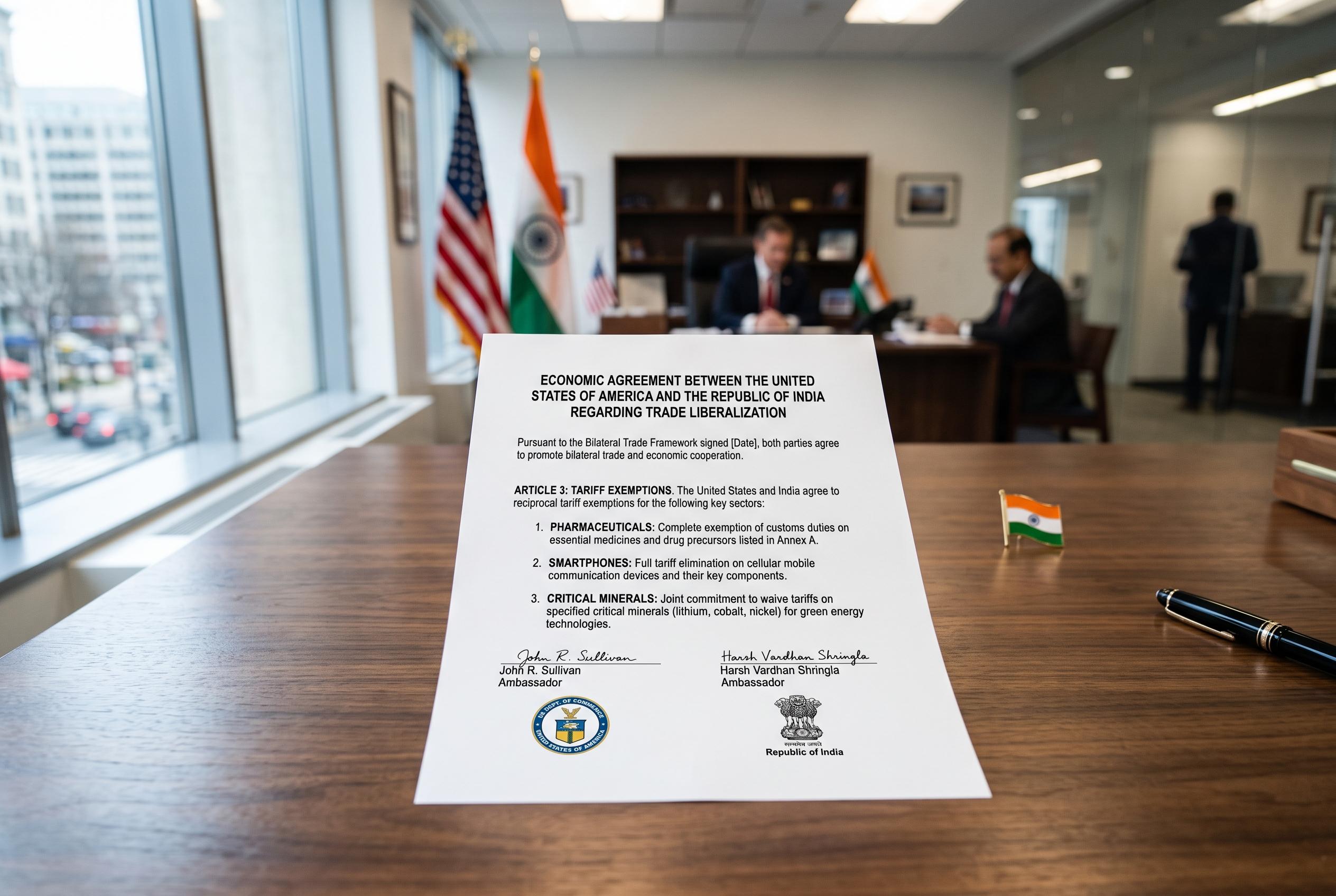

A parliamentary committee urges India to secure tariff exemptions for pharmaceuticals, smartphones, and critical minerals in talks with the US, amid rising trade protectionism and uncertainty, to bolster export confidence and accelerate the bilateral trade target of $500 billion by 2030.
A parliamentary committee has urged India to press for sweeping tariff protection in its planned bilateral trade agreement with the United States, arguing that pharmaceuticals, smartphones and critical minerals should be shielded from any future American duty hikes. The Rajya Sabha’s Department-related Standing Committee on Commerce said the pact should be wrapped up quickly to give companies more certainty at a time when US trade policy is becoming harder to predict, while still safeguarding India’s commercial interests.
The panel’s report, tabled in Parliament on Thursday and led by AITC MP Dola Sen, also called for a dedicated watch desk in the Directorate General of Foreign Trade to track changes in US customs rules and send exporters real-time alerts. The recommendation comes as the commerce ministry has already said about 45% of India’s exports to the US are outside the scope of the new 10% tariff linked to Section 301 action, including generic drugs and smartphones.
That partial exemption has offered some relief, but the committee warned that the wider tariff environment remains unstable. It said the expansion of Section 301 measures marks a shift towards more targeted, country-specific trade barriers, increasing uncertainty for Indian exporters, squeezing price competitiveness and affecting how US buyers source goods. Industry stakeholders told the panel that prolonged restrictions could damage investment sentiment and hurt small and medium-sized firms involved in value-added steel products.
The committee also pushed for a time-bound route to the “Mission 500” target of lifting bilateral trade to $500 billion by 2030. That goal has become a central reference point in India-US trade talks, with New Delhi still discussing a textile-specific mechanism with Washington and seeking broader carve-outs for major export sectors as negotiations over the proposed deal continue.
Disclaimer: This article is intended to inform and educate, not to recommend or endorse any financial product, investment or strategy. Please consider your own financial circumstances and seek professional advice where appropriate before making financial decisions.