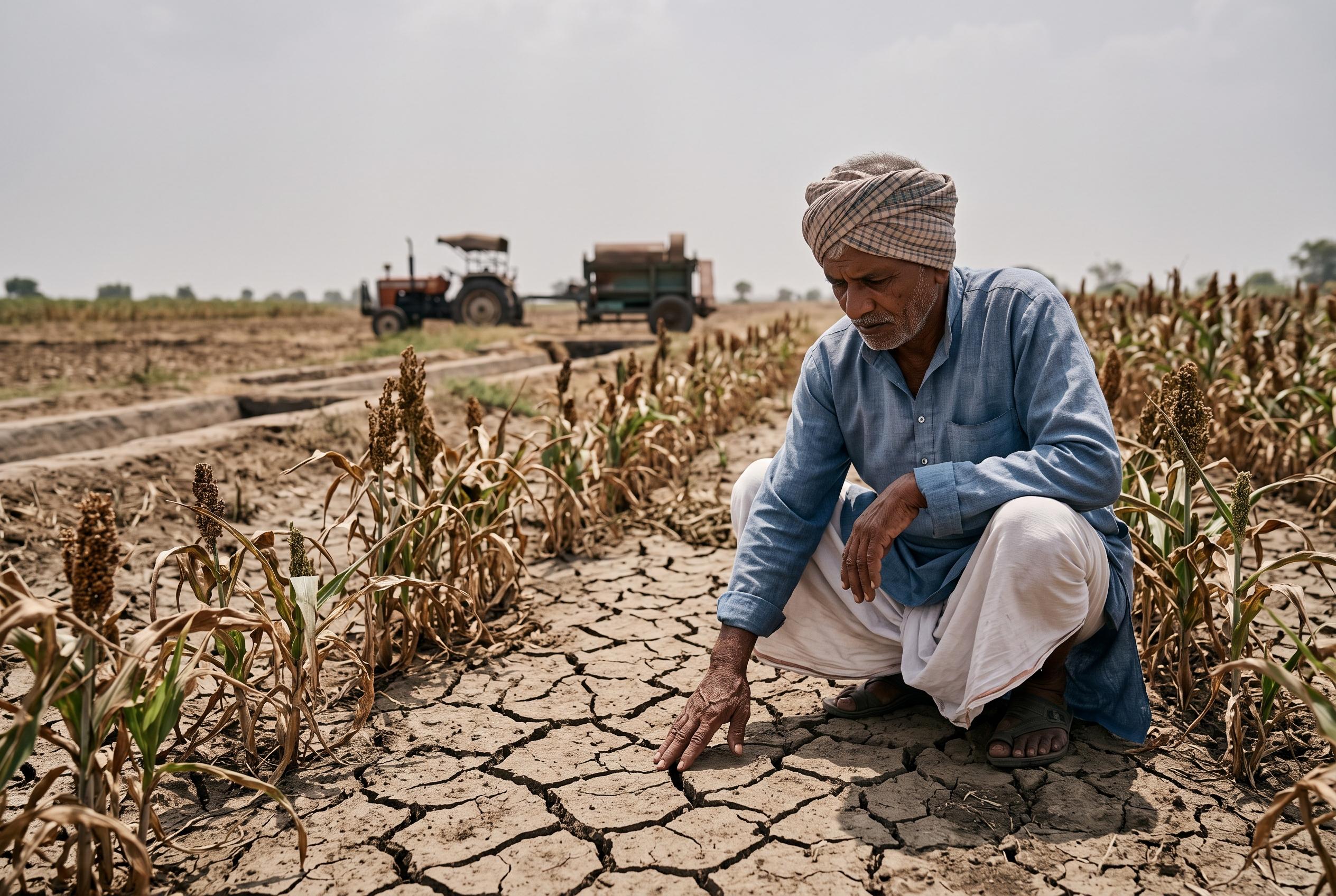

India’s weather office warns that the concluding phase of the 2026 monsoon may not bring sufficient rain, risking impact on crops, inflation, and trade amid a broader climate challenge.
Fresh guidance from India’s weather office suggests that the last stretch of the 2026 monsoon is unlikely to rescue the season nationally. In its updated extended-range forecast for 3 to 16 September, the India Meteorological Department said rainfall for the country as a whole was likely to stay below normal in both weeks, with better conditions mainly in east-central and eastern belts. That leaves the outcome for the kharif harvest hinging less on whether India finishes the season in deficit than on whether the remaining rain reaches the right districts at the right time. IMD data showed the monsoon was still 13% below the long-period average on 4 September, at 629.7mm against a normal 727.9mm. (mausam.imd.gov.in)
The broader September outlook has been pointing the same way. In a monthly forecast issued on 31 August, IMD said rainfall this month was most likely to be below 91% of the long-period average of 167.9mm, while maximum temperatures were expected to remain above normal across most of the country. August has already gone into the record books as India’s warmest August since 1901, and the department said strong El Niño conditions in the equatorial Pacific were expected to strengthen further in the coming months. For now, the Indian Ocean Dipole remains neutral, though IMD said some international climate centres saw a shift to a positive phase as possible from September onwards. (internal.imd.gov.in)
That matters because September is carrying unusual weight for both the standing kharif crop and the next planting cycle. Reuters reported that the monsoon’s late, weak start left June rainfall 35% below normal, delaying sowing of crops including rice, maize, cotton and soybean. Many of those crops are now moving through pod formation and grain filling after a dry August, when moisture is critical. September also sets up soil conditions for winter sowing: the monsoon normally starts withdrawing from north-west India around 17 September, and the moisture left behind influences germination and early growth for rabi crops such as wheat, rapeseed and chickpeas in October. (marketscreener.com)
The acreage numbers show why the market is watching rainfall distribution so closely. Agriculture ministry data for the week to 28 August put total kharif sowing at 107.1 million hectares, against 109.0 million a year earlier. Rice area had fallen to 41.41 million hectares from 42.85 million, while maize was down to 8.999 million from 9.387 million. Pulses were the main counterweight, at 11.505 million hectares versus 11.366 million a year earlier, with urad acreage almost 12% higher, and jute and mesta also slightly ahead. The ministry said the biggest falls in rice area were in Karnataka and Telangana, while gains in pulses were led by Uttar Pradesh, Jharkhand and Telangana. (pib.gov.in)
The economic stakes extend well beyond the farm gate. Mint noted that the south-west monsoon delivers more than 70% of India’s annual rainfall and that about 45% of net sown area remains rain-fed. Reuters said food accounts for more than a third of India’s consumer-price basket, making the September rainfall outcome important not just for harvests but for inflation and interest-rate policy. India’s retail inflation rose to 4.45% in July, while food inflation climbed to 5.52%. At the same time, Reuters said, higher commodity costs linked to the Iran conflict are already adding to price pressure. (livemint.com)
Some of the knock-on effects could show up in trade policy as well. Reuters said below-normal rain was already affecting sugar cane ahead of the crushing season and could cut planting for the next crop, potentially forcing imports beyond the 1 million tonnes of raw sugar India has already allowed in duty-free this year. Weaker soybean and groundnut output would increase dependence on imported edible oils, while lower pulses or cotton production could require extra imports there too. As G Chandrashekhar told Hindustan Times, “the total quantum of rainfall is less important than its temporal and spatial distribution”, and he warned that uneven rain could hurt yields, quality and overall crop size. (marketscreener.com)
Officials, however, are resisting the idea of a uniform farm shock. Briefing reporters on the economy, Chief Economic Adviser V Anantha Nageswaran said the season had been marked by a sharp June deficit, a July recovery and a more stable shortfall through August, but argued that many parts of the country had still received adequate rainfall and that sowing was only marginally below last year’s level. In an interview with Moneycontrol, IMD chief Mrutyunjay Mohapatra struck a similarly measured tone, saying, “We should not be too worried.” He said the Centre had already ordered special monitoring in low-rainfall districts and was focusing on seeds, moisture conservation, water management and alternative crop planning. Mohapatra also pointed to a more vulnerable belt running from Gujarat and Rajasthan towards Odisha, north Andhra Pradesh and Chhattisgarh, where irrigation cover is relatively weaker. (m.economictimes.com)
The next two weeks should decide whether that reassurance holds. IMD’s latest fortnightly outlook still favours below-normal rain for India as a whole in both 3-9 September and 10-16 September, even with some support from east-central India, the Gangetic plains and parts of the east and north-east. If that pattern persists, Reuters said, India could end up with its weakest monsoon in nearly two decades. The final reading on rainfall will come later, but the more immediate test will be visible sooner: in field moisture, late-season crop health, and the prices households pay once the harvest starts reaching the market. (mausam.imd.gov.in)
Disclaimer: This article is intended to inform and educate, not to recommend or endorse any financial product, investment or strategy. Please consider your own financial circumstances and seek professional advice where appropriate before making financial decisions.