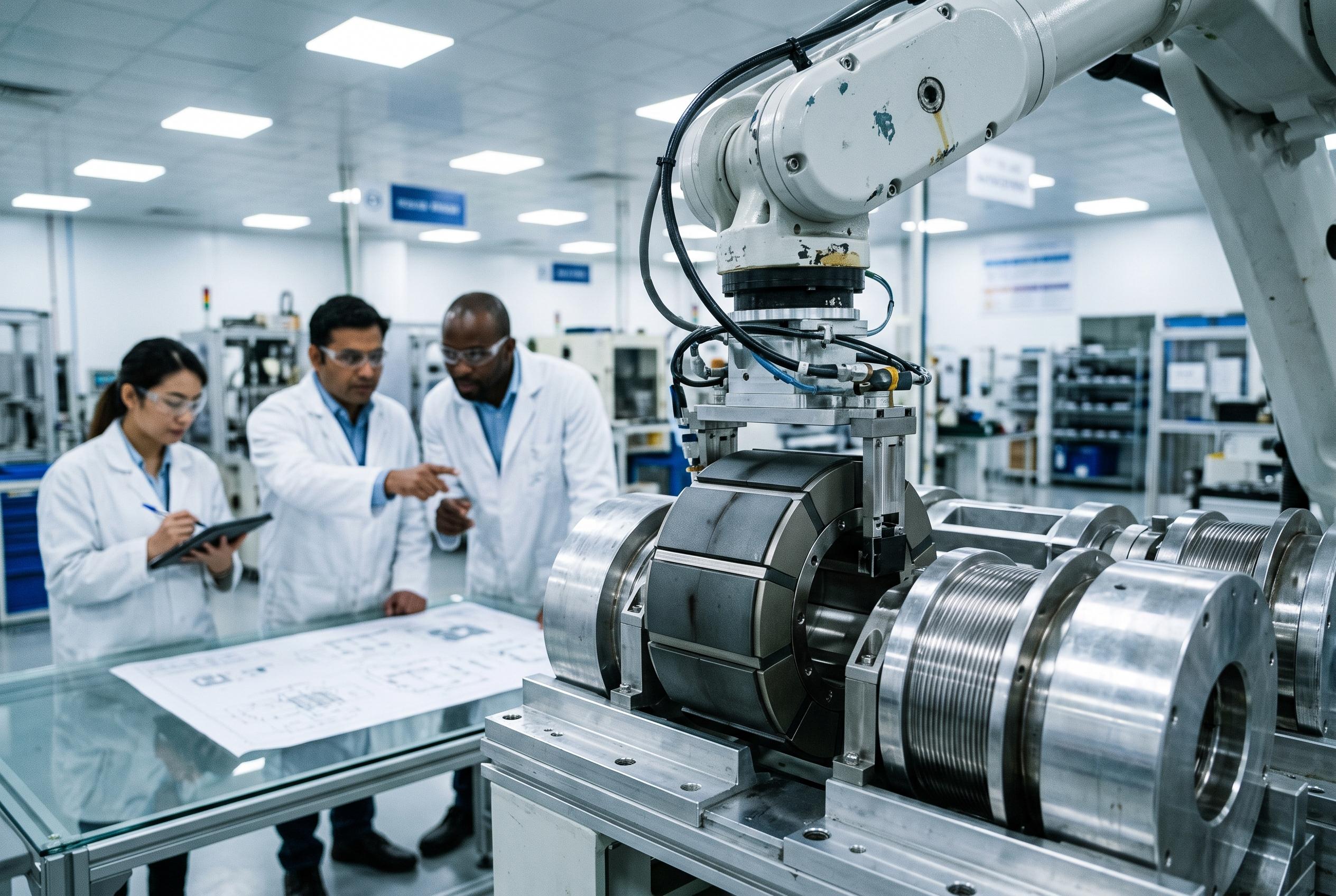

Despite some progress in licensing, India’s reliance on China for critical rare-earth magnets remains a strategic vulnerability as diplomatic negotiations and domestic initiatives struggle to address supply bottlenecks and technological dependencies.
By the end of October 2025, Indian officials were able to point to only a limited breakthrough in their stand-off with Beijing over critical technology supplies: a handful of companies had finally secured Chinese licences to import rare-earth magnets, yet the wider bottleneck remained firmly in place. Business Standard reported that Continental India, DE Diamond, Hitachi and Jay Ushin were among the firms to win approvals, but The Economic Times said all 51 applications from Indian carmakers for heavy rare-earth magnets were still pending in China, leaving one of the most sensitive parts of India’s manufacturing supply chain unresolved.
What China was asking for showed how strategic the issue had become. Business Standard said Indian importers had to submit end-user certificates promising that the magnets would not be diverted to the United States or used for defence production. Beijing was also seeking written assurances that heavy rare-earth magnets would be consumed only in India, in demands likened to export-control commitments for dual-use goods. Light rare-earth magnet shipments restarted after the Shanghai Cooperation Organisation summit, according to Business Standard, but supplies of heavy magnets remained blocked. Those materials are central to electric vehicles, renewable energy equipment, electronics, aerospace and weapons systems, and India imported 870 tonnes of rare-earth magnets worth about ₹306 crore in FY25.
The pressure on New Delhi had been building for months before the planned BRICS engagement with China. In a written Rajya Sabha reply on 1 August 2025, the Ministry of Heavy Industries said the Society of Indian Automobile Manufacturers and the Automotive Component Manufacturers Association had already submitted detailed assessments of the short- and long-term fallout. Official annexures showed how deep India’s reliance on China had become: in 2024-25, China accounted for 84.8 per cent of India’s imports by quantity in one permanent-magnet category and 90.4 per cent in another. The government response also pointed to a longer-term remedy, saying the National Critical Mineral Mission had been approved on 29 January 2025 and that 11 rare-earth-related research projects with a combined outlay of ₹9.33 crore had been cleared over two financial years.
That vulnerability helps explain why India was not only pressing China diplomatically but also looking for ways around it. Reuters reported in September 2025 that the Ministry of Mines had asked state-owned IREL and private company Midwest Advanced Materials to examine how samples could be collected and moved out of mines controlled by the Kachin Independence Army in north-eastern Myanmar. The goal was to test whether the ore contained enough heavy rare earths for magnets used in electric vehicles and other advanced equipment. The idea underlined the bind India faced: even if it could secure fresh mineral supplies, China still held near-total control over much of the processing technology needed to turn them into usable magnets. As the analyst Angshuman Choudhury put it in comments reported by Reuters: “If China is liaising with the KIA to secure access to rare earths, why should India be left behind?”
The diplomatic backdrop suggested warmer language, but only cautious progress. When Narendra Modi met Xi Jinping in Tianjin on 31 August 2025, Reuters reported that the two leaders described their countries as “development partners, not rivals”. Modi said India was committed to improving ties on the basis of “mutual respect, trust and sensitivities”, and linked a more stable relationship to the interests of 2.8 billion people. Yet the same report noted that India’s trade deficit with China had swollen to nearly $99.2 billion, a figure that shows why access to Chinese technology and industrial inputs remained such an urgent political issue in New Delhi. Manoj Kewalramani of the Takshashila Institution described the meeting as only “a step in the direction of incremental improvement”.
Industry frustration, meanwhile, was not confined to magnets alone. The Economic Times reported that Indian businesses had hoped the recent high-level exchanges might also lead to a relaxation of Press Note 3 restrictions on investment from neighbouring countries and ease Bureau of Indian Standards clearances. That had not happened. According to the newspaper, executives were particularly keen on allowing at least 50:50 joint ventures with Chinese partners so they could participate in India’s Electronics Component Manufacturing Scheme before its 30 September 2025 deadline. Instead, one senior auto executive said the talks were “moving very slowly”, and there had been “no movement” on heavy rare-earth supplies despite the political thaw.
The result was a two-track Indian response: keep talking to Beijing in the hope of unblocking crucial imports, while simultaneously trying to build domestic resilience and alternative supply routes. By late October, officials could say some licences had come through, and the Ministry of External Affairs said it was assessing how wider US-China understandings on rare earths might affect India’s own position. But the broader message from the past year was harsher. China’s grip on heavy rare-earth processing had exposed the fragility of India’s ambitions in electric mobility, clean energy and advanced manufacturing, and even after months of diplomacy, the country was still waiting for a durable solution.
Disclaimer: This article is intended to inform and educate, not to recommend or endorse any financial product, investment or strategy. Please consider your own financial circumstances and seek professional advice where appropriate before making financial decisions.