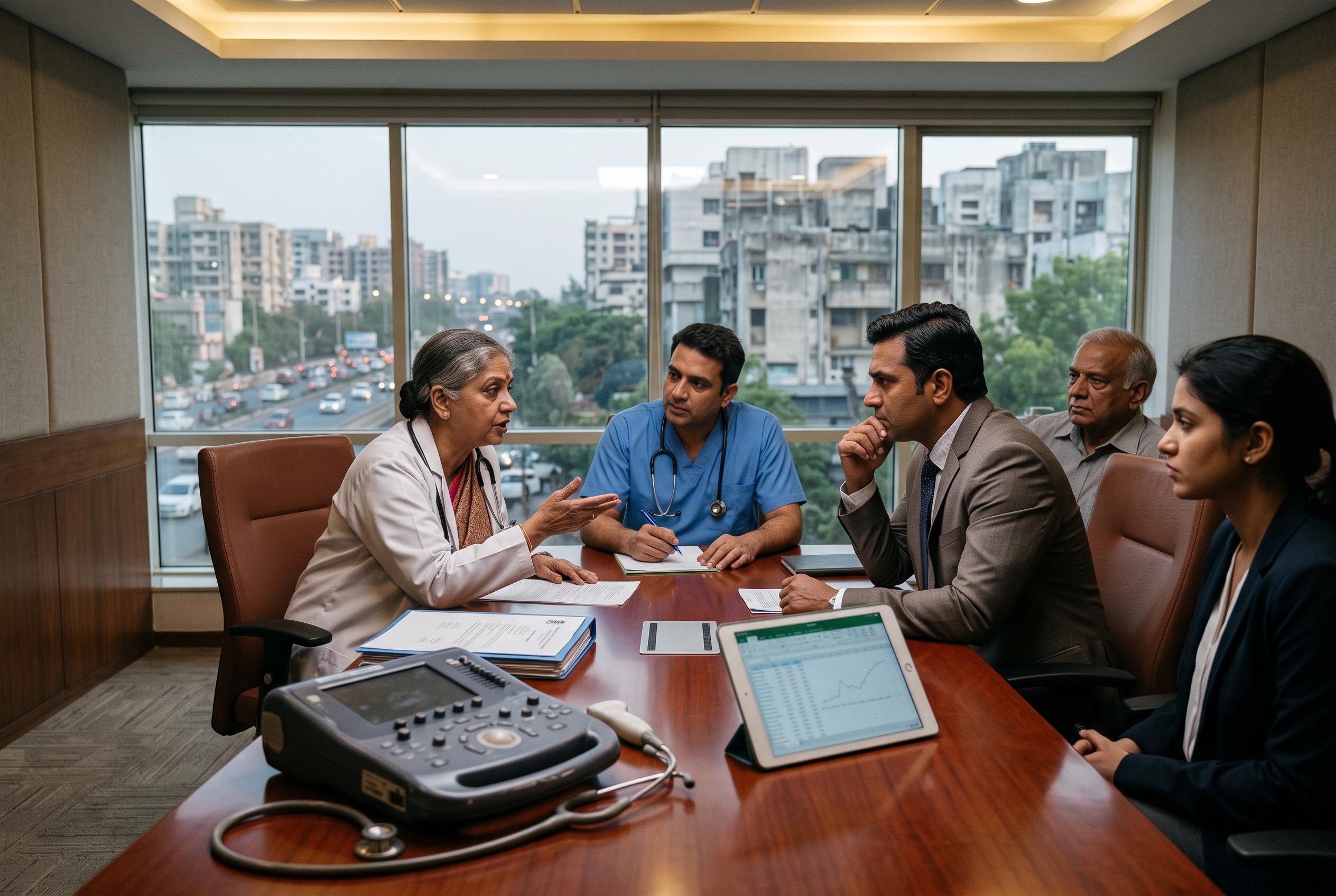

India’s government remains divided over regulations for imported second-hand medical devices, balancing improved healthcare access against safety risks as demand surges in small hospitals and Tier-II cities.
India’s long-running debate over refurbished medical device imports remains unresolved, with officials still weighing whether the country should tighten controls, keep existing restrictions or create a new framework for second-hand equipment. Business Standard reported that the issue has taken on added urgency because lower-cost imported machines are already widely used by smaller hospitals and diagnostic centres to make advanced scanning and treatment more affordable.
Industry executives estimate the pre-owned equipment market at about ₹1,500 crore, or nearly 10% of India’s overall medical equipment market. That demand is strongest in Tier-II and Tier-III cities, where hospitals often rely on refurbished CT and MRI scanners to expand access without the full cost of new systems. But domestic manufacturers warn that easier imports without clearer safeguards could open the door to unsafe or outdated machines.
According to people familiar with the discussions, an interministerial committee set up to frame rules has met only a few times and has started reviewing market data. The panel includes officials from the Ministry of Health and Family Welfare, the Directorate General of Health Services, the Central Drugs Standard Control Organisation, the Department of Pharmaceuticals and industry representatives. Rajiv Nath, forum coordinator of the Association of Indian Medical Device Industry, said the government has created a committee to examine and draft guidelines, but no comprehensive rules have yet been notified.
The regulatory gap is not new. In a January 10, 2025, communication to the principal commissioner of Customs, the CDSCO said the Medical Devices Rules, 2017, do not distinguish between new and refurbished devices. Business Standard reported that an existing route under the Ministry of Environment, Forest and Climate Change already allows imports of 38 specified high-end and high-value devices listed by the DGHS, including CT scanners, MRI systems, ultrasound and X-ray equipment, as well as some laboratory and critical-care products. Those imports must meet conditions including a residual life of at least seven years and a ban on hazardous material.
Officials are now considering whether that framework is enough or whether refurbished devices need their own rules. A senior health ministry official told Business Standard that the committee must decide how long second-hand devices should be allowed to remain in service, or whether imports should be limited to expensive critical-care equipment. Another person familiar with the matter said the health ministry has shared a draft or proposal with the environment ministry for comments, though the latter has not led the policy work. Industry views remain split: some want stricter traceability, servicing and liability rules, while multinational medtech companies argue that authorised channels for refurbished imports could widen access without compromising safety.
Disclaimer: This article is intended to inform and educate, not to recommend or endorse any financial product, investment or strategy. Please consider your own financial circumstances and seek professional advice where appropriate before making financial decisions.