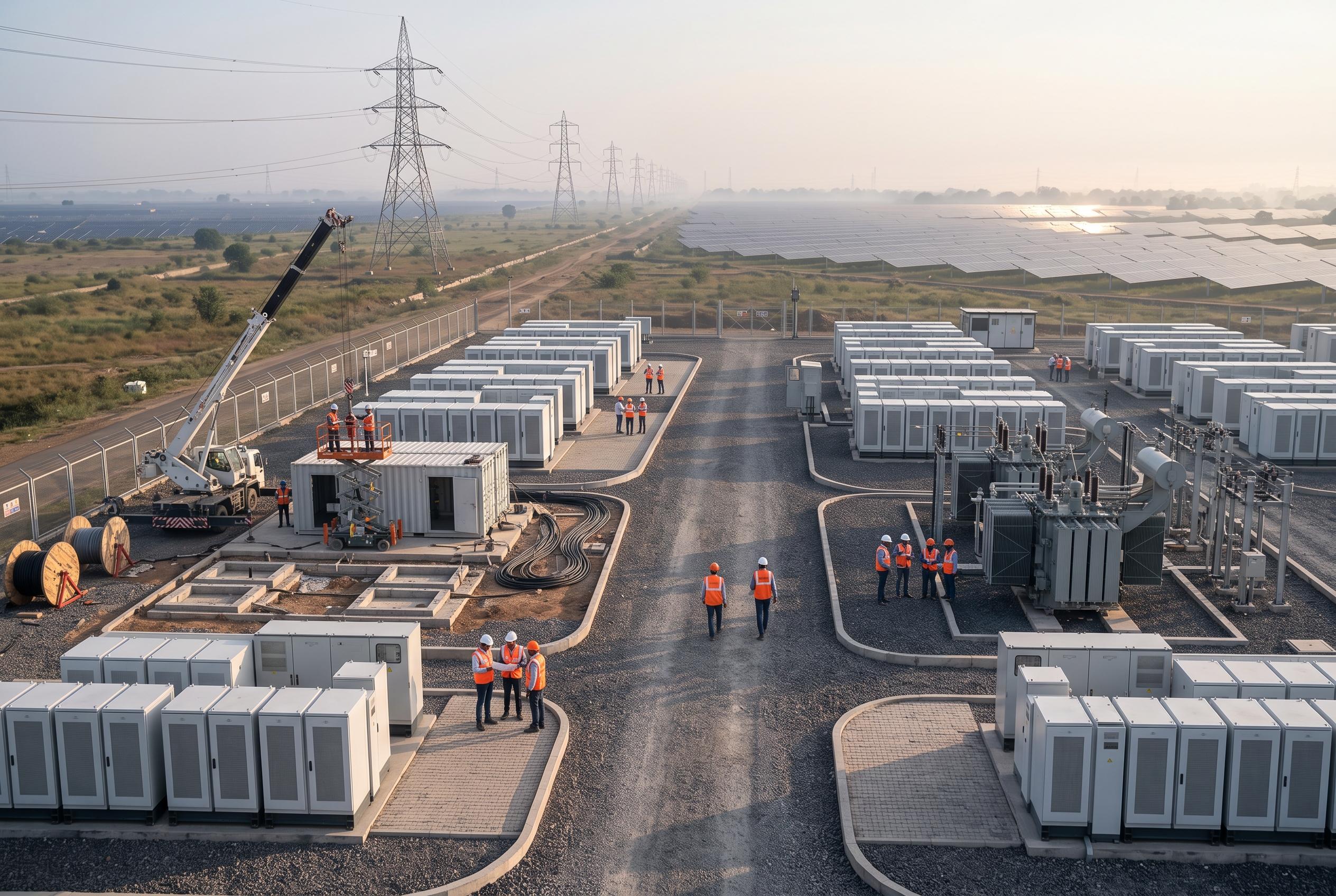

India’s Union Cabinet approves a ₹1.86 lakh crore scheme to expand intra-state power lines and add 50 GWh of battery storage, aiming to accelerate the country’s clean energy transition and address grid bottlenecks.
India’s Union Cabinet has approved the third phase of the Green Energy Corridor, a major push to expand intra-state power lines and add large-scale battery storage as the country tries to move more renewable electricity onto the grid. According to KNN and other Indian outlets reporting the decision, the scheme is designed to help evacuate as much as 135 gigawatts of renewable power across states and Union Territories, while also easing one of the biggest bottlenecks in the energy transition: getting clean electricity from generation sites to where it is needed most.
The programme carries a total outlay of ₹1,86,405 crore and is scheduled to run through FY2032-33. Of that amount, ₹1,36,378 crore is earmarked for intra-state transmission systems and ₹50,000 crore for 50 GWh of battery energy storage systems, according to the reports. The central government will contribute ₹54,082 crore in support, a measure officials say should help offset transmission charges and limit the impact on consumer power bills.
The scheme marks a shift in emphasis from earlier phases of the Green Energy Corridor, which focused more heavily on inter-state transmission. This round places greater weight on state-level networks and storage capacity, reflecting the growing need to handle variable solar and wind output. Business Standard reported that the battery systems are intended to deal with intermittency, congestion, peak-hour curtailment and the shortfall that can emerge during non-solar hours.
Implementation will follow a mixed model. Greenfield projects under the intra-state transmission part will be awarded through tariff-based competitive bidding, while brownfield upgrades and network-strengthening work will proceed on a cost-plus basis, according to the reports. State transmission utilities will act as the main implementing agencies, with transmission service providers taking part in build-own-operate-maintain arrangements for competitively bid projects. Officials say the scheme is also expected to support jobs in power, manufacturing, construction and the emerging domestic battery storage supply chain, while contributing to India’s longer-term target of 900 GW of installed non-fossil fuel capacity by 2035.
Disclaimer: This article is intended to inform and educate, not to recommend or endorse any financial product, investment or strategy. Please consider your own financial circumstances and seek professional advice where appropriate before making financial decisions.