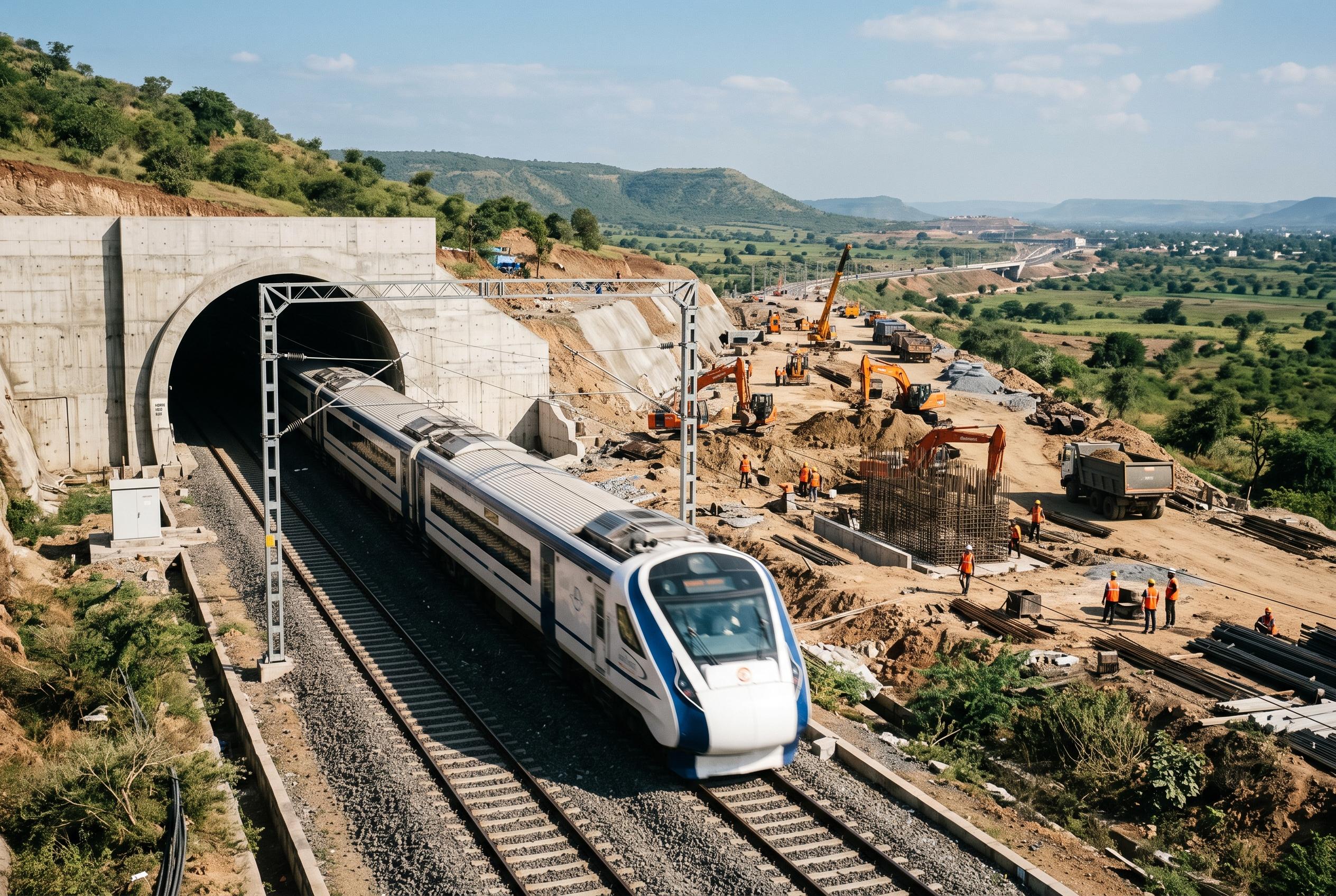

India’s cabinet has approved eight railway projects worth ₹20,804 crore, aiming to add nearly 1,200 km to the network, alleviate congestion on key corridors and catalyse economic activity across nine states by 2029-30.
India’s cabinet has approved eight railway expansion projects costing about ₹20,804 crore, a package that the government says will add 1,196 km to the network and ease pressure on some of the country’s busiest corridors. According to the Cabinet Committee on Economic Affairs, the works will be funded through gross budgetary support and are intended to improve passenger movement, strengthen freight capacity and open up better links to industrial and tourist centres across nine states.
Reuters-style reporting from Indian media said the projects are spread across West Bengal, Jharkhand, Odisha, Madhya Pradesh, Chhattisgarh, Tamil Nadu, Andhra Pradesh, Karnataka and Telangana, with officials describing them as a multitracking push designed to reduce congestion on heavily used routes. Business Standard reported that the overall package covers 31 districts and that five of the schemes are concentrated in southern states, where rail demand has been rising alongside industrial activity.
The largest share of the investment goes to corridors such as Kharagpur-Jharsuguda, Katni-Pendra Road and Whitefield-Bangarapet, which the government says are already running above or close to capacity. The approved works also include third and fourth lines between Arakkonam and Renigunta and between Secunderabad and Kazipet, plus doubling projects on the Hosur-Omalur and Salem-Karur-Dindigul routes. The RailPost summary said the schemes are expected to generate additional freight movement of 74 million tonnes a year, while the Economic Times reported that Railway Minister Ashwini Vaishnaw highlighted the use of AI, aerial mapping and the Rail Bhumi portal to speed up land acquisition and execution.
Officials said the projects could also support wider economic activity by improving access to ports, steel plants, power stations, logistics hubs and pilgrimage sites. The package is expected to help carry more coal, iron ore, steel, cement and other bulk goods, while cutting logistics costs and reducing fuel imports through a shift from road to rail, according to the government’s breakdown. Several reports said the schemes are targeted for completion by 2029-30.
Disclaimer: This article is intended to inform and educate, not to recommend or endorse any financial product, investment or strategy. Please consider your own financial circumstances and seek professional advice where appropriate before making financial decisions.