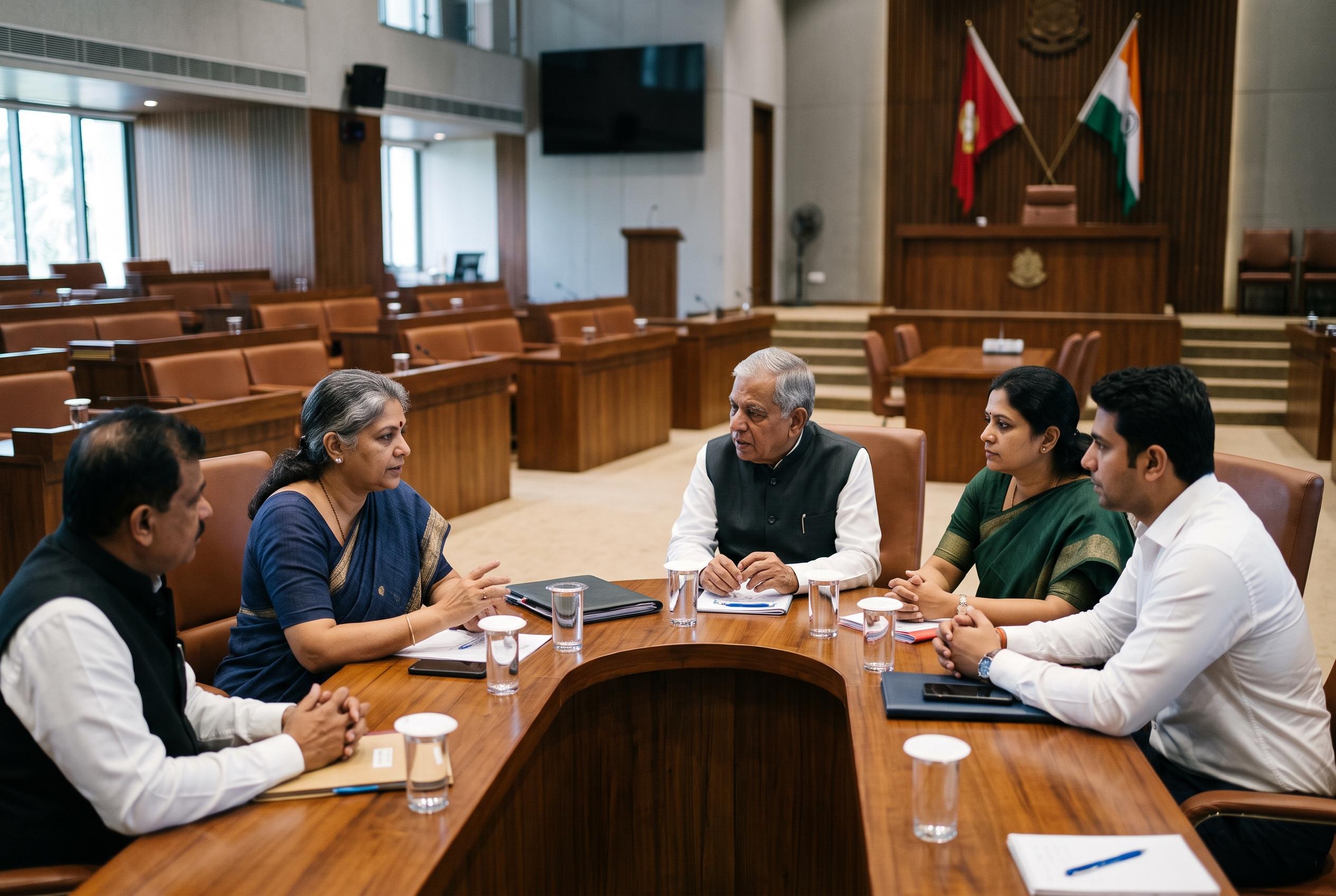

The Goa assembly concludes its session with significant bills passed amid opposition concerns, highlighting government focus on infrastructure and education ahead of upcoming elections.
Chief Minister Pramod Sawant used the close of Goa’s three-day Assembly session to argue that his administration is focused on long-term development, even as opposition members pressed a series of local and statewide concerns. On the final night, the House approved supplementary demands worth Rs 1,061 crore, and Sawant said the Budget reflected a push towards future-facing infrastructure, with particular emphasis on water supply, health facilities and education. The session, which ended close to midnight on Wednesday, was widely expected to be the last before the next state election, although Sawant and state BJP chief Damodar Naik said another sitting may still be held before polling.
The government also pushed through 16 bills, including the Goa Ease of Doing Business (Miscellaneous Amendments) Bill, 2026, which became one of the most contentious pieces of legislation in the session. According to reports on the bill’s earlier draft and its eventual passage, the measure is intended to reduce compliance burdens, speed up approvals and widen digital governance, but opposition lawmakers warned that changes to the Goa Industrial Development Corporation law could make it easier to convert industrial land into freehold property and fuel rapid urbanisation. Sawant rejected suggestions that the move would encourage land scams or revive special economic zone-style concerns, saying the aim was to improve investment conditions and simplify regulation.
Another flashpoint came when the government withdrew the Goa Private Universities (Amendment) Bill, 2026, only a day after introducing it. Opposition parties objected to proposals that would have loosened safeguards for private universities, including the removal of a requirement for a Rs 5 crore endowment fund and relaxed rules on land, infrastructure and library spending. The retreat underscored how sharply educational regulation has become contested in Goa, particularly where critics fear that deregulation could weaken academic standards.
Sawant also sought to present the session as evidence of steady public investment, saying the state is upgrading health and water systems while preparing students for emerging industries. He said a Rs 500 crore integrated campus is planned on Goa University land for five colleges, including the new Goa College of Pharmacy and Goa College of Architecture, both targeted for completion by next year. The government is also signing memorandums of understanding with universities to broaden career pathways beyond public-sector jobs. Yet the brevity of the session left little room for detailed scrutiny, with Zero Hour stretching into the second half as both opposition and ruling party members raised constituency matters, from power bills and smart meters to spending questions and the contentious Section 39A of the TCP Act.
Disclaimer: This article is intended to inform and educate, not to recommend or endorse any financial product, investment or strategy. Please consider your own financial circumstances and seek professional advice where appropriate before making financial decisions.