

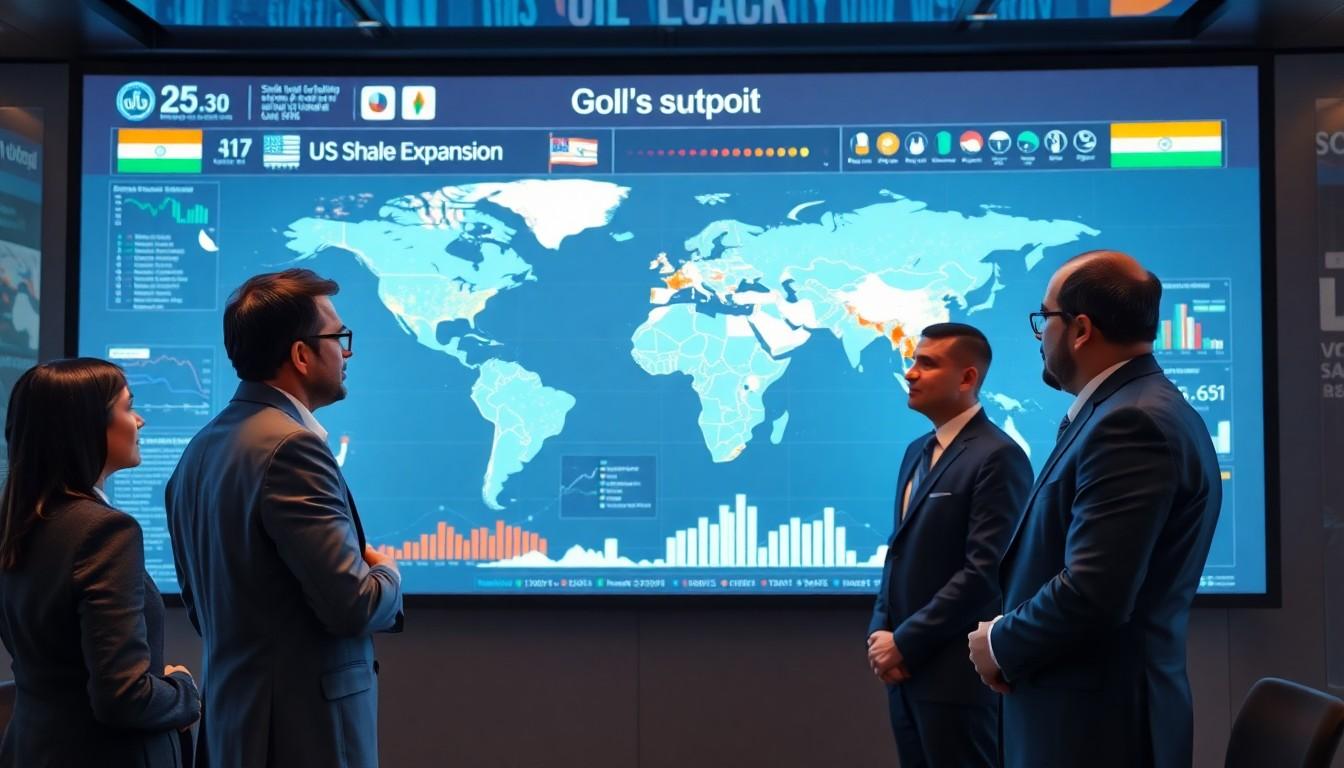

Despite recent geopolitical shocks, abundant global supply and US shale expansion are diminishing OPEC’s influence, prompting India to focus on securing supply rather than demand growth amid fluctuating prices and sanctions risks.
India’s oil outlook is being shaped by a simple but important fact: the global market remains well supplied. Despite the shock of the US-Iran war, crude prices have eased back towards their pre-crisis levels, a sign that supply is still running ahead of demand. Analysts at the International Energy Agency have also pointed to slower demand growth, while the US Energy Information Administration says surplus production capacity has long acted as a buffer when markets tighten. For a large importer such as India, that cushion matters because the country brought in 4.5 million barrels a day of crude and condensate in 2023, making it the world’s second-largest net importer.
That abundance also helps explain why the old idea of OPEC as the market’s decisive swing producer no longer fits as neatly as it once did. The rise of US shale output and softer demand in the developed world have reduced the cartel’s ability to dictate prices on its own, even though Saudi Arabia and the United Arab Emirates still hold spare capacity that can calm markets in a disruption. In practical terms, that means the cost of holding idle production has risen while the benefits have become less obvious, especially when prices are already subdued.
The next risk is less about barrels in storage and more about sanctions. After failing to alter the Gulf’s balance through military means, Washington is likely to lean more heavily on financial and trade restrictions, particularly against Russia and Iran. Because the US remains central to global banking and commodity trade, even companies and governments that do not formally recognise unilateral sanctions often have to comply in practice. The effect is stronger when the oil market is loose, because buyers have more alternatives and exporters have less leverage.
For India, the policy response is constrained by hard arithmetic. The country has explored overseas oil and gas assets before, but outbound acquisitions have slowed in recent years. At the same time, the push for electric vehicles has so far produced only modest penetration, while the turn towards biofuels has limits because it competes with food crops and water resources. The EIA says Russia became India’s top crude supplier in 2023, accounting for about 39% of imports, and fuel use kept rising even as the oil import bill fell with softer global prices. The broader lesson is that India is unlikely to escape hydrocarbons soon, so its best hedge is to keep investing in supply security rather than assuming demand will disappear.
Disclaimer: This article is intended to inform and educate, not to recommend or endorse any financial product, investment or strategy. Please consider your own financial circumstances and seek professional advice where appropriate before making financial decisions.



