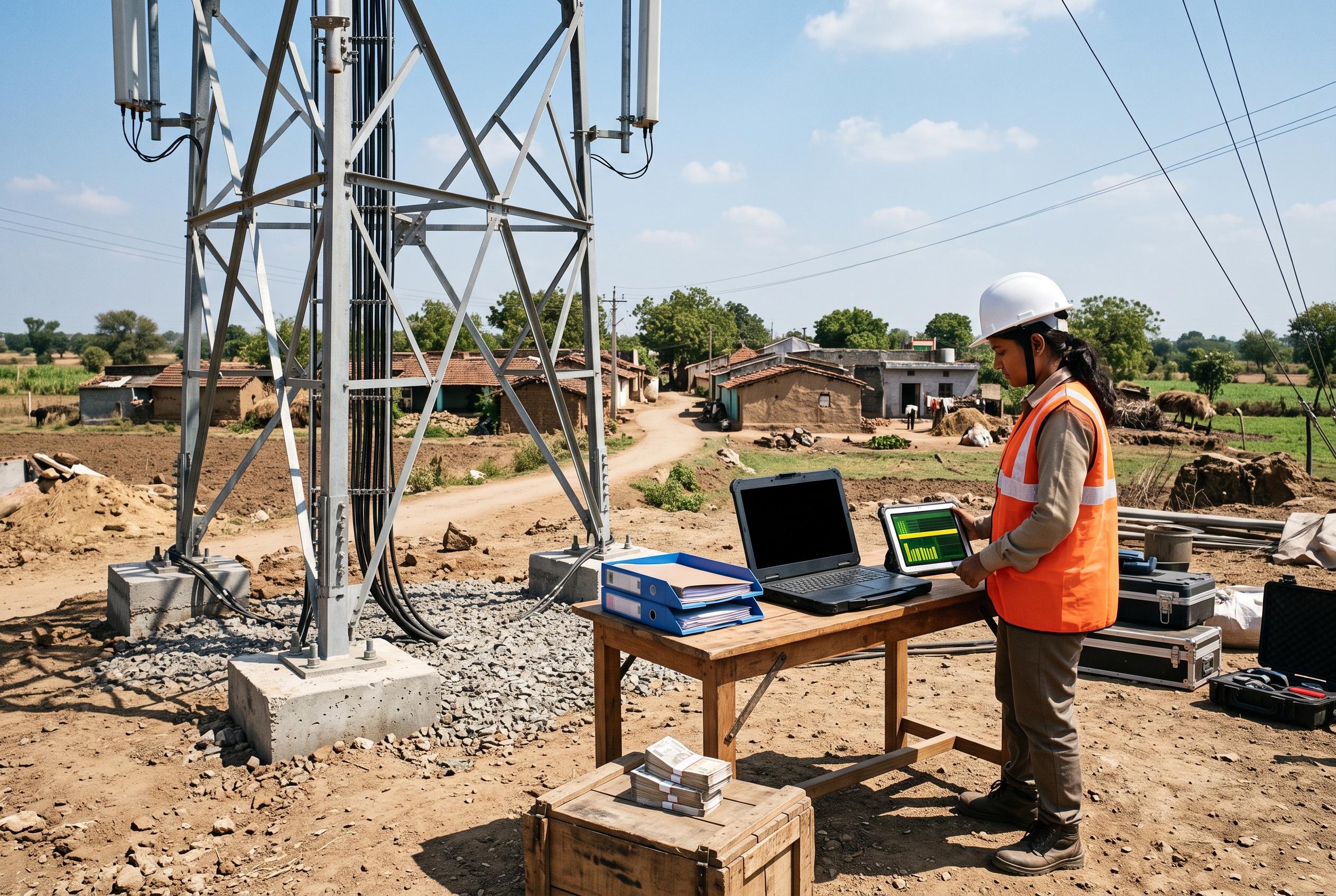

State-owned telecom operator Bharat Sanchar Nigam Ltd expands its indigenous 4G network into rural India amid mounting financial losses, highlighting the challenging balance between public service and commercial sustainability.
Bharat Sanchar Nigam Ltd is pressing ahead with a wider rural 4G push even as its latest quarterly loss deepens, underscoring the strain between the state-owned carrier’s public-service role and its effort to restore profitability. According to a Mint report cited in the company’s financial statements, BSNL posted a consolidated net loss of ₹1,280 crore in the June quarter, wider than a year earlier but better than the previous quarter. Revenue from operations rose, yet spending grew faster, leaving the operator still far from a clean turnaround.
The numbers show why. Total expenses climbed 5.5% year on year to ₹7,242.5 crore, with network costs rising sharply as BSNL continued building out its indigenous 4G network. Employee costs edged higher, while depreciation also increased, reflecting the capital-heavy nature of the rollout. Revenue from operations rose 4.2% from a year earlier to ₹5,306 crore, but that was not enough to offset the higher cost base. Communications Minister Jyotiraditya Scindia has said average revenue per user has improved, and the company’s mobility, enterprise and fixed-line businesses are still contributing to growth.
BSNL’s balance sheet pressures contrast with the scale of its network expansion. The company has installed more than 105,000 indigenous 4G sites, according to its response to a parliamentary panel, and it has begun deploying 5G in Delhi. Telecom regulator data showed a mobile subscriber base of 93 million at the end of June, although the number of active users has continued to fall. That makes the company’s push into underserved areas strategically important, but also costly.
Nowhere is that push more visible than in Odisha and Andhra Pradesh. In Odisha, BSNL has put up 1,741 new towers under the Digital Bharat Nidhi programme, bringing coverage to 2,487 villages that had no mobile signal, and another 865 villages are due to be covered by March 2027. In Andhra Pradesh, the operator has commissioned 1,350 4G sites that have reached nearly 2,500 previously unconnected villages, with more installations approved. Separate state updates in March said BSNL’s network in Andhra Pradesh had expanded to 6,132 sites, lifting its 4G customer base sharply and pushing daily data use higher.
The wider policy backdrop is the government’s effort to extend 4G coverage to about 30,000 uncovered villages nationwide through roughly 21,000 towers, using largely indigenous equipment. That makes BSNL central to a public infrastructure drive that is still running alongside a difficult commercial recovery. The company’s recent quarters suggest the payoff is real in connectivity terms, but not yet in earnings.
Disclaimer: This article is intended to inform and educate, not to recommend or endorse any financial product, investment or strategy. Please consider your own financial circumstances and seek professional advice where appropriate before making financial decisions.