


Advait Energy Transitions is rapidly advancing into the green energy sector, with plans for a large-scale manufacturing facility and a booming order book, positioning itself as a key player in India’s green hydrogen market growth.
Advait Energy Transitions is moving faster into clean energy than many of its peers, with a push that now spans electrolyser manufacturing, battery storage and fuel cells alongside its long-standing power transmission work. The Gujarat-based company, which began in transmission infrastructure in 2010, is trying to position itself as a broader energy-transition supplier as India’s green hydrogen market gathers pace.
According to Trade Brains, the stock has been drawing attention from investors as the company lays out its next phase of expansion. Shares recently traded at about Rs2,180.80, giving the company a market value of roughly Rs2,386 crore and valuing it at a price-to-earnings multiple of 38.26.
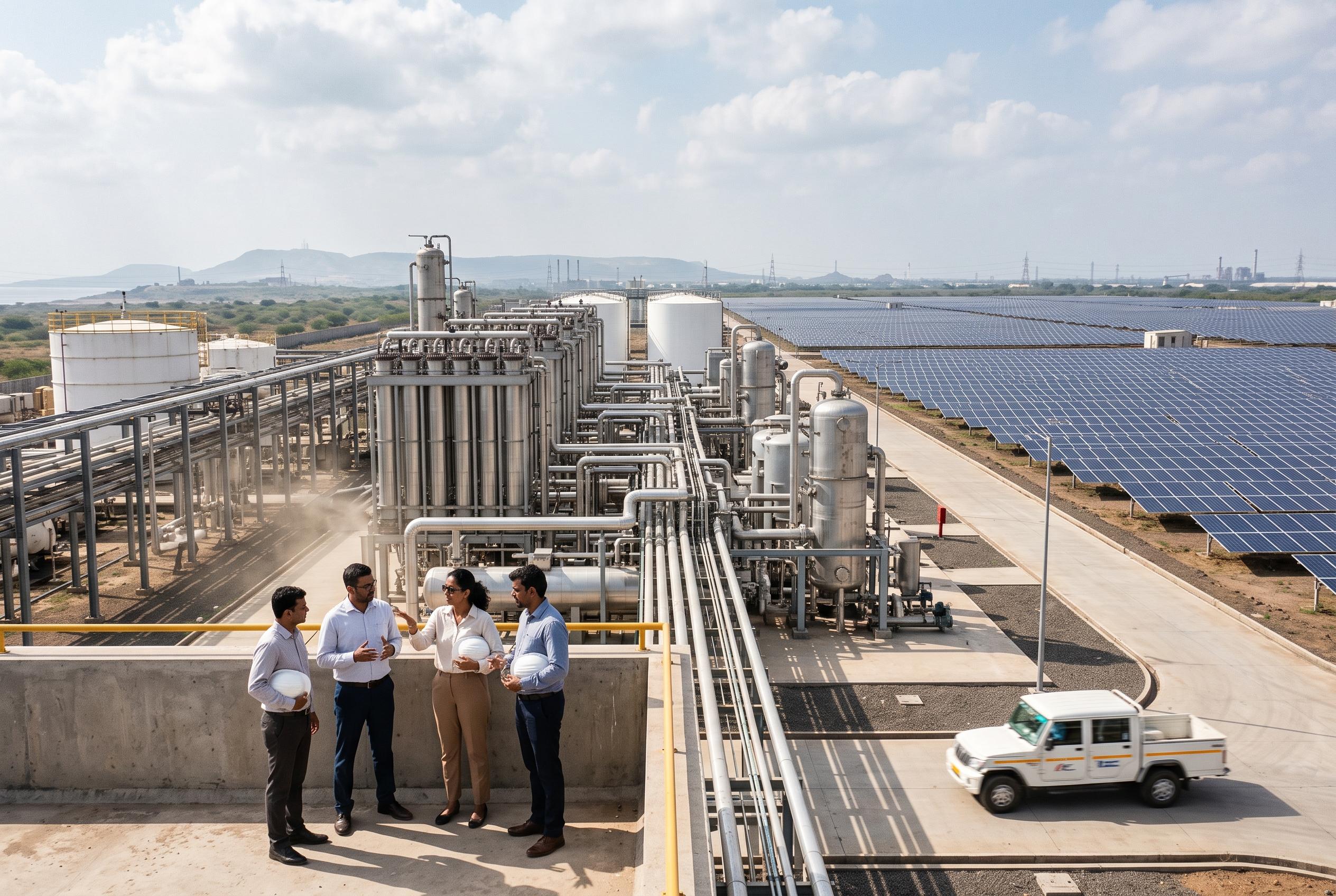
The centrepiece of the plan is a new 4,00,000-square-foot manufacturing site at Gangad in Gujarat. Trade Brains said the third unit is expected to begin operating by the fourth quarter of financial year 2027 and will bring together the company’s traditional transmission products and its newer energy businesses in one facility. The plant is intended to produce specialised conductors with capacity of 12,000 km, battery energy storage systems of 2.5 GWh, electrolysers of 300 MW and a proton exchange membrane, or PEM, fuel cell line.
That expansion follows earlier work by Advait Greenergy Private Limited, the group’s clean energy arm. Industry publications including Renewable Watch and PV Magazine India reported in March that the subsidiary opened a 30 MW alkaline electrolyser assembly facility in Mehsana, Gujarat, with a stated path to expand to 100 MW by the end of 2026, 300 MW by 2027 and eventually 1 GW a year. The company says its green hydrogen business covers manufacturing, system integration, engineering, procurement and construction, and project commissioning.
Advait has also been trying to build credibility in a segment where execution matters as much as ambition. Trade Brains reported that the company tested a 5 MW electrolyser batch and showed it to more than 13 green hydrogen players in India, while also saying it has commissioned what it described as India’s first operational green hydrogen microgrid for THDC India, pairing a 300 kW electrolyser with a 70 kW PEM fuel cell. The company has also said it is in discussions with green ammonia players for a possible order pipeline of 150 MW to 200 MW.
The order book suggests the shift is already contributing to the business mix. Trade Brains reported that as of June 30, 2026, Advait’s order book stood at Rs1,330 crore, up 97% from a year earlier. About 71% of that came from the power transmission business, while 29% was linked to energy-transition activities including battery storage, green hydrogen and solar engineering, procurement and construction.
Recent financial results were also strong. For the first quarter of financial year 2027, the company posted revenue of Rs179 crore, up 51.4% from a year earlier, while earnings before interest, tax, depreciation and amortisation rose 80.2% to Rs25 crore and net profit increased 61.2% to Rs15.6 crore. On a quarterly basis, results were softer than the previous quarter, which the company’s project-heavy business model can make lumpy. For the full 2026 financial year, revenue was Rs715 crore and profit after tax was Rs58 crore, Trade Brains said.
Investor interest has also been helped by the presence of well-known market participants. According to the shareholding data cited by Trade Brains, Ashish Kacholia held 1.83% and Vijay Kedia 1.14% as of June 2026. Promoter ownership eased slightly to 66.76% from 67.45% a year earlier, while public shareholding rose to 32.51%.
For now, Advait’s appeal lies in the combination of an expanding order book, improving margins and a timely bet on green hydrogen. The harder test will come as the Gangad plant ramps up and the company tries to turn early interest in electrolyser systems into sustained industrial-scale business.
Disclaimer: This article is intended to inform and educate, not to recommend or endorse any financial product, investment or strategy. Please consider your own financial circumstances and seek professional advice where appropriate before making financial decisions.



