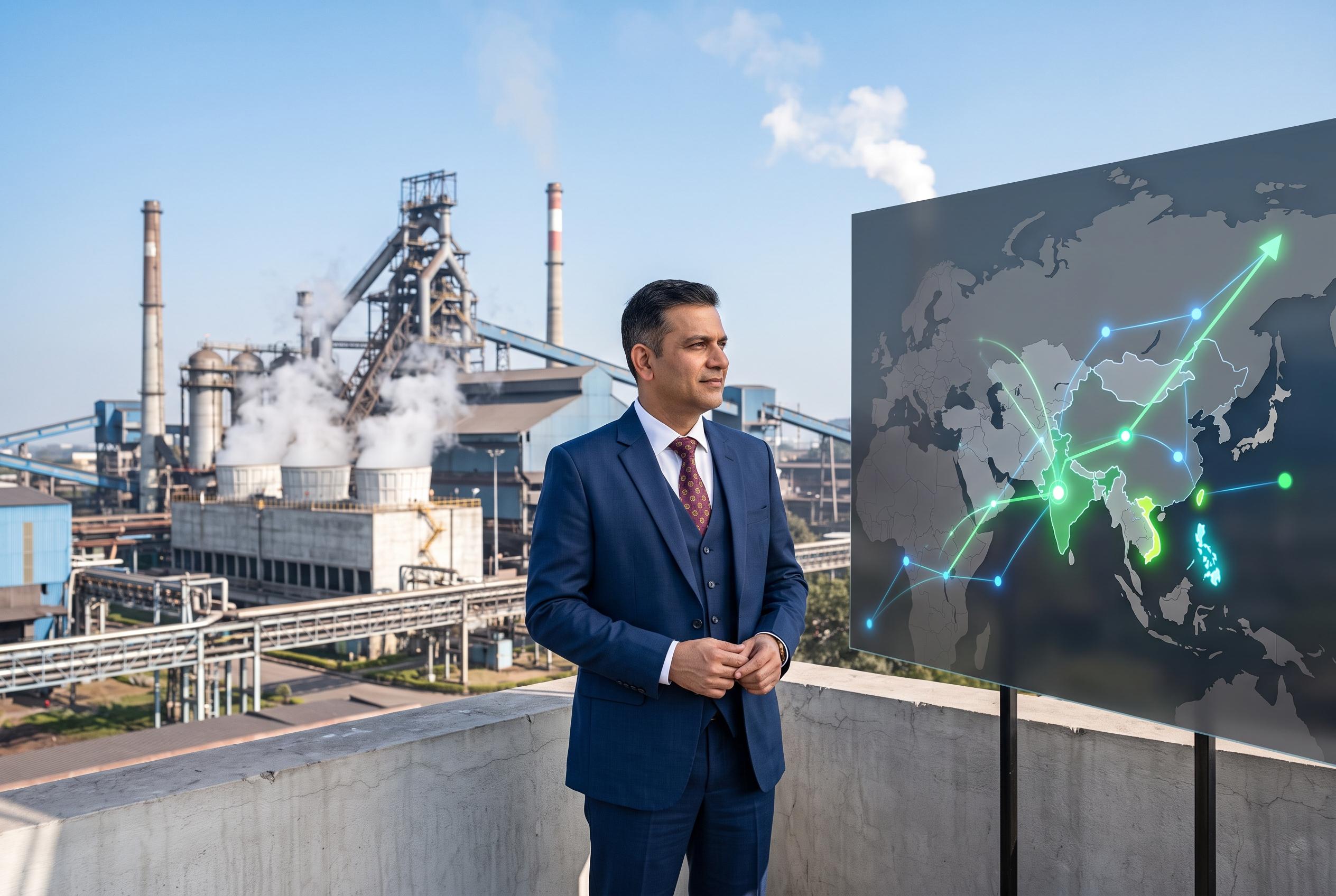

India’s steel exports showed a patchy recovery in FY26, with a marked shift towards Asian markets like Vietnam and Taiwan, while European sales declined. Domestic demand continued to fuel growth amid production and capacity concentration, signalling evolving dynamics in India’s steel industry.
India’s steel export recovery in FY26 was patchy, with a sharp shift towards newer Asian markets even as several long-standing European destinations lost ground. Data cited by Business Today show shipments to Vietnam surged to 772,000 tonnes from 11,000 tonnes a year earlier, while exports to Taiwan rose to 376,000 tonnes from 31,000 tonnes in FY25. By contrast, sales to Italy, still India’s biggest overseas market, slipped to 1.07 million tonnes from 1.67 million tonnes in FY24, with exports to Spain and the UK also weaker.
The pattern points to a broader diversification in India’s steel trade. According to a separate government release cited in the summaries, the rebound in exports was aided by stronger competitiveness and a wider spread of markets, while finished steel imports fell 31.7%, allowing India to regain net exporter status. That improvement came alongside a stronger domestic industry, with crude steel output rising 10.7% to 168.4 million tonnes in FY26 and finished steel consumption reaching 164 million tonnes.
Domestic demand remained the main engine of growth. Business Standard reported that consumption climbed 7% in FY26, supported by infrastructure, construction, railways and manufacturing, all of which have benefited from sustained public and private investment. The same momentum was visible earlier in the year: IBEF said crude steel production increased 5.8% year on year to 14.09 million tonnes in April 2026, while finished steel consumption rose 8.1% to 12.99 million tonnes.
The industry’s production base also remains highly concentrated. Ministry of Steel data cited in the lead report show JSW Group as the largest producer with a 15.5% share, followed by Tata Steel Group at 13.7% and Steel Authority of India at 11.3%. Jindal Stainless and Jindal Steel & Power together accounted for 5.7%, while ArcelorMittal Nippon Steel India had 4.6%. Together, the five largest producer groups made up 50.8% of producer-wise output.
Geography is similarly concentrated. Odisha led state-wise steel production with 8.21 million tonnes, or 19.5%, followed by Chhattisgarh, Jharkhand, Karnataka and West Bengal. Those five states together contributed 66.1% of the total shown in the ministry data, underlining how dependent India’s steel-making remains on a small number of industrial hubs even as export markets continue to evolve.
Disclaimer: This article is intended to inform and educate, not to recommend or endorse any financial product, investment or strategy. Please consider your own financial circumstances and seek professional advice where appropriate before making financial decisions.