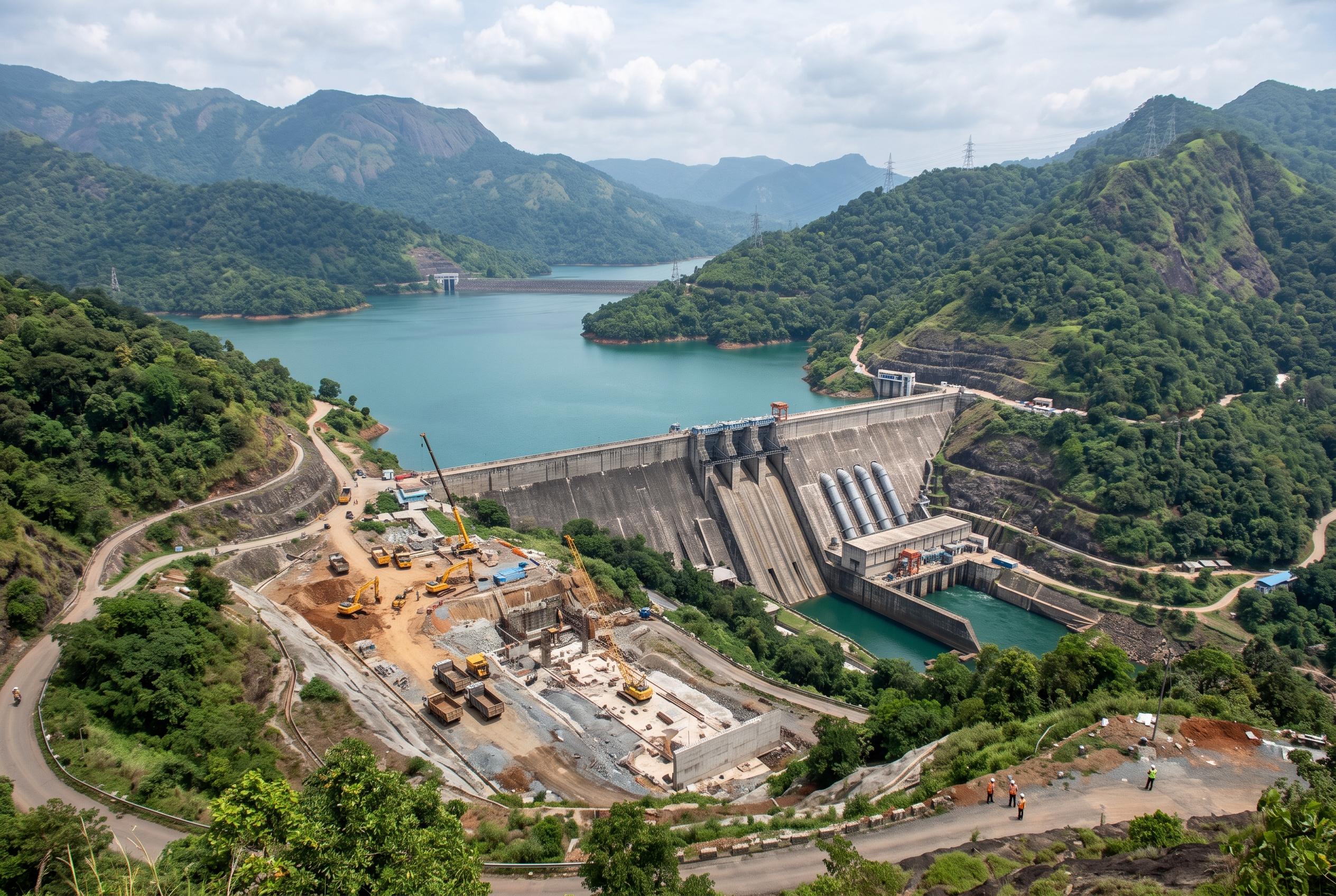

India’s pumped storage sector is transitioning from planning to implementation, with substantial pipeline developments and policy support, yet a significant gap remains between potential and actual capacity as projects face scaling challenges.
India’s pumped storage sector is moving from a planning story to an execution story, but the gap between ambition and built capacity remains wide. The Central Electricity Authority said in February that India’s pumped storage potential is roughly 267 GW, with off-stream, closed-loop schemes accounting for most of the opportunity. That assessment underpinned a roadmap aimed at reaching 100 GW of hydro pumped storage by 2035-36, as the grid leans more heavily on long-duration storage to manage rising renewable output and maintain reliability.
The latest market snapshot from Power Line Research shows that India’s identified PSP potential stood at 290,435.6 MW as of May 2026, though only 7,425.6 MW was operating at the time. A further 15,870 MW was under construction and 92,190 MW was at the survey and investigation stage, indicating a large pipeline but also a long lead time before capacity reaches the grid.
Recent government updates suggest that momentum is improving. In November 2025, the Ministry of Power said India had identified about 224 GW of PSP potential, with around 7 GW commissioned, about 12 GW under construction and roughly 78 GW in planning and development. The ministry also pointed to policy steps such as site-allotment guidelines and exemptions from certain obligations, while highlighting the commissioning of the 1,680 MW Pinnapuram project and the 500 MW Tehri project as major milestones.
Construction activity is concentrated in a handful of states. Power Line Research said Maharashtra has the largest project pipeline under way, led by the 3,000 MW Saidongar-1 site, while Andhra Pradesh, Karnataka, Madhya Pradesh and Tamil Nadu also account for substantial capacity additions. A July 2026 ministry update similarly said 11 PSPs totalling 15,870 MW were under construction, with commissioning dates stretching from 2026 to 2032.
The development pipeline is also heavily clustered by geography and ownership. Maharashtra, Andhra Pradesh and Tamil Nadu together account for nearly half of the cumulative identified capacity, according to Power Line Research, while private groups dominate the top of the developer table. Adani Group, Greenko Group and JSW Energy together control a large share of the portfolio, although state-owned names such as NHPC, NTPC and THDC India remain important participants.
That concentration matters because PSPs are increasingly being treated as a core grid asset rather than a niche hydro segment. The CEA has argued that pumped storage can do more than shift energy from off-peak to peak hours: it can also provide frequency control, voltage support and inertia, all of which become more valuable as variable renewable energy expands. Even so, the sector’s long-term promise will depend on whether developers can move projects from surveys and permits into financeable, buildable schemes at scale.
Disclaimer: This article is intended to inform and educate, not to recommend or endorse any financial product, investment or strategy. Please consider your own financial circumstances and seek professional advice where appropriate before making financial decisions.