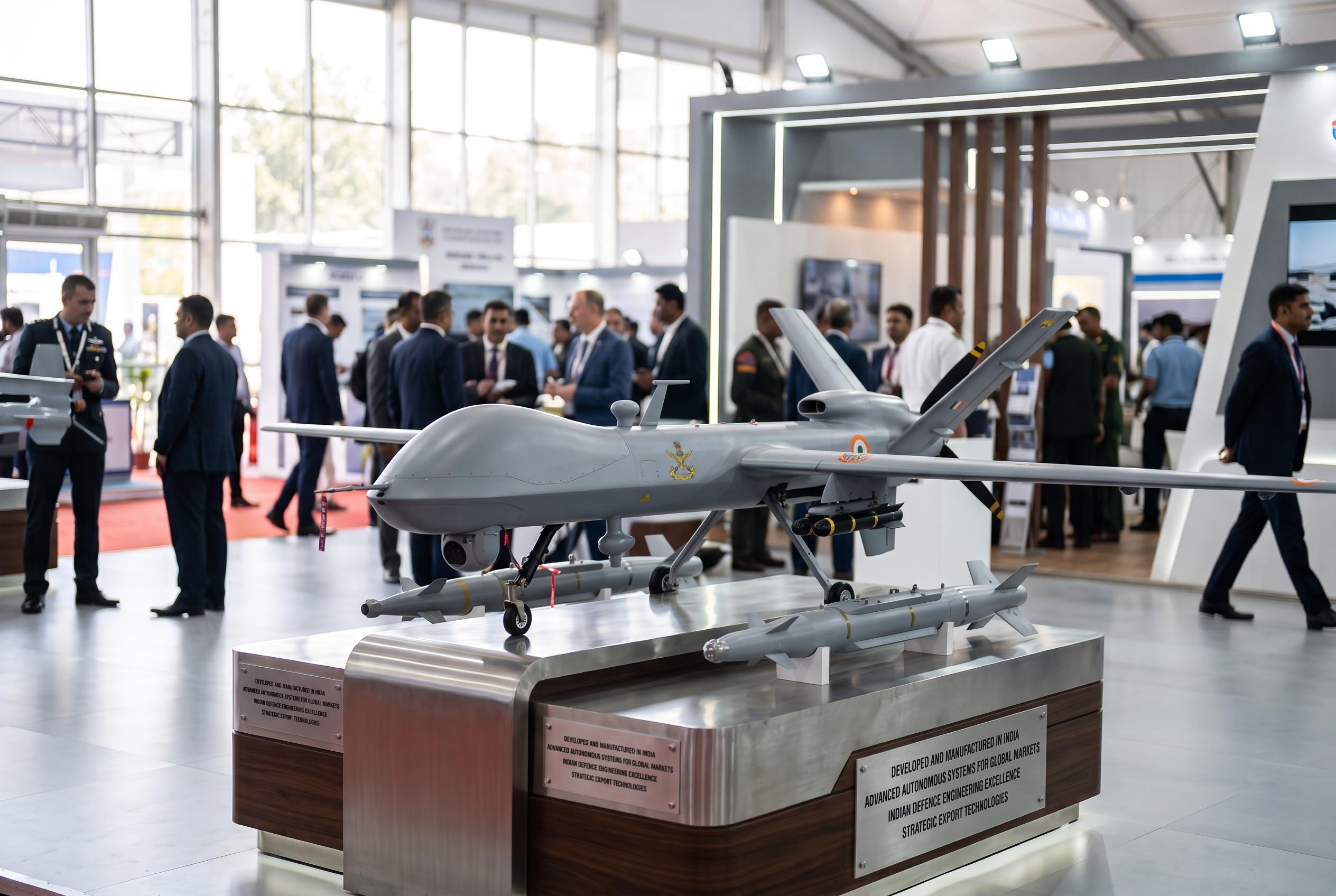

India’s defence exports reached a record ₹38,424 crore in FY26, with a sharp rise in technologically advanced systems like drones and precision-guided weapons, signalling a transformative phase in its global military footprint.
India’s defence export surge has reached a new milestone, with shipments climbing to a record ₹38,424 crore in FY26, according to Business Standard and other Indian outlets. The jump of about 62.7% from the previous year underlines how quickly the country’s military-industrial base has moved from a narrow export story centred on missiles to a broader, more diversified offering. BrahMos remains the best-known name in the portfolio, but the next phase of growth is being shaped by drones, loitering munitions, precision-guided weapons and autonomous systems.
Officials and industry figures see that shift as crucial if India is to meet its target of ₹50,000 crore in defence exports by 2029-30. The changing battlefield is driving demand away from heavy platforms alone and towards smaller, smarter and cheaper systems that can be produced at scale. According to reports from The Economic Times and The Times of India, India now sells defence equipment to more than 80 countries and has 145 exporters, showing how both public and private manufacturers are widening the export base.
Drones are among the clearest signs of where the market is heading. Armed unmanned aerial vehicles, kamikaze drones and long-range loitering munitions are attracting attention because they can deliver strike capability at a lower cost than traditional missiles. Systems such as IG Defence’s KAL drone, which is said to have a range of up to 1,000 km with a 50 kg payload, illustrate how Indian firms are trying to move into autonomous strike platforms. At the same time, the Defence Research and Development Organisation, IIT Madras and Munitions India are working on ways to convert conventional artillery shells into precision-guided rounds, a sign that the export opportunity is increasingly about electronics and guidance rather than metal alone.
The broader ecosystem is also expanding into radars, electronic warfare systems, counter-drone technologies, aircraft components, helicopters, fast interceptor boats, torpedoes and protective equipment. Products including the Akash air defence system, Swathi weapon-locating radar, Pinaka rocket launcher and ATAGS artillery gun have already found buyers abroad, with Armenia and the Philippines among the customers cited in recent reporting. Industry players argue that the biggest opportunity may lie in the “intelligence layer” inside weapons, such as fuses, sensors and guidance electronics, which could make India a supplier of critical subsystems as well as finished hardware.
Disclaimer: This article is intended to inform and educate, not to recommend or endorse any financial product, investment or strategy. Please consider your own financial circumstances and seek professional advice where appropriate before making financial decisions.