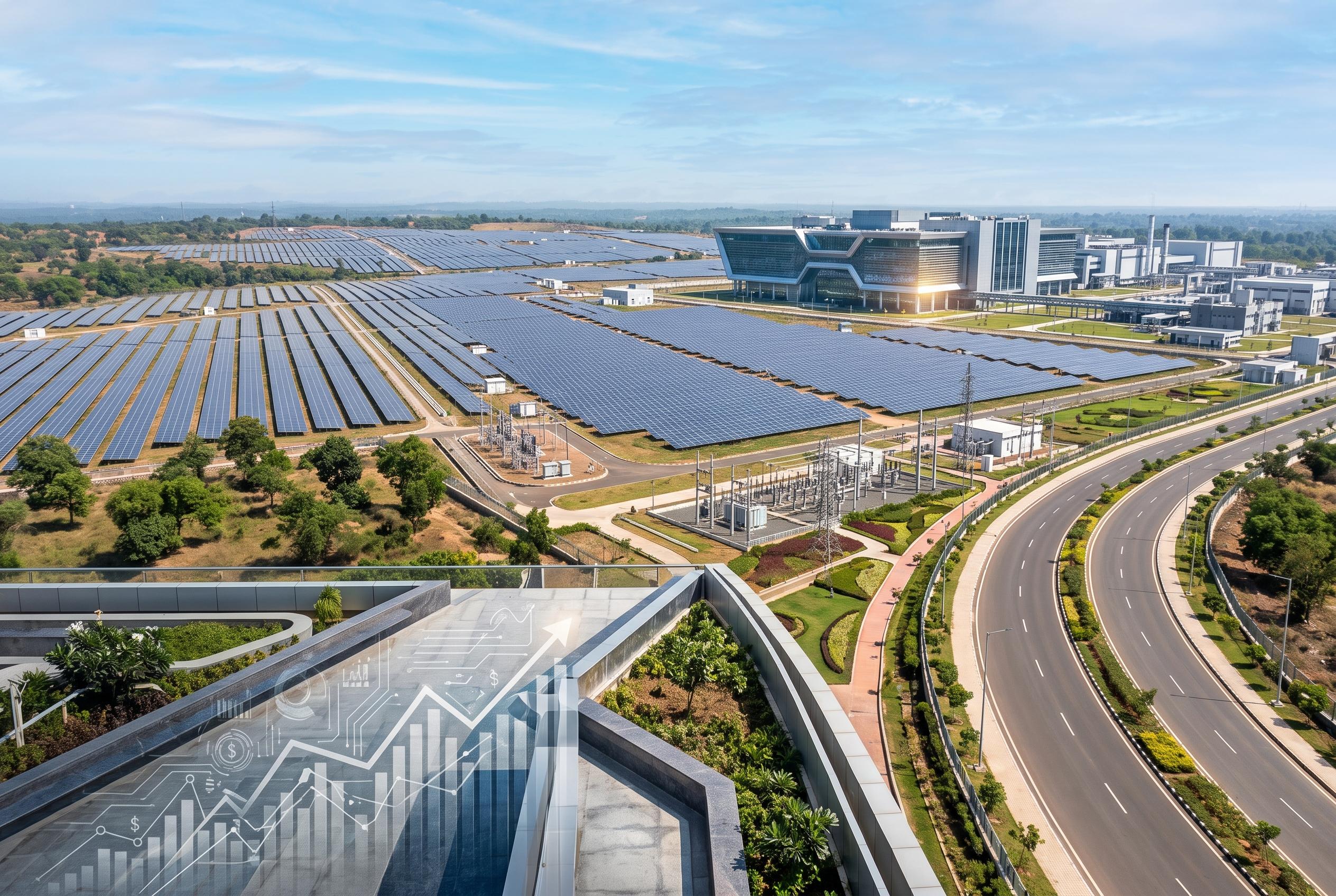

The Odisha government has announced major reforms and investments in semiconductor manufacturing and renewable energy, including financial incentives, large-scale irrigation projects, and social welfare schemes, aiming to boost industrial growth and social development.
The Odisha government has widened its push into semiconductors and clean power, approving changes to two key investment policies as part of a package of 10 decisions cleared at a cabinet meeting in Bhubaneswar on Wednesday.
Chief Secretary Anu Garg said the revised semiconductor policy is meant to keep pace with industry demand and national priorities. According to the government, the latest amendment builds on a policy first notified in September 2023 and later updated in March 2024 and July 2025. The new version extends support beyond chip fabrication and design to cover semiconductor equipment manufacturing, research and development, and the production of semiconductor-grade chemicals, gases, materials and related supply-chain components.
Officials said Odisha has already cleared proposals from five companies under the semiconductor framework, including two projects backed by the India Semiconductor Mission. The state will now offer additional fiscal support worth 25% of eligible capital expenditure for projects approved under that central scheme, in a move aimed at improving Odisha’s position in a sector where states are competing aggressively for investment.
The cabinet also revised the Odisha Renewable Energy Policy, 2022, with the stated aim of speeding up green power development and improving investor confidence. Under the changes, eligible net-metering consumers using renewable energy projects set up in the state will receive an electricity duty exemption of 50 paise per unit for 10 years from commissioning. The government will also extend a 20 paise per unit exemption on state transmission utility charges for standalone battery energy storage systems commissioned in Odisha.
Beyond industrial policy, the cabinet cleared a major irrigation commitment. The Parbati Giri Megalift Irrigation Project will be executed with an outlay of ₹12,458 crore from state resources over five years from 2026-27 to 2030-31, creating additional irrigation potential across all districts. The government also approved phase three of the tanks and minor irrigation projects scheme, with ₹389 crore set aside to restore irrigation over 15,700 hectares.
Among the social measures approved, the cabinet extended the Malati Devi Prak Vidyalaya Paridhan Yojana for five years from 2026-27, with a budget of ₹586.50 crore to provide free uniforms and shoes to pre-school children in Anganwadi centres. It also renewed the Jashoda scheme and its sub-scheme Ashribad for another five years with an outlay of ₹296.99 crore. The programmes were launched under the previous government to support children without biological parents, those with incapacitated parents, children affected by HIV and families that lost a breadwinner during the COVID-19 pandemic.
The cabinet also approved Odisha State Workflow Automation System 3.0 at a cost of ₹122.60 crore, a step the government said would advance paperless office operations.
Disclaimer: This article is intended to inform and educate, not to recommend or endorse any financial product, investment or strategy. Please consider your own financial circumstances and seek professional advice where appropriate before making financial decisions.