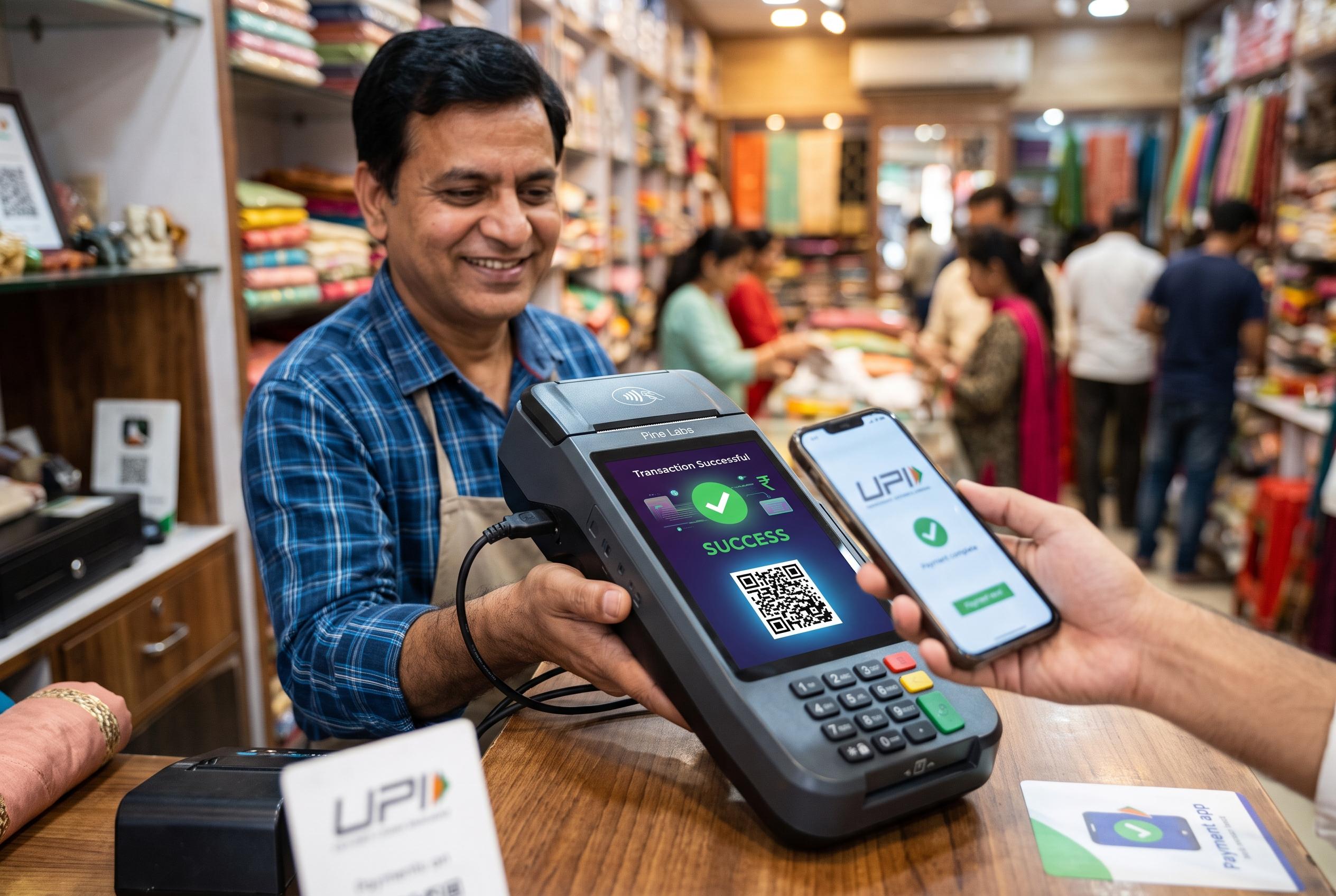

As India’s Unified Payments Interface cements its role in everyday transactions, a debate emerges on whether large merchants should start bearing fees to sustain the system, shifting the cost burden from consumers to high-value digital transactions.
India’s Unified Payments Interface has become so embedded in daily life that the real question is no longer whether people will adopt digital payments, but who will ultimately pay to keep the system running.
For now, the answer for consumers appears unchanged. Finance Minister Nirmala Sitharaman has said users will not be charged for UPI transactions and that no final merchant discount rate framework has been fixed. The legal change now under discussion creates room for future charges or exemptions, but it does not itself impose a fee.
That debate matters because UPI is no longer a niche experiment. The National Payments Corporation of India launched it in April 2016 with 21 banks on board and 373 transactions in its first month. By May 2026, it was processing 23.2 billion transactions worth ₹29.9 lakh crore, with 720 banks connected, according to the latest government and industry data.
Government figures released in June 2026 show the platform had onboarded 55.49 crore users and handled 24,161.69 crore transactions worth ₹314.23 lakh crore in FY2025-26. UPI now accounts for about 85% of India’s digital payment volume, underscoring how far it has moved from a convenience to a piece of national financial infrastructure.
That scale has been built on a simple user experience. UPI is not the app itself, but the system behind apps such as PhonePe, Google Pay and Paytm. It lets money move instantly between bank accounts through a UPI ID, mobile number or QR code, removing much of the friction that once made small digital payments awkward.
The QR code proved especially important for small merchants. A Department of Financial Services assessment in 2026 found that 94% of surveyed small merchants accepted UPI, while 72% said they were satisfied with digital payments and 57% said sales had increased. The same report found that 57% of users preferred UPI over cash, highlighting how deeply the system has altered everyday commerce.
The policy choice behind that growth was to keep ordinary UPI payments free for merchants, while the government absorbed part of the cost through incentives. The Finance Ministry says the zero-MDR model has helped reduce cost barriers and speed merchant onboarding, with budgetary support for the scheme totalling ₹8,276 crore. RBI Governor Sanjay Malhotra has also said that someone is paying for the system, even if users do not see it directly.
The current discussion is therefore less about whether UPI has costs than about how those costs should be shared. Reuters reported that one proposal under consideration would impose a merchant discount rate of about 0.3% to 0.5% on UPI payments above ₹2,000 made to large merchants. Another report has put the possible range at roughly 0.25% to 0.4%, but no final threshold or rate has been announced.
That narrower focus is important. The issue is not a fee on a ₹500 transfer to a friend or a small purchase at a neighbourhood shop. It is a question of whether larger merchants, which benefit from high-value digital traffic, should contribute more directly to the upkeep of a system that has been subsidised for years in order to achieve mass adoption.
Disclaimer: This article is intended to inform and educate, not to recommend or endorse any financial product, investment or strategy. Please consider your own financial circumstances and seek professional advice where appropriate before making financial decisions.