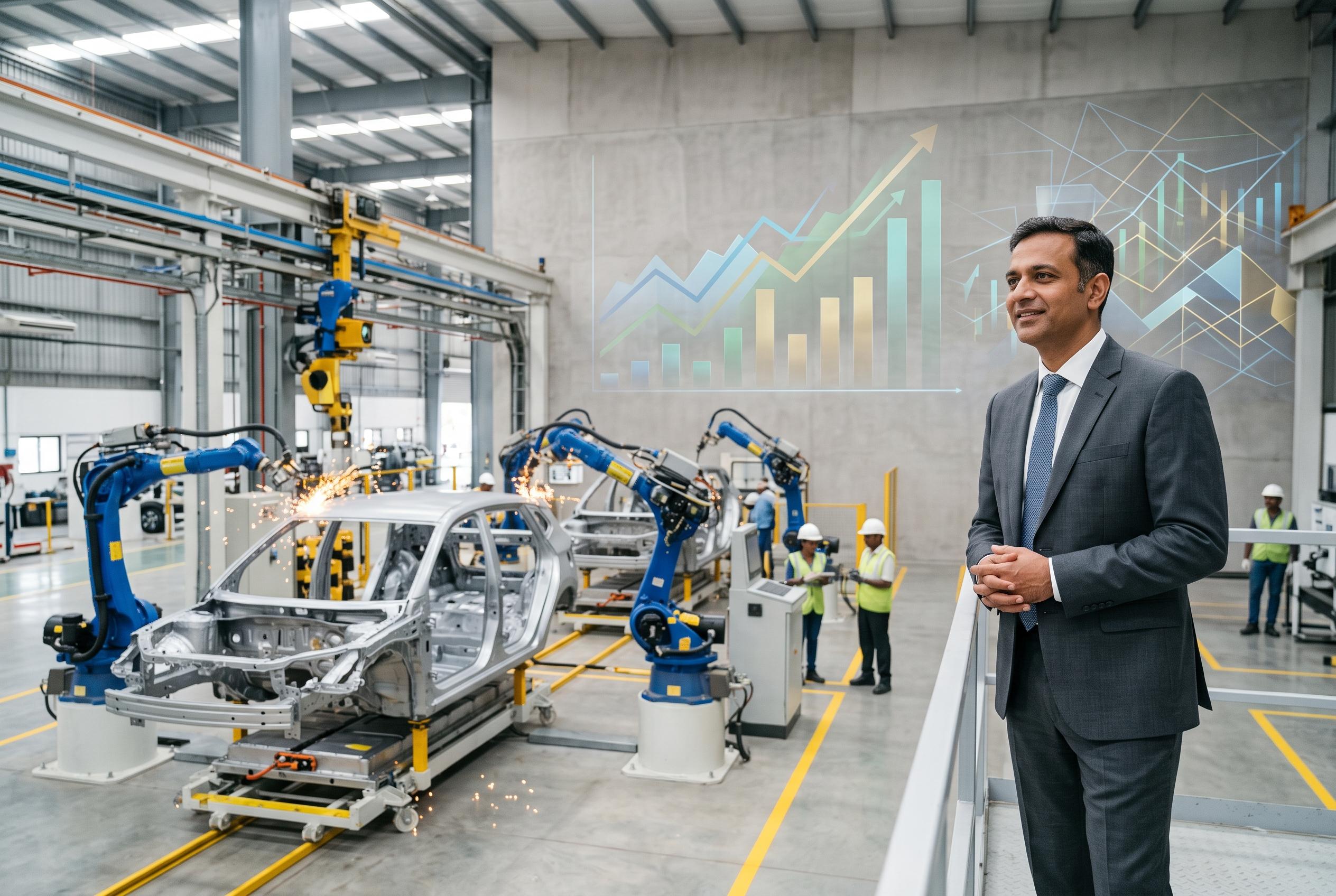

The Indian government anticipates a sharp increase in claims under its auto PLI scheme, signalling accelerated investment and output as domestic manufacturers ramp up electric vehicle production and infrastructure initiatives.
The government expects disbursement under India’s auto production-linked incentive scheme to more than double in the current fiscal year, a senior official said, underscoring a sharp ramp-up in claims as manufacturers lift output and investment.
About Rs 700 crore of the FY27 payout has already been released and the remainder is likely to go out over the next few months, the official said. The auto PLI scheme carries a total incentive outlay of Rs 25,938 crore and was designed to support makers of electric vehicles and advanced automotive components, including traction motors and angle encoders. Although it was initially planned for five years, it was later extended by one year, with incentive payments now due to continue until FY29.
The official said the scheme had been built around targeted investment of Rs 42,000 crore, but actual investment has already crossed Rs 45,000 crore. That compares with the government’s official scheme page, which says the programme was approved by the Union Cabinet in September 2021 to support advanced automotive technology and zero-emission vehicle manufacturing, while industry trackers have separately said cumulative incentive claims and investment have continued to rise as manufacturers ramp up qualifying sales.
Beyond the PLI scheme, the Ministry of Heavy Industries is looking at a financing solution for electric buses and trucks, after lenders raised concerns about resale values and battery durability, according to the official. Where financing is available, borrowing costs can be much higher than for diesel vehicles, and the industry has proposed interest subvention, or partial government support for interest payments, to close the gap. The proposed mechanism is expected to focus on electric trucks in the 3.5-tonne to 55-tonne range, where penetration remains extremely low, with the official saying fewer than 1,000 such vehicles have been sold so far.
The challenge is made clearer by broader truck market data. Society of Indian Automobile Manufacturers figures show India sold 951,125 trucks in FY26, while a Petroleum Planning & Analysis Cell study found trucks accounted for 64.2 per cent of diesel sold through surveyed retail outlets and buses for 4.1 per cent. The ministry is also weighing whether companies should be barred from claiming support under both the proposed financing programme and the PM E-Drive scheme, although that discussion is still under way.
Charging infrastructure remains another obstacle. The ministry is in talks with charge-point operators because heavy-duty chargers are still scarce and, the official said, the business case for e-truck and e-bus charging has not yet become commercially viable. Under Ministry of Power guidelines, highways are expected to have a bus and truck charger every 100 km and a car charger every 20 km, but the government is still examining ways to draw in private investment.
On the separate Scheme to Promote Manufacturing of Electric Passenger Cars in India, the ministry said no vehicle maker has applied so far. The official suggested one reason may be India’s free-trade agreements with Europe and the UK, which could give companies a cheaper route into the market through lower import duties. The scheme remains open, but the ministry does not currently plan to reopen applications. It would require approved firms to invest at least Rs 4,150 crore and would allow imports of up to 8,000 electric passenger cars a year at 15 per cent customs duty for five years.
The government is more upbeat about its rare-earth magnet plan. The official said the global tender for the Scheme to Promote Manufacturing of Sintered Rare Earth Permanent Magnets has drawn a very strong response from Indian and international companies. If the process is completed on schedule, India could begin domestic production within 1.5 to 2 years, with five beneficiaries selected to build annual capacity of 6,000 metric tonnes. The programme sets aside about Rs 6,450 crore in sales-linked incentives and Rs 750 crore in capital subsidy over seven years.
Disclaimer: This article is intended to inform and educate, not to recommend or endorse any financial product, investment or strategy. Please consider your own financial circumstances and seek professional advice where appropriate before making financial decisions.