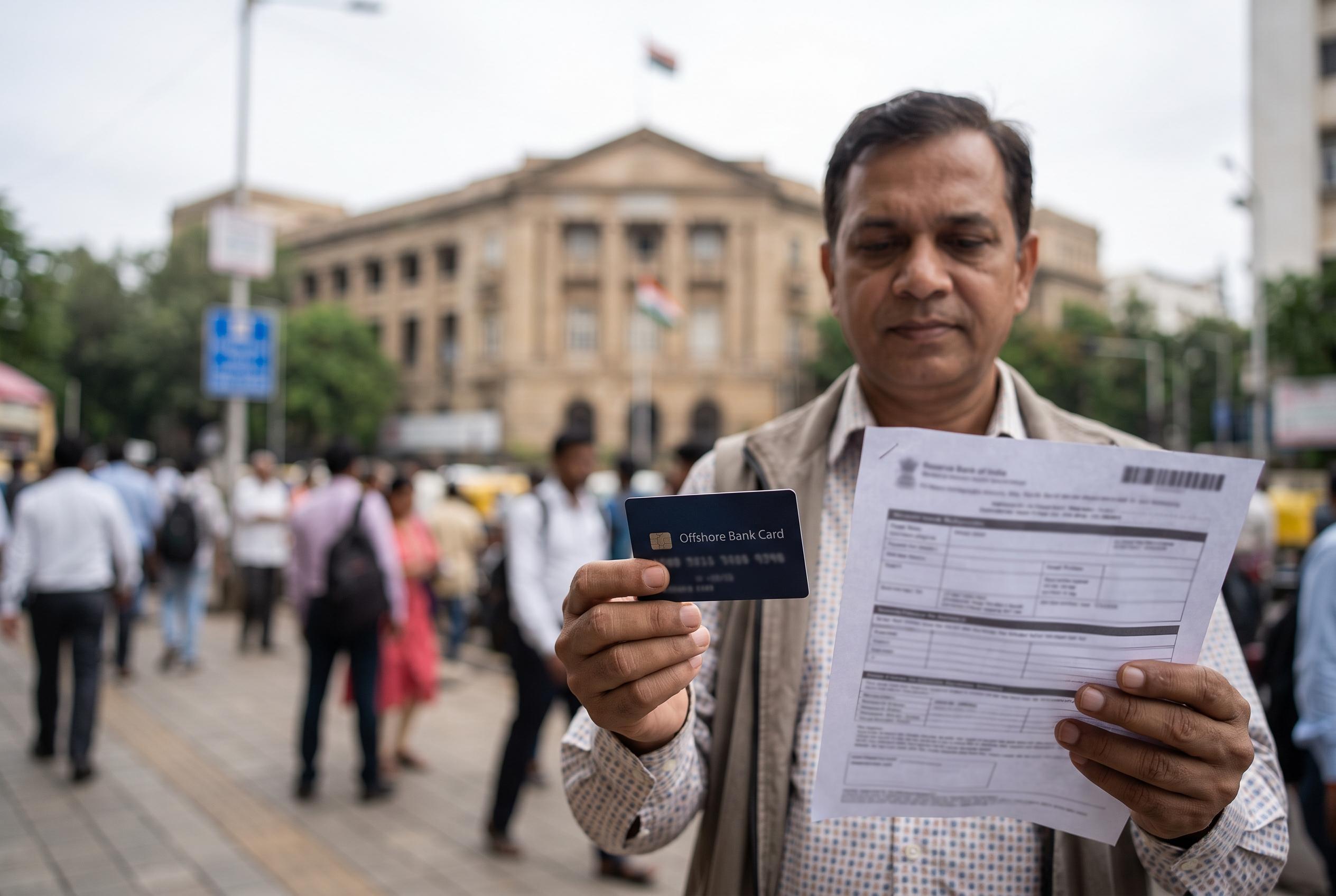

Indian residents with offshore credit cards are facing renewed restrictions as the Reserve Bank of India’s 180-day remittance rule complicates maintaining overseas banking relationships, impacting high-net-worth individuals and families alike.
Offshore banks in financial centres including Zurich, Singapore and London are becoming more cautious about issuing or renewing international credit cards for Indian residents, as compliance concerns tied to the Reserve Bank of India’s Liberalised Remittance Scheme begin to collide with everyday banking relationships.
The issue is not necessarily a customer’s creditworthiness. Instead, the pressure comes from RBI rules that require funds sent abroad under the scheme to be used or invested within 180 days, a provision that has proved awkward for residents who want to keep sizeable balances sitting in overseas accounts. The Financial Express reported that the RBI’s 180-day repatriation requirement also applies to unused foreign exchange in a range of cases, underlining how tightly the central bank now monitors funds that leave India.
India’s Liberalised Remittance Scheme allows resident individuals to remit up to $250,000 a financial year for permitted current and capital account transactions. That ceiling covers overseas card spending as well as travel, education and investment-related remittances, according to industry guidance and legal commentary on the scheme. For many Indian customers, foreign-issued credit cards remain attractive because spending is billed in the currency in which the account is maintained, which can reduce conversion friction and, in some cases, lower costs.
But the same features that make offshore cards useful can also make them harder to sustain. According to lawyers quoted in the report, foreign cards are often part of a broader banking relationship that assumes the customer will keep money parked abroad and use the account regularly. That model sits uneasily with RBI rules, which limit how long funds can remain idle and may force customers to return money to India if it is not deployed in line with permitted purposes.
Harshal Bhuta of PR Bhuta & Co said the Foreign Exchange Management Act does not impose a separate monetary cap on the payment of overseas card dues from India; instead, the limit depends on the credit line agreed with the foreign bank or card issuer. He also said the tax treatment can differ from that of cards issued by Indian banks, with some foreign-card spending potentially falling outside tax collected at source rules that apply to certain LRS transactions. That distinction matters because it helps explain why some customers and banks view foreign-issued cards as administratively cleaner than domestic alternatives.
The tightening is not confined to affluent adults. The report said minors can also remit money under LRS, although the practical scope for using those funds abroad is narrower. Moइन लाधा of Khaitan & Co said the 180-day condition is having an unintended effect on family banking ties, while Rajesh Shah of Jayantilal Thakkar & Co said the rules for minors’ remittances have been broadly unchanged since February 2004.
For now, the shift does not amount to a blanket closure of foreign credit card access for Indians living in India. The impact appears concentrated among higher-net-worth customers and certain offshore banking relationships. Even so, the trend is a reminder that a bank’s decision to issue or renew a card may depend not just on credit history but also on whether the customer’s overseas banking set-up fits India’s remittance rules. FATCA and other information-sharing arrangements add another layer of scrutiny, even if transaction data is not automatically visible to Indian authorities in every case.
Disclaimer: This article is intended to inform and educate, not to recommend or endorse any financial product, investment or strategy. Please consider your own financial circumstances and seek professional advice where appropriate before making financial decisions.