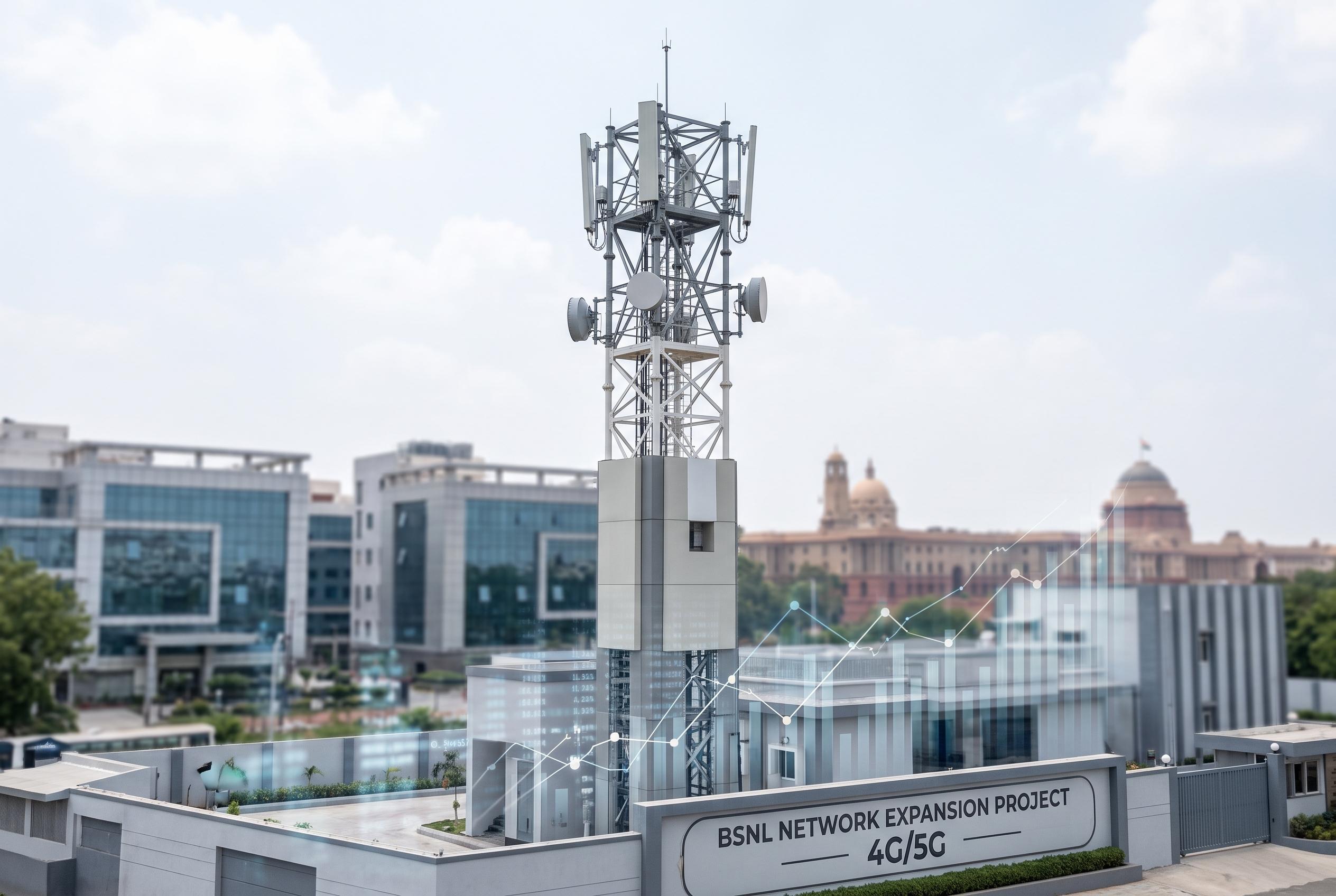

Bharat Sanchar Nigam Ltd has announced a five-year ₹77,000 crore capital expenditure plan aimed at expanding its 4G network, transitioning to 5G, and revitalising its financial position amid ongoing industry competition and infrastructure sharing efforts.
Bharat Sanchar Nigam Ltd has put forward a five-year capital spending plan of ₹77,000 crore aimed at adding 200,000 more 4G sites, strengthening its network, beginning 5G service in selected high-traffic areas and improving customer support, according to a report by TV9 Hindi. The Department of Telecommunications told a parliamentary panel on August 6 that the investment could help the state-owned operator reach operational break-even by financial year 2029 and cover 98% of the country. The proposal comes as BSNL is still under pressure to prove that repeated state support can translate into a durable turnaround.
The timing is significant because BSNL has already been on a large-scale revival path for years. Economic Times reported in August 2025 that the government approved an additional ₹6,982 crore for 4G capex, adding to earlier revival support. By July 31, 2025, BSNL had installed 96,300 4G sites, of which 91,281 were operational, while Mint reported in September 2025 that the operator had crossed 20 million 4G users. Industry sources later said the company had 97,672 sites installed by January 15, 2026, with more than 95,500 live, and that the equipment was already designed to be upgraded to 5G.
The parliamentary panel also questioned BSNL’s financial strength. TV9 Hindi reported that the company’s loss widened to ₹4,738 crore in financial year 2026 from ₹2,247 crore a year earlier, even though operating revenue rose 1.7% to ₹21,199 crore. That was well below the target of ₹28,476 crore agreed between the department and the operator. The telecom department said the larger loss reflected depreciation and amortisation charges, and argued that heavy spending in financial year 2025 on 4G rollout and network expansion had built the platform for future revenue growth.
BSNL is also leaning more heavily on infrastructure sharing and enterprise services. The department told lawmakers that it is in active talks to expand Vodafone Idea’s use of BSNL tower assets for 4G and 5G. TV9 Hindi reported that BSNL had leased 1,441 towers to Vodafone Idea by April, while the two companies already have intra-circle roaming arrangements in Delhi and Mumbai and share fibre under BharatNet. The operator has also identified data centres, edge computing, private 5G networks, cloud, internet of things and enterprise digital services as areas where it sees commercial opportunities.
Those plans will face scrutiny from lawmakers and industry veterans alike. The parliamentary committee urged the government to assess tower, fibre, spectrum and other forms of sharing between BSNL and Vodafone Idea within six months, and to estimate possible savings before any fresh outlay is fully committed. However, the department pushed back, warning that a halt to further spending could slow the ongoing 4G rollout. Former TRAI principal adviser Satyan G. Gupta said, according to TV9 Hindi, that any new capex should come with clear accountability and return analysis, and suggested that BSNL could also raise money through land monetisation, real estate investment trusts and repurposing properties into data centres.
Disclaimer: This article is intended to inform and educate, not to recommend or endorse any financial product, investment or strategy. Please consider your own financial circumstances and seek professional advice where appropriate before making financial decisions.