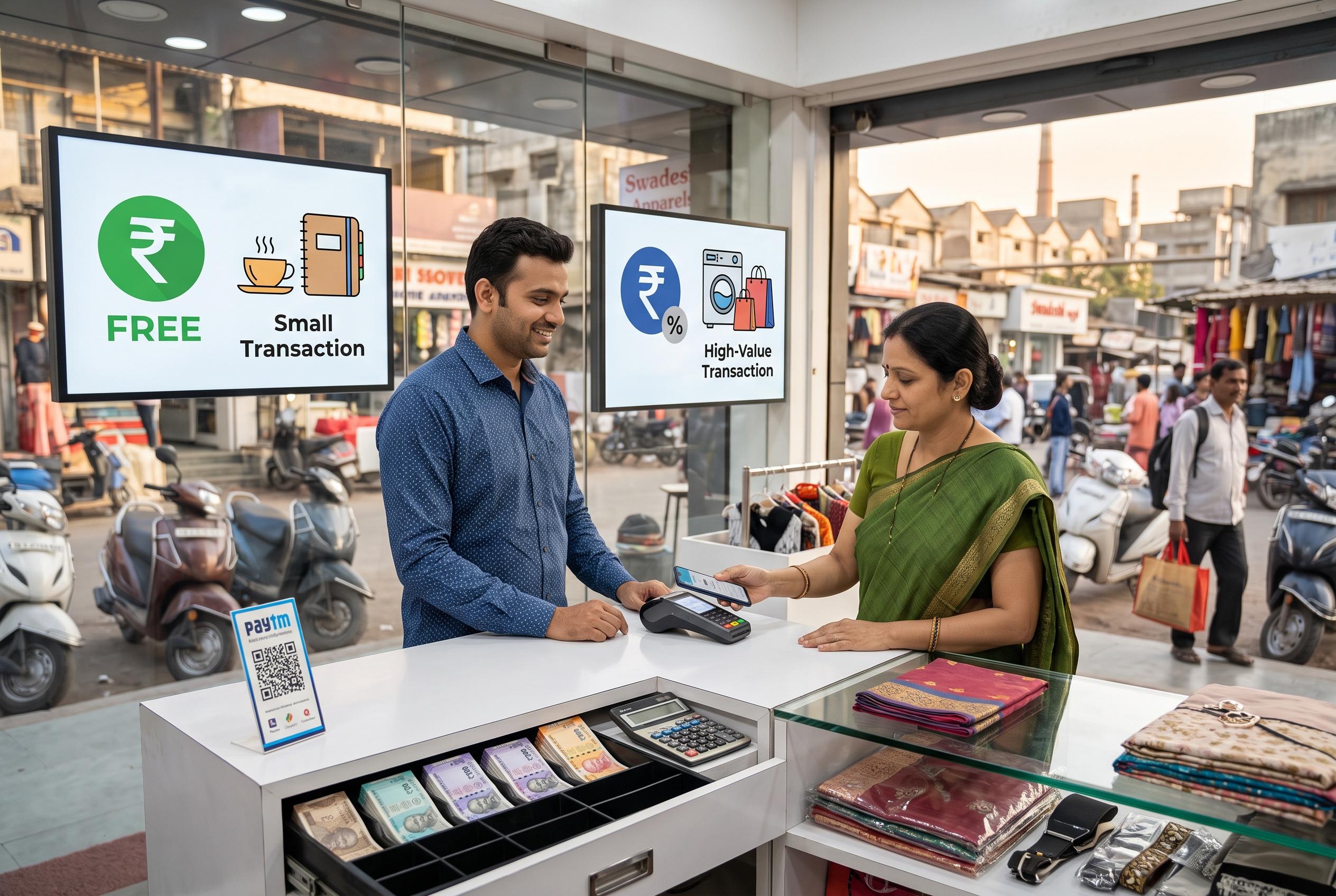

Finance Minister Nirmala Sitharaman has announced that any future merchant discount rate fees on digital transactions will apply only to high-value merchant transactions, ensuring low-value and consumer transactions remain free, amid efforts to sustain innovation and boost manufacturing in India.
Finance Minister Nirmala Sitharaman has said any future fee on digital payments would be confined to a narrow set of high-value merchant transactions, with ordinary consumers and small businesses continuing to use the Unified Payments Interface without charges. Speaking in the Rajya Sabha on Monday during debate on the Taxation and Other Laws (Amendment) Bill, 2026, she said no merchant discount rate framework has yet been finalised.
The Bill would amend the Payment and Settlement Systems Act, 2007 to permit a transaction fee, known as merchant discount rate, while maintaining statutory protection for payment modes that the government specifies by notification. According to the minister, a committee would examine whether such a fee should be introduced at all and, if so, how it would work. She also said small traders, including tea sellers, vegetable vendors, street vendors, flower sellers, auto drivers and kirana shops, would be left out.
Sitharaman sought to reassure users that UPI itself would remain free at the point of use. She said any future charge would apply only to a limited category of merchant payments above a prescribed high threshold, while the vast majority of low-value transactions would stay exempt. In remarks reported by Business Standard, she compared the proposal with card payments, where merchants typically absorb fees of about 1.5% to 2% on credit cards and up to 0.90% on debit cards.
The minister argued that a sustainable revenue stream could help support further innovation in the payments ecosystem. She pointed to countries including Australia, Brazil and China as examples where payment acceptance charges exist in faster payments systems. She also said UPI processed 2,366 crore transactions worth ₹29.9 lakh crore in July 2026 and is now available in 11 countries, underlining the scale of the network.
The same Bill also contains a separate push to deepen India’s manufacturing base. Business Standard reported that it would grant tax exemptions to foreign companies supplying capital goods, equipment and tools to contract manufacturers in India, a move tax experts said could benefit Apple’s supply chain. The proposal would allow eligible foreign firms to keep components in customs-bonded facilities and supply them quickly to Indian manufacturers, with the aim of strengthening local production of phones, laptops, tablets, servers and related products.
Beyond electronics, the legislation extends incentives to data-centre activity and diamond trading. According to the government’s plan, foreign companies using Indian data-centre services would get an exemption up to March 31, 2047, a horizon Sitharaman said was needed for long-term investment. The Bill also seeks to encourage wholesale diamond trading and financing in India, with the minister saying that shifting more of that business onshore could support a labour-intensive industry where the country already has a strong position in cutting and polishing.
Disclaimer: This article is intended to inform and educate, not to recommend or endorse any financial product, investment or strategy. Please consider your own financial circumstances and seek professional advice where appropriate before making financial decisions.