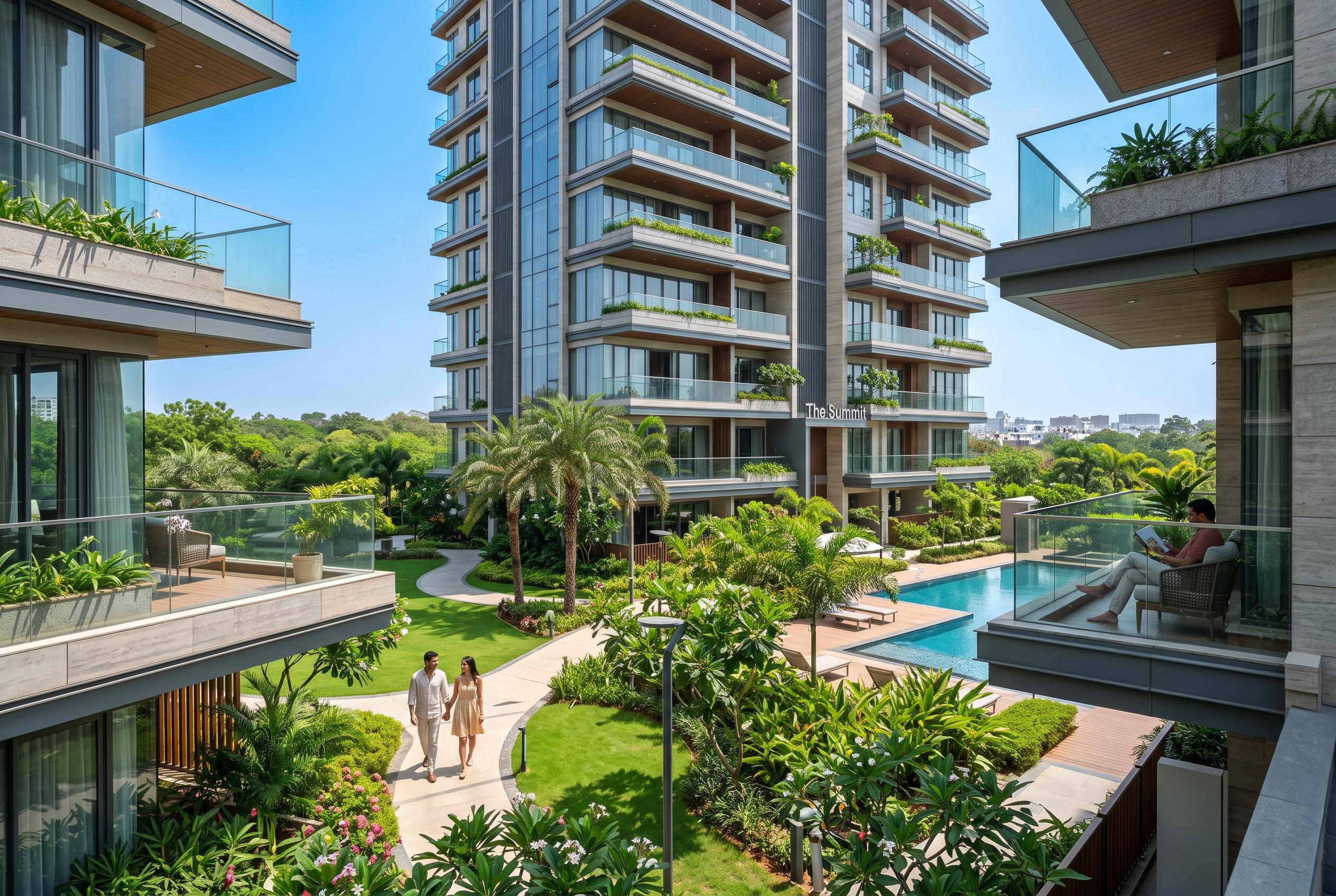

Hyderabad has overtaken Mumbai as India’s largest housing market by value, driven by demand for luxury homes and infrastructure growth, though affordability challenges persist amidst a market that is becoming increasingly selective.
Hyderabad has emerged as India’s biggest housing market by value over the past five years, with residential sales between 2021 and 2025 reaching ₹4,77,977 crore, according to CRE Matrix. The data, as reported by Deccan Chronicle, puts the city narrowly ahead of Mumbai, where homes worth ₹4,51,811 crore changed hands over the same period, and well clear of Bengaluru, Gurugram and Ahmedabad.
The figures underline how Hyderabad’s property market has shifted towards higher-value housing. Industry voices cited in the report said demand has been increasingly concentrated in premium, mid-luxury and luxury homes, with buyers opting for larger 3BHK and 4BHK apartments, gated communities and high-end projects. That trend has been reinforced by the city’s expanding technology, pharmaceuticals, defence, aerospace, food processing and global capability centre base.
Recent market data suggests the momentum has continued even as volumes have softened. Magicbricks reported that Hyderabad’s housing registrations in May 2025 rose 14% year on year to ₹4,302 crore, even though the number of registered units increased only 2% to 6,177. Separate reporting from Hindustan Times showed average home prices climbed 81% between 2019 and 2025 to ₹8,326 per square foot, while average home sizes shrank slightly, a sign that developers and buyers alike are moving up the value chain.
The strongest activity remains concentrated in the western corridor, especially Financial District, Gachibowli, Kokapet, Narsingi and Tellapur, with newer growth pockets emerging in places such as Kollur, Kompally, Medchal and Adibatla. Telangana Today has also reported that, between the end of 2021 and the end of 2024, capital values in key micro-markets such as Hitec City and Gachibowli rose faster than rents, a pattern that can make ownership look more attractive than leasing for many households.
Yet the same forces behind Hyderabad’s rise are also making the market harder for many buyers to enter. The Deccan Chronicle report said higher land prices, construction costs and compliance burdens have pushed up weighted average prices, squeezing affordability for middle-class and first-time purchasers. One buyer in Kompally told the paper that her EMI now takes up most of her salary, forcing her to cut back elsewhere.
There are also signs that the market has not been uniformly strong through 2025. The Hans India reported that housing sales in the city fell 23% year on year in 2025 and new launches declined 26%, even as tighter supply limited inventory build-up. That mix of softer volumes and higher transaction values suggests a market becoming more selective, with demand increasingly concentrated in better-located and higher-end projects.
Developers and industry leaders say Hyderabad’s edge rests on more than housing alone. K. Sreedhar Reddy of Naredco Telangana said the city’s growth reflects a structural shift in demand, while Indian Green Building Council chairman Sekhar Reddy warned that congestion in the western corridor and the need for greener, more sustainable construction will shape the next phase of expansion. Credai Hyderabad president-elect Jagannath Rao Bandari said the city’s transparency, timely delivery and infrastructure investment continue to support buyer confidence.
Disclaimer: This article is intended to inform and educate, not to recommend or endorse any financial product, investment or strategy. Please consider your own financial circumstances and seek professional advice where appropriate before making financial decisions.