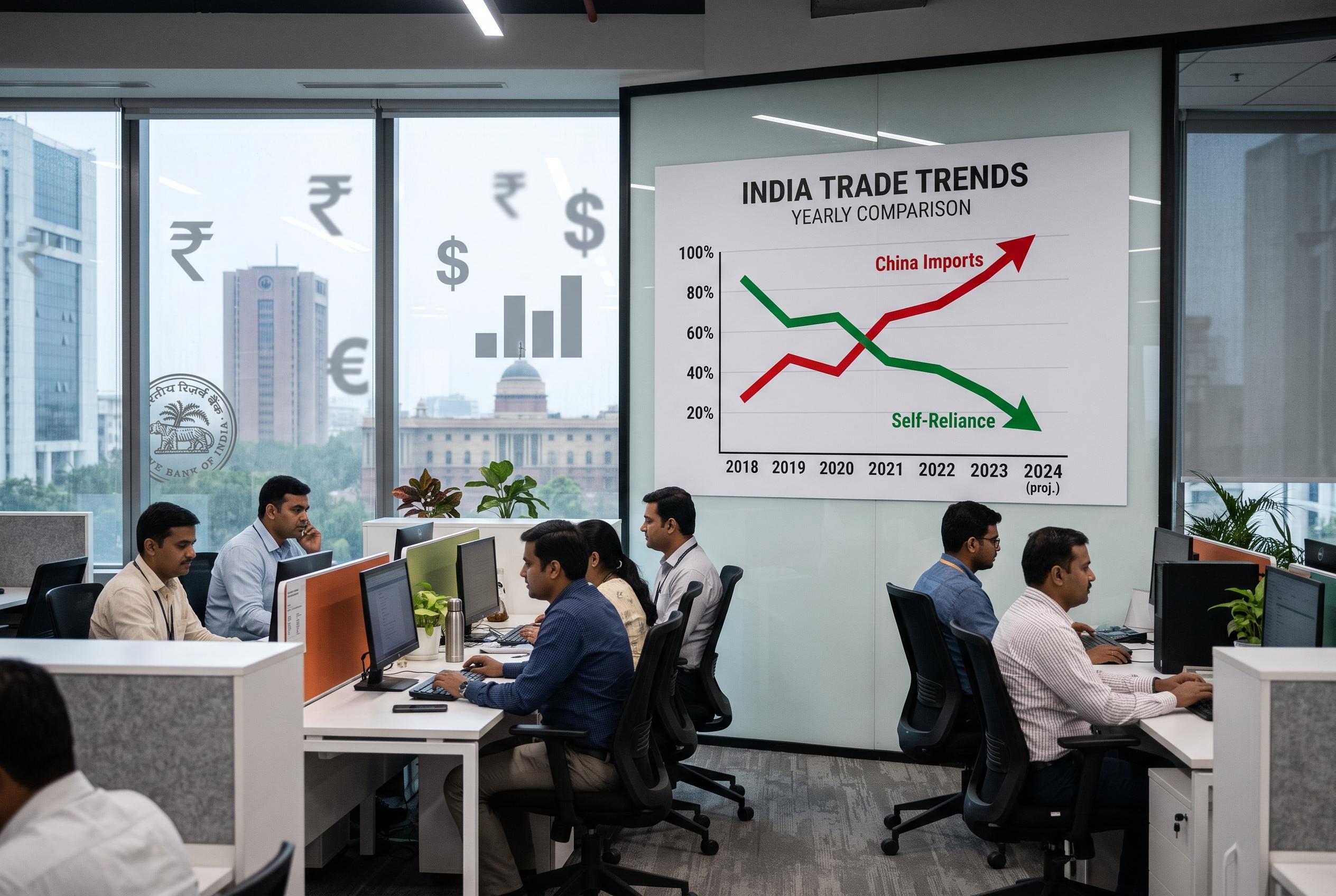

Despite years of promoting self-reliance, India’s imports from China have surged, intensifying its reliance on Chinese goods and widening the trade deficit, raising questions over the pace of economic transition.
India has spent years pitching Make in India, Atmanirbhar Bharat and production-linked incentives as the answer to its dependence on foreign suppliers. Yet the latest government figures show that, when it comes to China, the trade relationship is moving in the opposite direction.
According to a reply in the Rajya Sabha on August 7, India imported $131.63 billion worth of goods from China in 2025-26, up from $94.57 billion in 2021-22. That is a rise of roughly 39% in five years. China’s share of India’s total merchandise imports also edged higher, from 15.43% to 16.96%, underlining how central Chinese goods remain to the Indian economy.
The bigger concern is the widening deficit. India’s trade gap with China climbed from $73.31 billion in 2021-22 to $112.16 billion in 2025-26, marking a jump of about 53%. Business Standard reported that bilateral trade in 2025-26 reached $151.1 billion, making China India’s largest trading partner as it overtook the United States. Indian exports to China rose to $19.47 billion, but they were still dwarfed by the import bill.
The explanation is not limited to consumer electronics or finished goods. The commerce ministry said India’s import needs include lithium, cobalt, nickel, graphite, rare earth elements and copper, all of which are vital for electric vehicles, clean energy systems, electronics and semiconductors. It also pointed to the importance of intermediate goods, capital equipment and advanced technology in sectors such as pharmaceuticals, fertilisers, energy and infrastructure. In other words, a significant share of what India buys from China is feeding Indian factories, not just filling shop shelves.
That dependence helps explain why cutting imports is far more complicated than swapping out one finished product for another. The Times of India reported that China accounts for about 16% of India’s total imports but supplies 30.8% of its industrial needs, a reminder of how deeply embedded Chinese components and inputs are in domestic manufacturing. The challenge for New Delhi is therefore not simply to reduce trade with China, but to build enough domestic capacity in raw materials, parts, machinery and technology to make that dependence less acute over time.
Government policy is aimed at doing exactly that. But the numbers suggest the transition is still in its early stages. Imports from China have continued to rise, the trade gap has crossed the $100 billion mark and India’s manufacturing base remains tied to Chinese supply chains in several strategic sectors. Until those links are replaced or reduced, China is likely to remain both India’s largest import source and one of its most persistent economic vulnerabilities.
Disclaimer: This article is intended to inform and educate, not to recommend or endorse any financial product, investment or strategy. Please consider your own financial circumstances and seek professional advice where appropriate before making financial decisions.