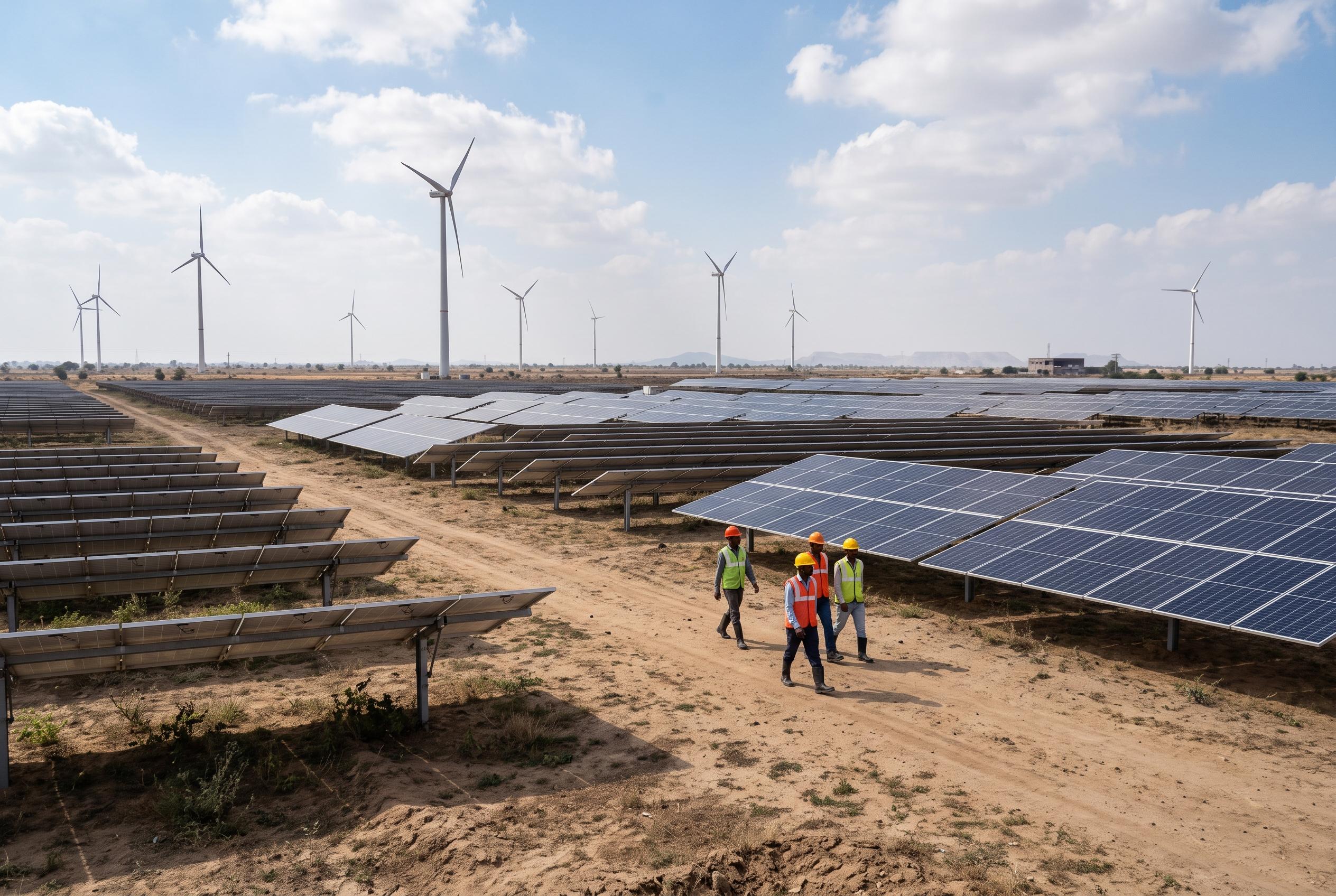

Renewable energy developers are increasingly targeting Gujarat and Rajasthan’s border belts, attracted by vast, dispute-free lands and proximity to export ports, but new security rules are adding complexities to the sector’s rapid growth.
Renewable energy developers are moving deeper into Gujarat and Rajasthan’s border belts, drawn by large tracts of inexpensive land, quicker clearances and access to export routes through ports such as Mundra and Kandla. The shift reflects a broader scramble for space in a sector where land acquisition remains one of the biggest bottlenecks, even as officials work on creating land banks for large-scale projects.
According to industry participants, the borderlands offer the kind of uninterrupted terrain that makes utility-scale solar feasible. One renewable energy executive told Business Today that the land is barren, expansive and largely free of acquisition disputes, allowing companies to build out major capacity without the legal complications that often slow projects elsewhere.
The rush has been especially visible in the Rann of Kutch, where Adani Green Energy is developing the Khavda hybrid renewable energy park. Envisioning says the site covers 72,600 hectares and is designed for 30 GW of combined solar and wind capacity, making it one of the largest such projects in the world. A separate assessment released by Adani Green Energy describes the Khavda development as a 4,750 MW renewable energy park intended to support lower dependence on fossil fuels and cut greenhouse gas intensity.
Reliance Industries is also expanding its clean-energy footprint in the same region. Business Standard reported that the company plans to begin solar generation from its Kutch project in the first half of the next financial year, while other industry reports have described the site as a single-location project on a massive scale with battery storage. The concentration of investment has helped turn Kutch into a focal point for India’s renewable ambitions, but it has also drawn the attention of security officials.
That concern sharpened after the Ministry of Home Affairs issued new guidelines imposing a blanket ban on renewable projects within 1 km of the international border and requiring security clearance for projects up to 50 km away. The rules cover solar, wind and hybrid schemes near the Line of Control, Line of Actual Control and international border, and they also restrict the use of workers from Pakistan, Bangladesh and China without approval. The move came after a surge in applications for border-area projects and followed warnings that such installations could carry national security risks.
Disclaimer: This article is intended to inform and educate, not to recommend or endorse any financial product, investment or strategy. Please consider your own financial circumstances and seek professional advice where appropriate before making financial decisions.