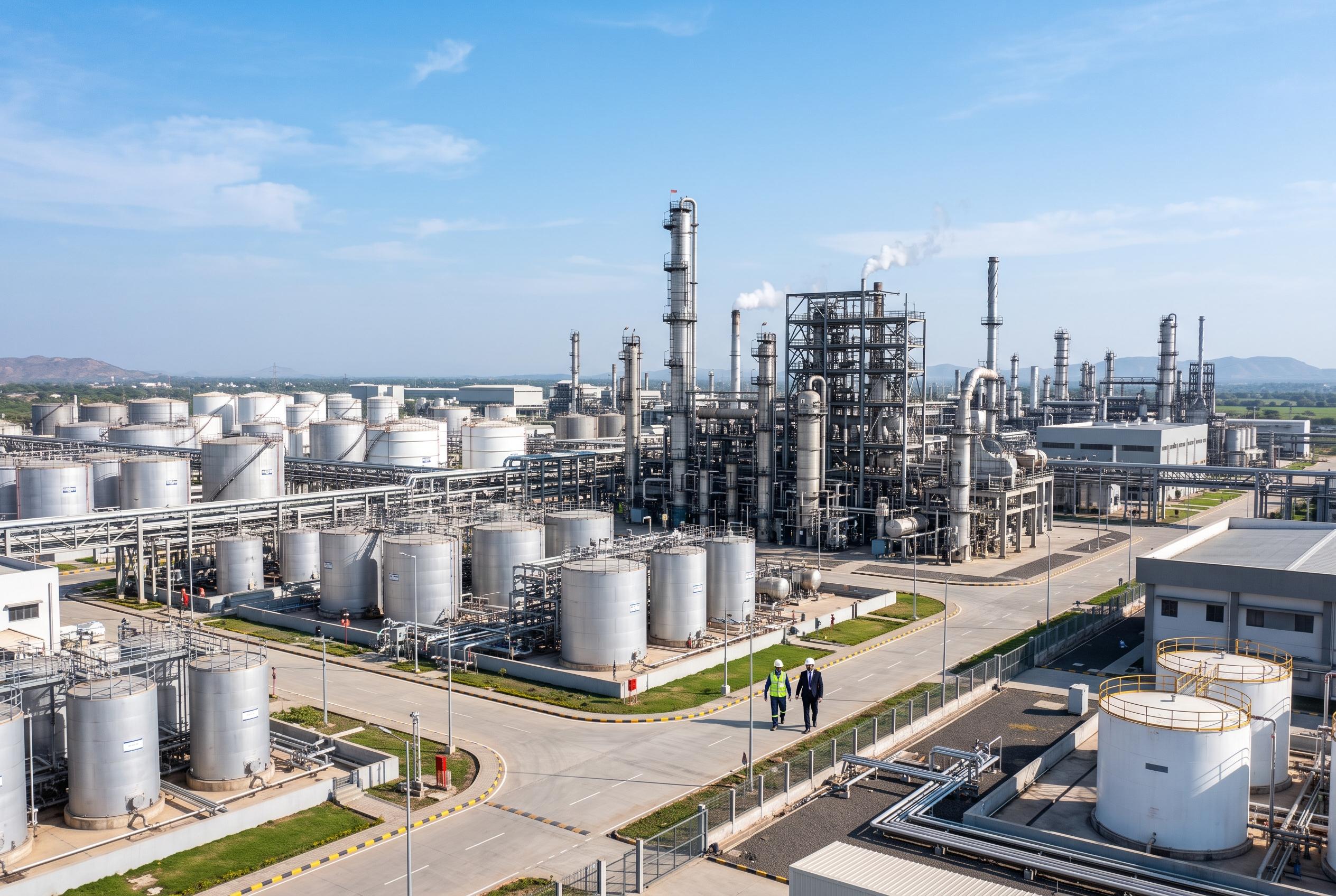

India’s chemicals and petrochemicals industry has experienced rapid expansion over the past decade, driven by policy reforms, infrastructure development, and increased foreign investment, positioning the country as a global manufacturing hub under the Viksit Bharat 2047 and Atmanirbhar Bharat initiatives.
India’s chemicals and petrochemicals sector has expanded sharply over the past 12 years as New Delhi has paired policy reform with industrial infrastructure, investment promotion and skills-building, according to the Department of Chemicals and Petrochemicals. The government says those measures have helped deepen domestic manufacturing, support innovation and prepare the industry for its broader goals under Viksit Bharat 2047 and Atmanirbhar Bharat.
A central part of that effort has been the development of Petroleum, Chemicals and Petrochemicals Investment Regions, or PCPIRs, which are large, designated industrial zones for manufacturing and related activity. The three operational hubs at Dahej in Gujarat, Visakhapatnam-Kakinada in Andhra Pradesh and Paradeep in Odisha have together drawn ₹3.4 lakh crore in investment, generated jobs for nearly 3.7 lakh people and supported more than 2,200 chemical manufacturing units, the government says. Industry descriptions of the PCPIR framework note that such regions are designed to combine production, utilities, logistics and residential infrastructure in a single planned zone.
Foreign investment has also risen. Government figures show the sector attracted ₹1,04,895 crore in foreign direct investment between 2014 and 2026, compared with ₹45,240 crore in the previous decade. That increase points to stronger investor confidence in India’s role as a manufacturing base for chemicals and petrochemicals, particularly as companies look to diversify supply chains and shift towards higher-value production, according to sector analysis from IBEF.
At the same time, officials have pushed harder on quality and compliance. The government has introduced 37 Quality Control Orders covering a range of chemical products, a move intended to raise product standards and limit substandard imports. It has also approved 10 plastic parks, four of which have finished their infrastructure, as part of an effort to build more integrated and competitive plastics manufacturing clusters.
The support system around the sector has widened as well. The Central Institute of Petrochemicals Engineering and Technology has grown to 51 centres, including 19 set up since 2014, and says it has trained nearly 6.72 lakh professionals while carrying out about 8.53 lakh technology support assignments. In pesticides and crop protection, the Institute of Pesticide Formulation Technology has transferred 64 formulation technologies to industry, while the Department of Biotechnology has backed a biofoundry facility with ₹28.69 crore for work on biopesticides and advanced biological formulations.
The latest policy step is BHAVYA Rasayan, a ₹3,030 crore scheme approved by the Union Cabinet to establish three plug-and-play chemical parks. According to the government’s announcement, the programme will provide shared infrastructure such as effluent treatment, solvent recovery, steam systems, pipelines and warehousing, with the aim of cutting set-up time and costs while improving competitiveness. Taken together, the government says the measures are helping position India as a stronger global manufacturing base for chemicals and petrochemicals.
Disclaimer: This article is intended to inform and educate, not to recommend or endorse any financial product, investment or strategy. Please consider your own financial circumstances and seek professional advice where appropriate before making financial decisions.