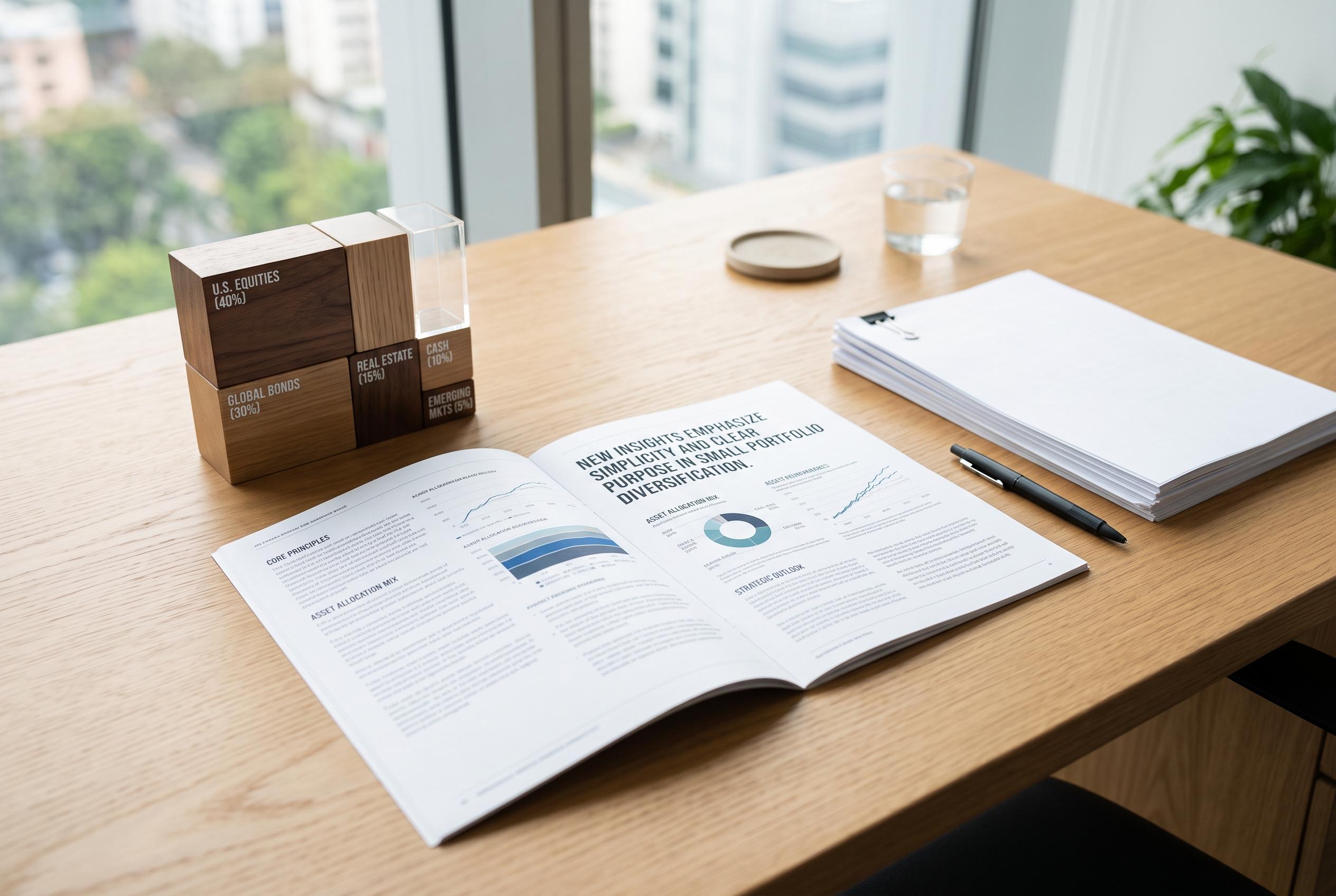

Experts highlight that effective diversification for small portfolios prioritises simplicity, clear asset roles, and understanding over sheer number of holdings, with recent guidance stressing ease of management and disciplined rebalancing.
Diversification is often misunderstood as simply buying more investments, but the real aim is to stop a portfolio from relying too heavily on one company, sector, country or source of return. That matters even more when starting with limited capital, because spreading small sums too thinly can add costs and complexity without meaningfully improving resilience. Fidelity says diversification is designed to reduce risk and smooth returns by spreading money across asset classes and individual holdings, rather than concentrating it in a few positions.
The first step is to separate money you may need soon from money that can stay invested for longer. A cash buffer for emergencies and near-term spending should sit outside the portfolio, while longer-term savings can accept more volatility in pursuit of growth. Fidelity’s guidance also stresses that a sensible asset mix should reflect an investor’s time horizon and comfort with risk, because being forced to sell during a downturn is one of the most common and costly mistakes.
For small portfolios, simplicity usually works better than a long list of holdings. A compact core built around broad index funds or exchange-traded funds can provide instant exposure to many companies or bonds without requiring investors to pick every asset individually. Fidelity notes that a diversified portfolio often includes domestic stocks, international stocks, bonds and cash equivalents, while StockAnalysis.com warns that over-diversification can leave investors with little more than index-like returns and extra management friction.
It is also important to understand what a fund actually holds. A product labelled as global or diversified may still be heavily concentrated in one market or one set of large companies. The article by Urbanitae points out that a fund tracking the S&P 500 is still largely a US large-cap bet, while a World index covers developed markets but not every region. That means investors should look through the label and assess the real exposure before adding another fund that may simply duplicate what they already own.
Individual shares can play a role, especially now that fractional investing makes expensive stocks more accessible. Even so, buying small stakes in several companies does not automatically produce a better-diversified portfolio. Each share still depends on the fortunes of a single business, and those positions can overlap with broad funds if the same large names already dominate the index. For investors who want a simpler structure, Curved Trading suggests using one to three broad ETFs as the core and adding only a few individual names where there is a clear reason to do so.
Other assets can add variety, but only if they serve a purpose. Urbanitae notes that real estate can offer a return profile different from equities and bonds, yet direct property ownership requires substantial capital and leaves investors exposed to one asset in one location. More accessible routes, such as property crowdfunding, can lower the entry point, though the money is typically locked up until the project ends and the risk of delay or loss remains. The same caution applies to gold, commodities and cryptocurrencies: a different behaviour pattern does not guarantee better results.
What matters most in a small portfolio is not how many products it contains but whether each one has a clear job. Regular contributions often matter more than perfect initial allocation, because steady investing builds the portfolio over time and reduces dependence on timing the market. Fidelity and other investing guides both emphasise rebalancing and discipline, since diversification only works properly when the overall mix is kept under review. In that sense, the best small portfolio is usually the one that is easiest to understand, cheapest to maintain and least likely to push the investor into bad decisions.
Disclaimer: This article is intended to inform and educate, not to recommend or endorse any financial product, investment or strategy. Please consider your own financial circumstances and seek professional advice where appropriate before making financial decisions.