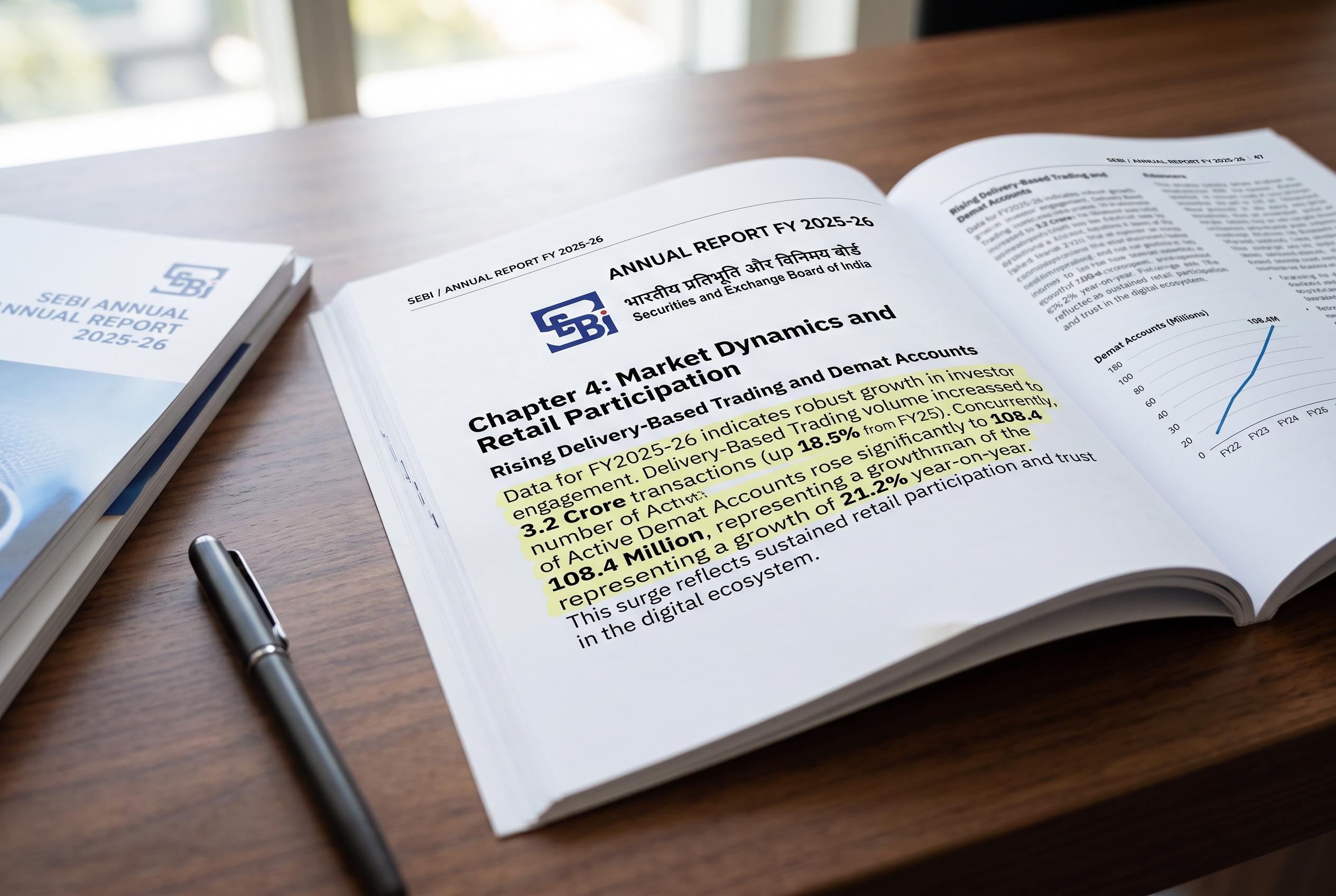

SEBI’s annual report indicates a notable move away from short-term speculation with rising delivery-based trading and increased demat accounts, signalling a focus on ownership and risk management in India’s equity markets.
India’s equity markets appeared to be tilting towards longer-term investing in FY2025-26, with the Securities and Exchange Board of India’s annual report pointing to a rise in delivery-based trading and a broader move away from short-term speculation. The regulator said the delivery-to-traded quantity ratio across National Stock Exchange Clearing and Indian Clearing Corporation rose to 29.3% from 23.6% a year earlier, while the delivery-to-traded value ratio increased to 27.4% from 24.4%, suggesting more investors were buying shares to hold rather than to flip quickly. The report also noted that demat accounts climbed to 22.5 crore as digital onboarding made it easier for more people to enter the market.
That shift came even as overall cash equity turnover fell 6.8% to ₹280 lakh crore, which SEBI linked to valuation concerns and some diversion of retail savings into gold and silver. At the same time, the derivatives market remained active, with combined notional turnover rising 4.3% to ₹1,10,418 lakh crore, though the number of options contracts dropped 51.5%. SEBI said the fall in contract volume mainly reflected larger contract sizes, meaning fewer contracts changed hands even as the value of trades increased.
The annual report fits with SEBI’s broader effort over the past year to cool excess speculation in futures and options trading. Reuters and other market reports have said the regulator introduced higher contract sizes, tighter rules on weekly expiries, mandatory upfront premium collection and a higher securities transaction tax after studies showed many individual traders were losing money. Outlook Money reported that trading activity has since eased in parts of the derivatives market, while Business Standard said SEBI is preparing new risk metrics, including a delta-based approach to open interest, to improve monitoring of trader positioning.
SEBI has argued that the changes are meant to make the derivatives market more orderly and resilient without undermining its role in hedging and price discovery. Business Standard also reported that the regulator has overhauled position-limit rules by tying them more closely to actual market activity, a change aimed at reducing unnecessary bans in index derivatives. The broader picture from the annual report is of a market that is still growing, but with regulators trying to shift activity away from pure speculation and towards ownership, risk management and longer-term participation.
Disclaimer: This article is intended to inform and educate, not to recommend or endorse any financial product, investment or strategy. Please consider your own financial circumstances and seek professional advice where appropriate before making financial decisions.