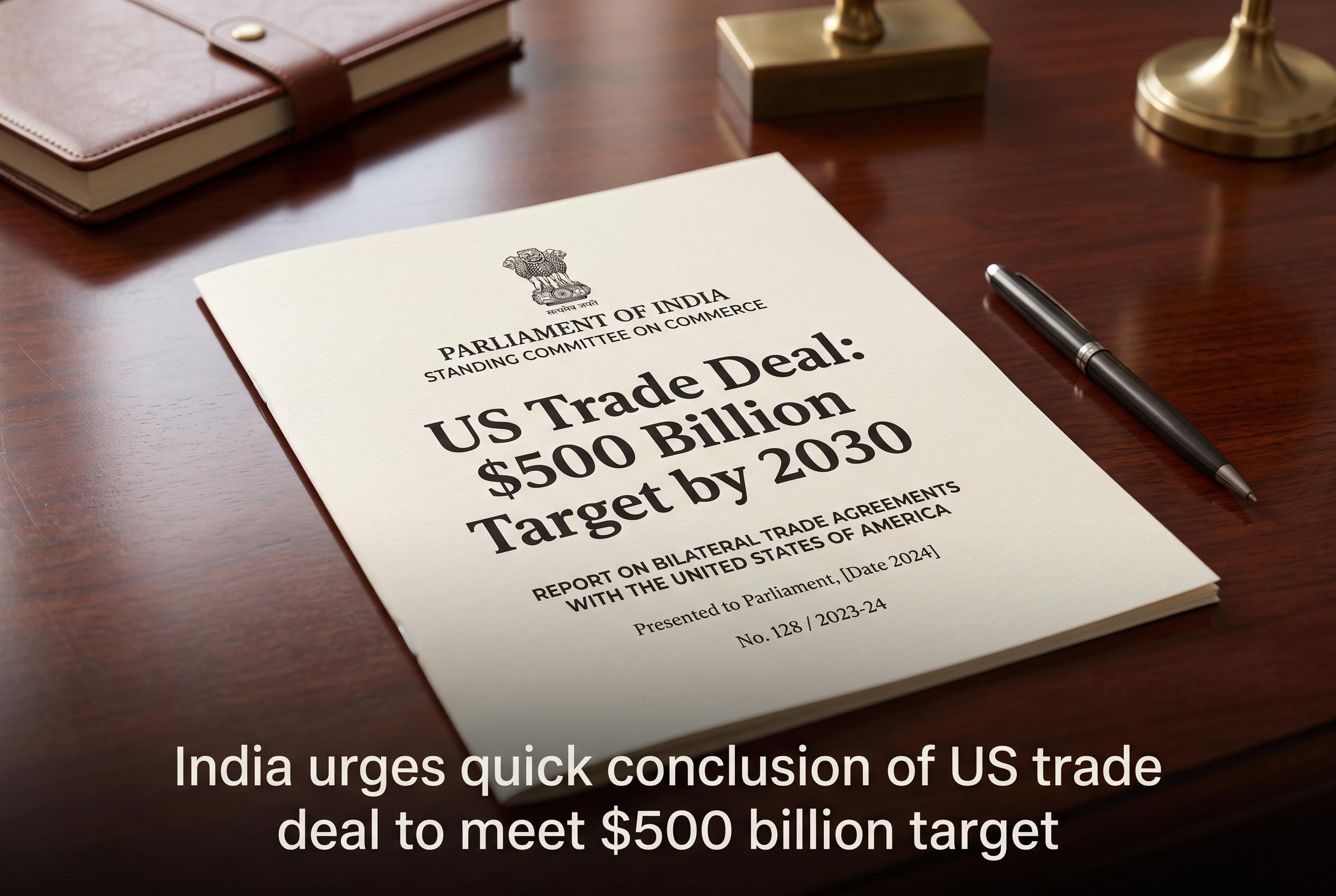

India’s parliamentary committee calls for an expedited US bilateral trade agreement, emphasising the need to safeguard economic priorities and boost sectors to achieve a $500 billion trade goal by 2030.
A parliamentary committee in India has urged the government to move quickly on the proposed India-US Bilateral Trade Agreement, arguing that an early deal could protect domestic interests while helping both sides reach their shared $500 billion trade target by 2030. The Parliamentary Standing Committee on Commerce said the pact should be concluded as soon as possible, but only on terms that safeguard India’s economic priorities.
In its report, the committee said New Delhi should press for tariff relief on key exports, including generic medicines, while also seeking lower duties on engineering goods, auto components and other vehicle-related products. It said higher US tariffs are still weighing on Indian exporters and recommended closer monitoring of both tariff and non-tariff barriers, along with faster support for sectors under pressure.
The panel also called for stronger protection for small and medium-sized businesses that can be hit hardest by sudden trade shifts. It proposed export credit support, financial assistance programmes and a rapid-warning system to alert companies to new US customs requirements. One of its more practical suggestions was a fast-response monitoring desk to track US customs audits in real time and reduce the risk of shipment delays caused by paperwork or regulatory problems.
Beyond goods trade, the committee urged the government to push Indian services more aggressively in areas such as artificial intelligence, digital health and engineering research. It also said India should take advantage of the global shift towards friend-shoring by drawing more of its manufacturers into US supply chains, especially in electronics, semiconductors and clean energy. To help companies meet international standards, the report proposed a national fund for product redesign, prototype development, new tooling and certification costs.
The wider trade goal has been reinforced by recent industry and government commentary. A joint KPMG-AMCHAM report projected bilateral trade could reach $500 billion by 2030, while Indian officials have said the two countries are aiming to finalise a comprehensive agreement within months. US Ambassador Sergio Gor has also pointed to the scale of the opportunity, saying stronger supply chains and fresh investment could flow from a deal. The committee’s message, however, was that speed should not come at the expense of predictability for exporters or policy stability for investors.
Disclaimer: This article is intended to inform and educate, not to recommend or endorse any financial product, investment or strategy. Please consider your own financial circumstances and seek professional advice where appropriate before making financial decisions.