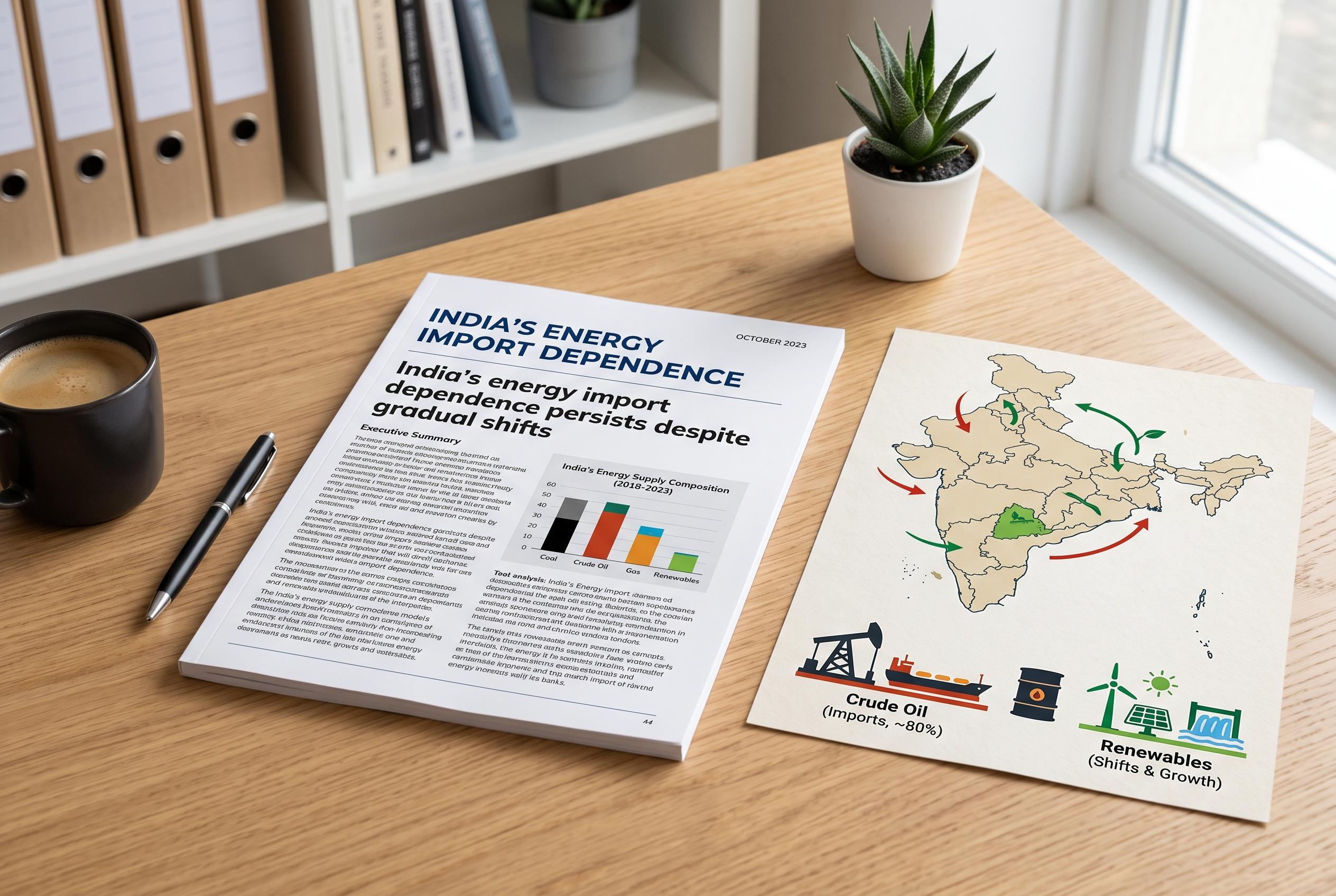

A recent joint study reveals that India’s reliance on imported primary energy remains high, with crude oil still covering about 90% of domestic demand, underscoring persistent energy security challenges amid evolving sources and global shifts.
India’s reliance on imported primary energy has eased only slightly, according to a joint study by the Confederation of Indian Industry and EY, but crude oil still covers about 90% of domestic demand. The report said total dependence on imported primary energy fell to around 42% in FY25 from 47% in FY17, helped mainly by lower coal imports and stronger domestic coal output, even as oil remains the country’s most important energy import.
The study also said natural gas import dependence has climbed to about 50% because demand has risen faster than local production, while coal import reliance has dropped to roughly 18%. That shift shows India’s energy mix is changing, with electricity and renewable power taking a larger role, but the report warned that clean-energy growth alone will not remove the need to tackle structural import exposure across the wider energy system.
India has also widened its crude sourcing since the Russia-Ukraine war, with Eurasia taking a much larger share of imports, according to the report. Even so, the Middle East still supplied about 47% to 49% of India’s crude in FY25, and remained the biggest single source. For liquefied natural gas, the Middle East accounted for 62.9% of imports in FY26, underscoring how concentrated supplies remain.
Other recent reporting points to the same pressure. The Indian Express said oil import dependence climbed above 88% in the April to February period of FY25, while domestic output stayed sluggish. That leaves India exposed to global price swings, wider trade deficits and inflation risks, making the CII-EY message clear: energy security will depend on a mix of cleaner power, higher domestic production, better efficiency and broader fuel diversification as the country works towards its Viksit Bharat 2047 goals.
Disclaimer: This article is intended to inform and educate, not to recommend or endorse any financial product, investment or strategy. Please consider your own financial circumstances and seek professional advice where appropriate before making financial decisions.