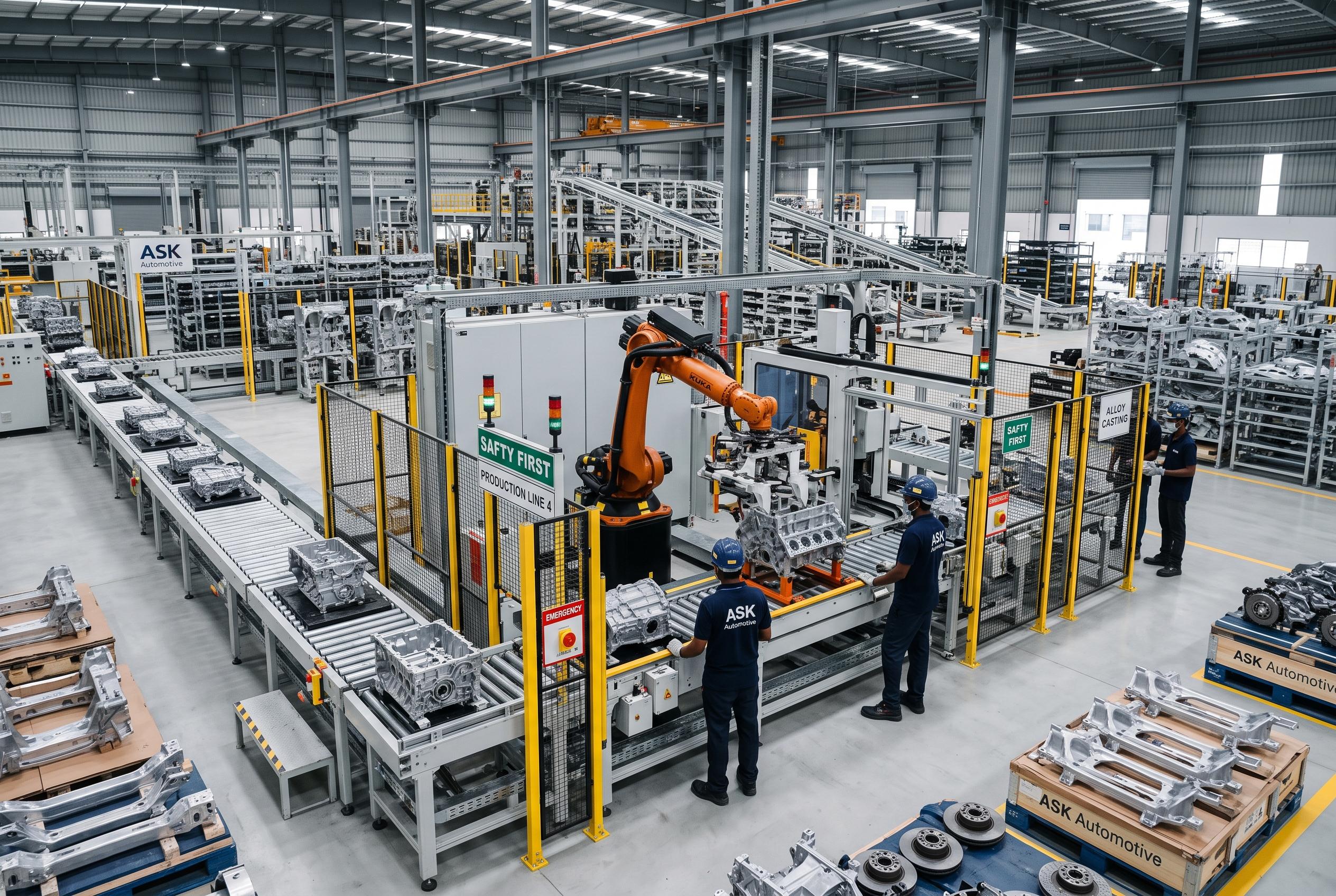

ASK Automotive sustains an 11th consecutive quarter of record-high revenue, driven by robust demand for advanced safety and lightweight systems, as the company announces significant expansion and strategic partnerships despite alloy price volatility.
ASK Automotive said its latest quarter marked the 11th straight period of strong results, with consolidated revenue, EBITDA and profit after tax all reaching record highs. Revenue rose 25.3% from a year earlier, helped by gains across its main businesses, while the company said it continued to grow faster than the two-wheeler market.
The strongest momentum came from advanced braking systems, which grew 48%, followed by aluminium lightweight precision solutions, up 75%, and safety control cables, which rose 20%. According to reporting by GuruFocus and LiveMint, management also said the company’s technical tie-up with Kyushu Yanagawa in Japan has moved into commercial supply, with the first high-pressure die-cast alloy wheels now going to a Japanese customer.
That business is becoming more important. Kuldip Rathee, ASK Automotive’s chairman and managing director, said confirmed alloy wheel orders are expected to total about ₹70 crore to ₹90 crore in FY27 and rise to roughly ₹250 crore in FY28. He also said exports to Ford Motors should come in at around ₹40 crore to ₹45 crore this year before increasing to about ₹60 crore next year.
The company is also stepping up capital spending. Rathee said FY27 capital expenditure has been lifted to about ₹700 crore from an earlier range of ₹450 crore to ₹500 crore, driven by fresh orders and the need for a new plant in south India, which the company wants operating before March 2027. Naresh Kumar, the chief financial officer, said internal cash generation should cover growth needs, though some term borrowing may be used for working capital management.
At the same time, ASK Automotive is dealing with margin pressure from sharp alloy price swings. The company said higher metal costs created a denominator effect that reduced reported EBITDA margin to 12%, even though the business remains fully hedged and passes those costs through to customers. Kumar said a 15% margin is not realistic for the industry, while Rathee suggested a more normal range is 13.5% to 14%.
Management also sounded more upbeat on the year ahead. It raised full-year growth guidance to the high teens, citing tax cuts, improved consumer sentiment and better rural demand after the impact of El Niño has faded. The company said its 9.9 MW solar plant is already running and an 11.55 MW project should be commissioned in the second quarter of FY27, while the Aisin joint venture is still loss-making but expected to move into modest profitability by the end of the fiscal year.
Disclaimer: This article is intended to inform and educate, not to recommend or endorse any financial product, investment or strategy. Please consider your own financial circumstances and seek professional advice where appropriate before making financial decisions.