
A probe reveals that most private companies receiving early loans from India’s Rs 1 lakh crore deep-tech fund have ties to committee members, prompting calls for greater transparency in government-backed innovation schemes.
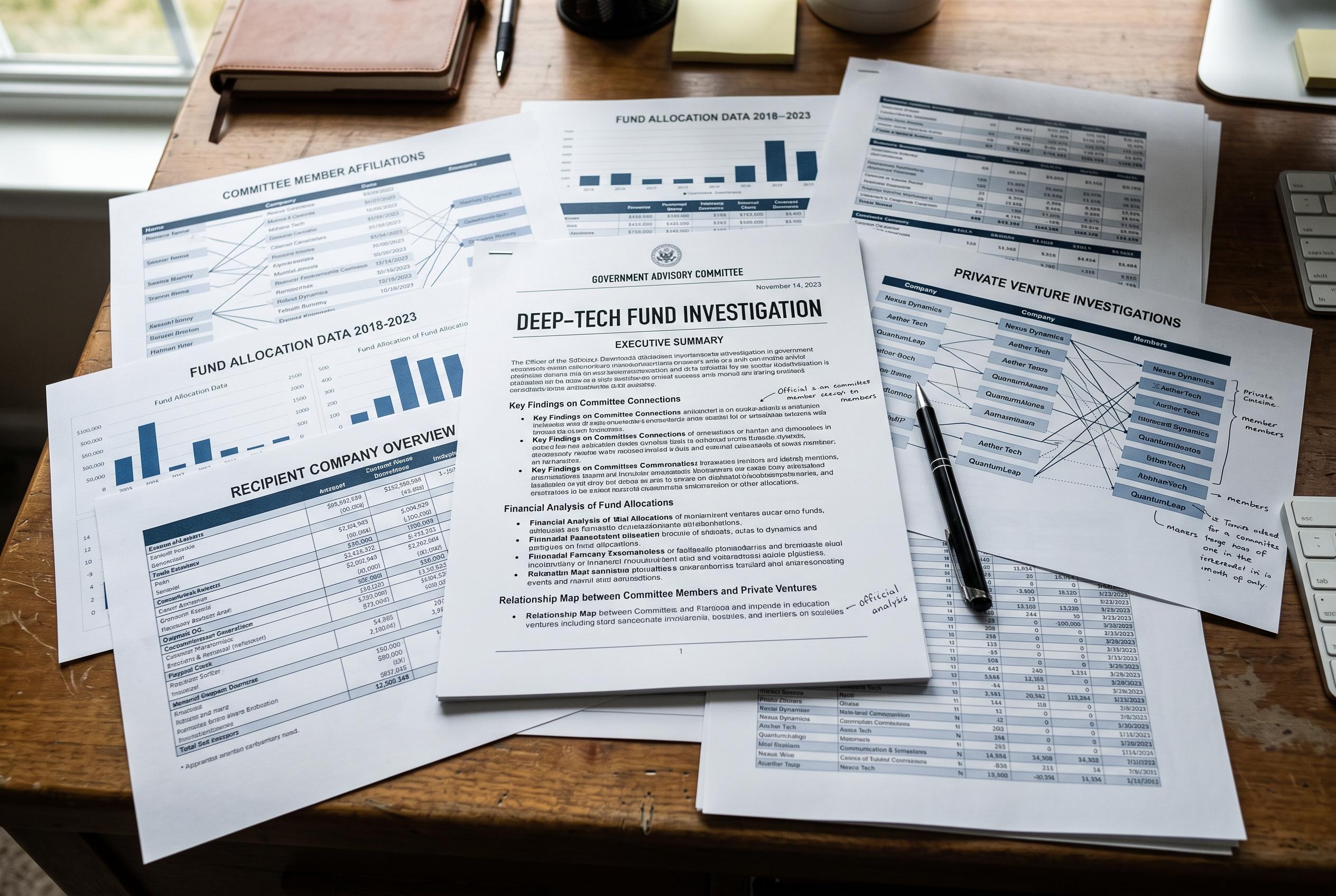
An investigation by The Indian Express has found that 15 of the 22 private companies that won early soft loans from India’s new deep-tech fund had investment links to seven members of the selection committee, raising fresh questions about how public money is being allocated in one of the government’s most closely watched innovation schemes.
The Research, Development and Innovation Fund, set up with a corpus of Rs 1 lakh crore, was announced to back private firms working on advanced research in areas the government sees as strategically important, including artificial intelligence, quantum technology, space science, defence, robotics, clean energy, semiconductors and digital health. The fund is meant to offer long-term, low-cost, collateral-free loans to companies whose technologies have already moved beyond the basic research stage.
Administratively, the money sits under the Anusandhan National Research Foundation, a statutory body created to strengthen research and innovation and improve links between industry and academia. A special purpose fund under the foundation holds the corpus, while the actual lending is routed through second-level fund managers. So far, the Technology Development Board and the Biotechnology Industry Research Assistance Council have been chosen for that role, with more, including private-sector entities, expected to follow.
The companies themselves are chosen through investment committees set up separately by each fund manager. In theory, the fund managers make the final call after background checks and other assessments, but in practice a company rejected by the committee does not proceed. The Technology Development Board’s committee has 11 private-sector members and one non-voting government secretary, while BIRAC’s selection process is still under way.
Eligible companies can borrow up to 50% of project cost, with loans offered at roughly 2% to 4% interest for a 15-year term and without collateral. Only technologies at technology readiness level 4, meaning they have been validated in laboratory conditions, can apply. In the first round, the Technology Development Board received 124 applications, reviewed 51, and approved 22 projects worth Rs 2,192 crore. The remaining 73 applications are still being examined, and a second round is expected to be finalised this month.
The overlap between committee members’ investment interests and approved companies is likely to intensify scrutiny of the fund’s governance. One suggested safeguard is to bring in scientists and academics from institutions such as the Indian Institutes of Technology and the Indian Institute of Science, then use outside experts to determine valuations and the size of each loan. Another would be mandatory public disclosure by committee members, a step that could help show whether the country’s newest deep-tech push is being guided by commercial merit or by entrenched networks.
Disclaimer: This article is intended to inform and educate, not to recommend or endorse any financial product, investment or strategy. Please consider your own financial circumstances and seek professional advice where appropriate before making financial decisions.