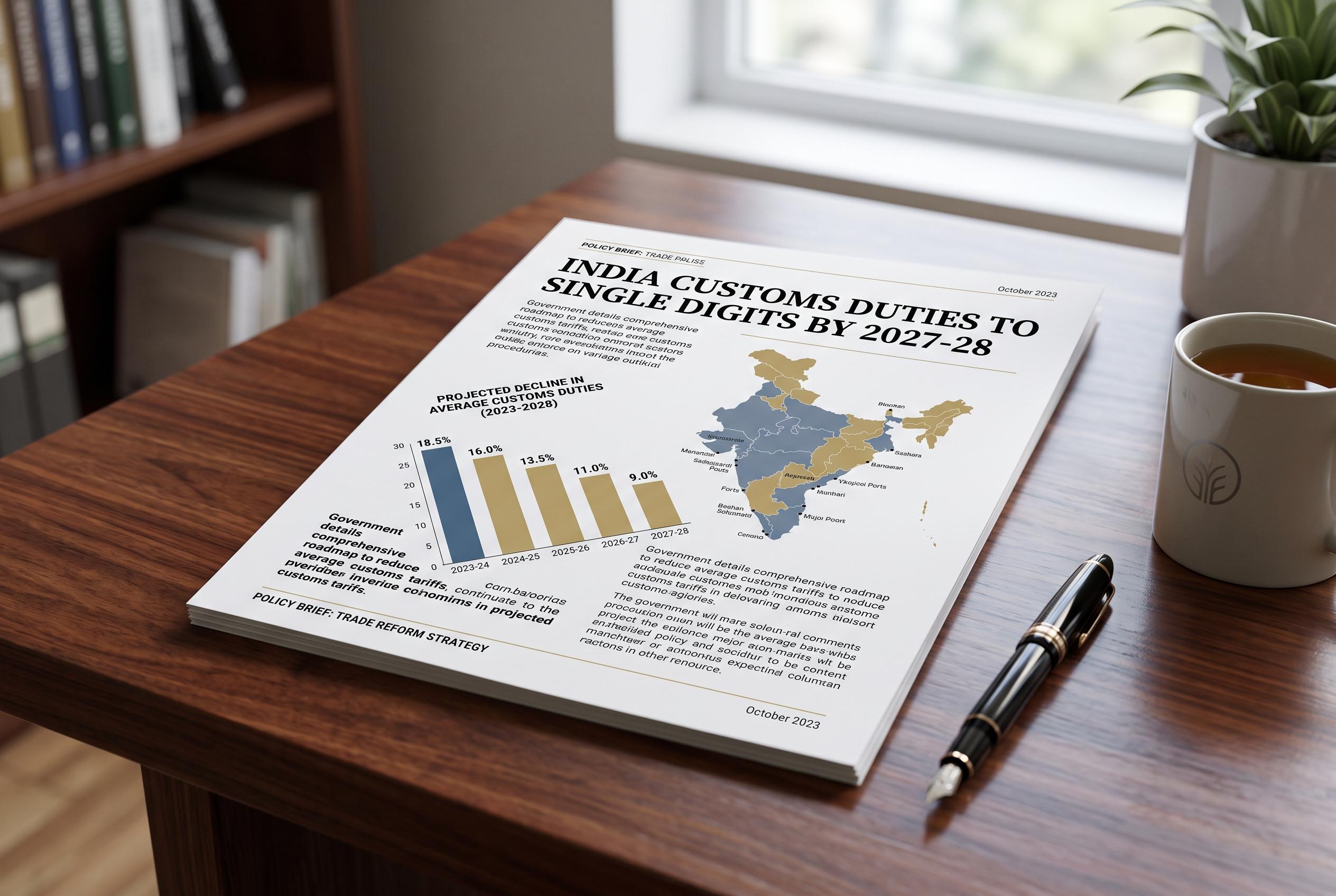

Finance Minister Nirmala Sitharaman announces plans to lower customs duties on most goods to single digits by 2027-28, as part of ongoing efforts to simplify India’s tax system and boost manufacturing linkages with fiscal discipline.
Finance Minister Nirmala Sitharaman said on Thursday the government is aiming to bring customs duties on most goods down to single digits by the 2027-28 Budget, extending a wider push to simplify India’s tax structure and support manufacturing.
Speaking at the National Council of Applied Economic Research’s India Policy Forum in New Delhi, Sitharaman said that, apart from a handful of items, customs duties had already been rationalised. The government has steadily pared back tariff slabs in recent Budgets, reducing the number to eight, including a zero-duty band, and removing seven tariff rates in both the 2024-25 and 2025-26 Budgets.
According to Business Standard, the latest changes have helped lower India’s average customs duty rate to 10.66% from 11.65%, based on government estimates. The move follows earlier tax reforms in corporate tax, income tax and the Goods and Services Tax over the past six years, as the government continues its effort to reduce complexity in the indirect tax system.
Sitharaman also linked the tariff clean-up to broader concerns about growth and public debt, arguing that borrowing should be used to create assets rather than fund consumption. She said the Centre had significantly increased capital spending after the Covid-19 pandemic to generate a multiplier effect in the economy and said that had helped draw in private investment as well.
She also urged state governments to follow the same principle, borrowing for asset creation while ensuring revenue grows enough to keep debt manageable. Sitharaman said some states had approached the Centre for help restructuring debt and cutting interest costs, and added that the finance ministry was working with them. The IMF has estimated India’s general government debt at 83.4% in 2026, underscoring the scale of the fiscal challenge.
Disclaimer: This article is intended to inform and educate, not to recommend or endorse any financial product, investment or strategy. Please consider your own financial circumstances and seek professional advice where appropriate before making financial decisions.