

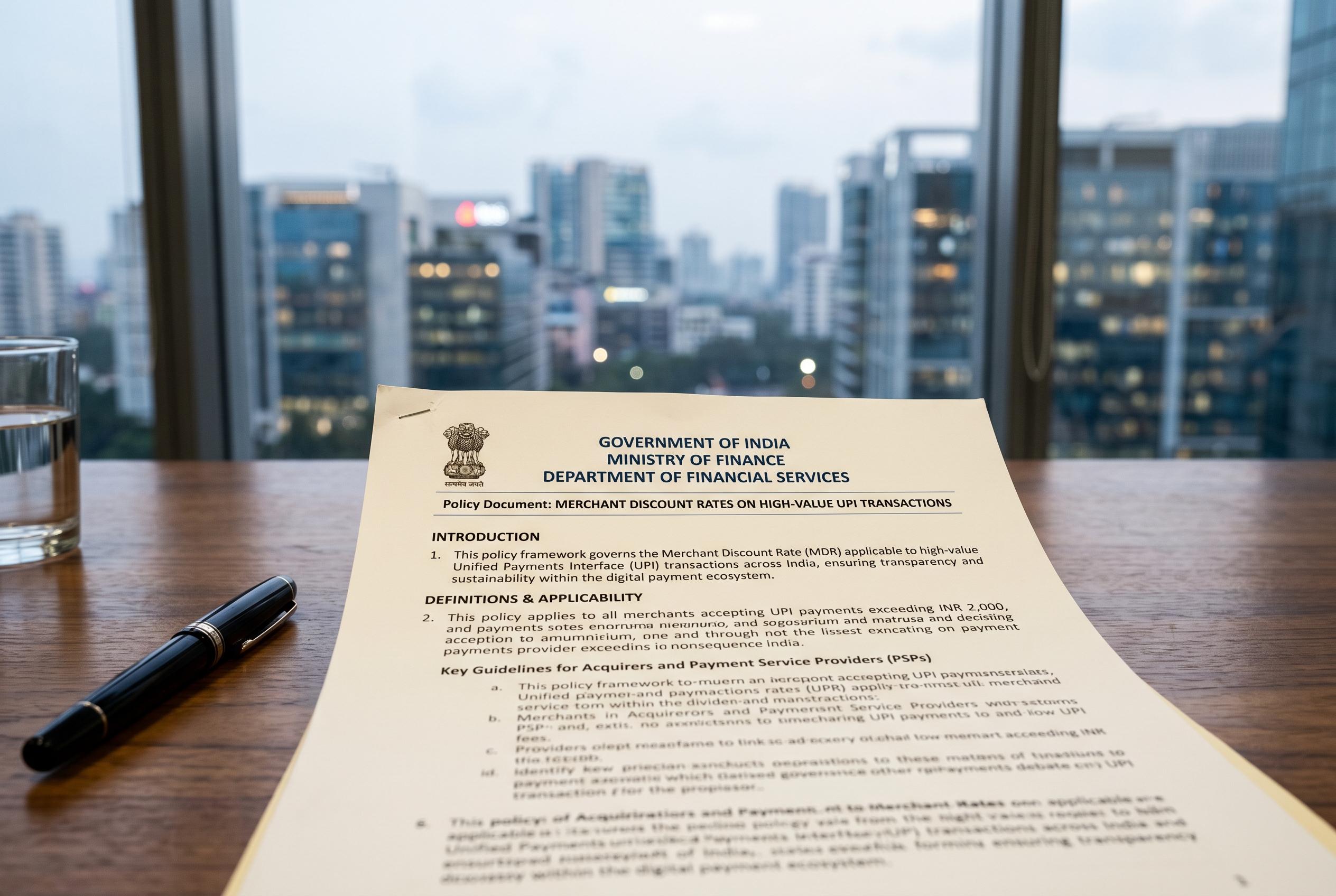

The Indian government’s move to potentially reintroduce merchant discount rates on certain high-value UPI payments faces criticism from industry stakeholders, who fear increased costs for small businesses and disruption to digital payment growth.
A possible move by India to reintroduce merchant discount rates on some Unified Payments Interface transactions has drawn sharp criticism from business group ASSOCHAM, which says the change could raise costs for small firms and slow the country’s shift towards digital payments. Saurabh Sanyal, the group’s secretary general, told ANI at ASSOCHAM’s fintech festival in New Delhi that any fee on UPI transfers above ₹2,000 would be a burden for micro, small and medium-sized enterprises, which rely heavily on low-cost digital transactions. At the same time, the finance ministry has denied separate claims that goods and services tax would be imposed on UPI payments above that threshold, saying such reports were false and misleading.
The debate centres on whether the government should allow MDR, a charge paid by merchants to banks or payment firms for processing digital transactions, on certain high-value UPI payments made to businesses. Media reports have said the levy could apply only to larger merchants, with small businesses and peer-to-peer transfers left out, and that the rate under discussion could fall between 0.25% and 0.5%. Business Standard and other publications have reported that the aim would be to help banks and payment providers absorb rising technology and operating costs after years of zero MDR on UPI.
Sanyal argued that any extra cost would hit smaller firms hardest because they process large volumes of digital payments and have less room to absorb fees. He said such charges should remain off-limits for MSMEs, though larger companies handling much bigger transactions could cope with them. He also said digital payments should stay affordable if India wants to keep expanding its cashless economy.
India’s UPI system has become one of the world’s largest real-time payment networks, with ASSOCHAM citing about 22 billion digital transactions a month. The government has long promoted the platform through incentive schemes, and industry observers say the policy question now is how to balance that push with the cost of maintaining the underlying infrastructure. For fintech firms and policymakers gathered in New Delhi, the issue is no longer whether digital payments will keep growing, but who should pay for the next stage of that growth.
Disclaimer: This article is intended to inform and educate, not to recommend or endorse any financial product, investment or strategy. Please consider your own financial circumstances and seek professional advice where appropriate before making financial decisions.



