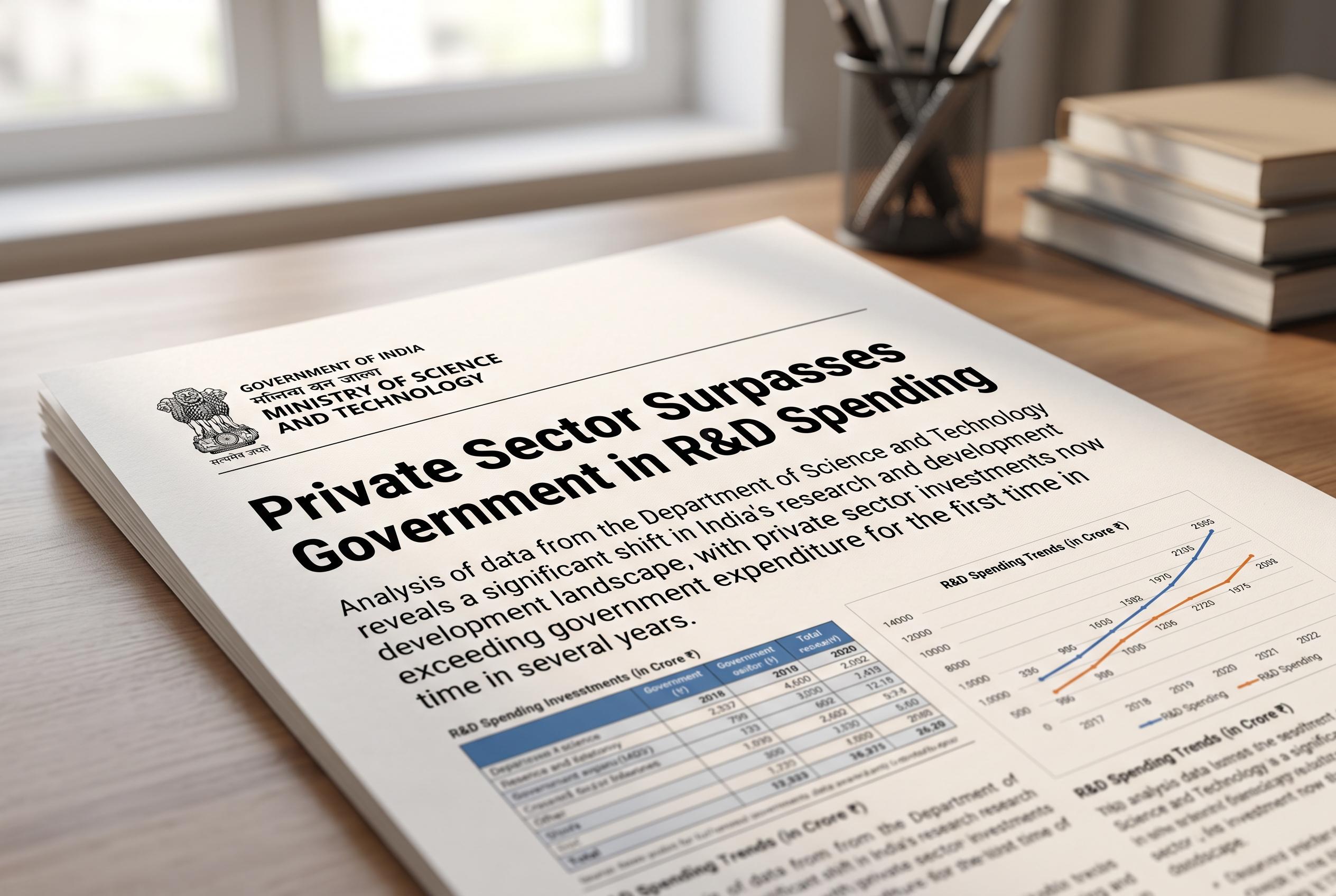

For the first time, private industry in India accounts for over half of national R&D expenditure, reflecting a major shift in the country’s scientific investment priorities amid concerns over overall spending and research capacity.
India’s research and development landscape has crossed an important threshold, with private industry accounting for 51.8% of total R&D spending in 2023-24, according to the Department of Science and Technology. For the first time, businesses contributed more than the combined spending of the Centre, states and public institutions, marking a clear shift in who is driving scientific investment in the country. The change matters because R&D is not only a measure of innovation, but also a signal of where future industrial strength may come from.
The growth of corporate spending suggests that Indian industry is taking a larger role in building new technologies, products and manufacturing capacity. Government data released in December 2025 showed that gross expenditure on research and development had more than doubled over a decade, rising from ₹60,196.75 crore in 2010-11 to ₹1,27,380.96 crore in 2020-21, with the private sector then accounting for 36.4% of that total. The latest figures point to a further expansion in industry’s role, with transport emerging as the biggest corporate spender on R&D, followed by pharmaceuticals, biotechnology and information technology.
That said, the headline rise in private spending should be read with caution. Some of the increase between 2020-21 and 2021-22 may reflect better reporting rather than a sudden surge in genuine research activity, as mandatory sustainability disclosures and tighter Reserve Bank of India reporting norms brought more spending into official records. A part of the total also appears to include overseas subsidiaries and captive research centres of multinational companies, which can inflate domestic comparisons without necessarily deepening India’s own research base.
The larger concern is that India still spends too little overall on research relative to other major economies. The Department of Science and Technology’s data place national R&D spending at 0.84% of GDP, well below China, the United States and South Korea. The country also has just 354 researchers per million people, far behind research-intensive peers. Economic Times reported last year that private sector participation in India remained far lower than in China and the US, where companies contribute the bulk of gross R&D spending.
Business Standard has also reported that many Indian companies continue to spend more on advertising than on research, underlining how limited innovation remains as a corporate priority. Even where firms are investing, much of the money goes into salaries, maintenance and other recurring costs rather than high-risk discovery work. New areas such as artificial intelligence, chip design and semiconductor manufacturing are still heavily weighted towards infrastructure build-out, which may strengthen capacity but does not always translate into original research.
Policy support will matter if this new private-sector momentum is to become durable. The Anusandhan National Research Foundation, with its proposed ₹50,000-crore corpus, could help expand the country’s scientific base if it is implemented effectively. The priority now is to convert higher spending into a larger pool of skilled researchers, stronger universities and labs, and more advanced manufacturing. India’s challenge is not simply to spend more, but to spend better.
Disclaimer: This article is intended to inform and educate, not to recommend or endorse any financial product, investment or strategy. Please consider your own financial circumstances and seek professional advice where appropriate before making financial decisions.