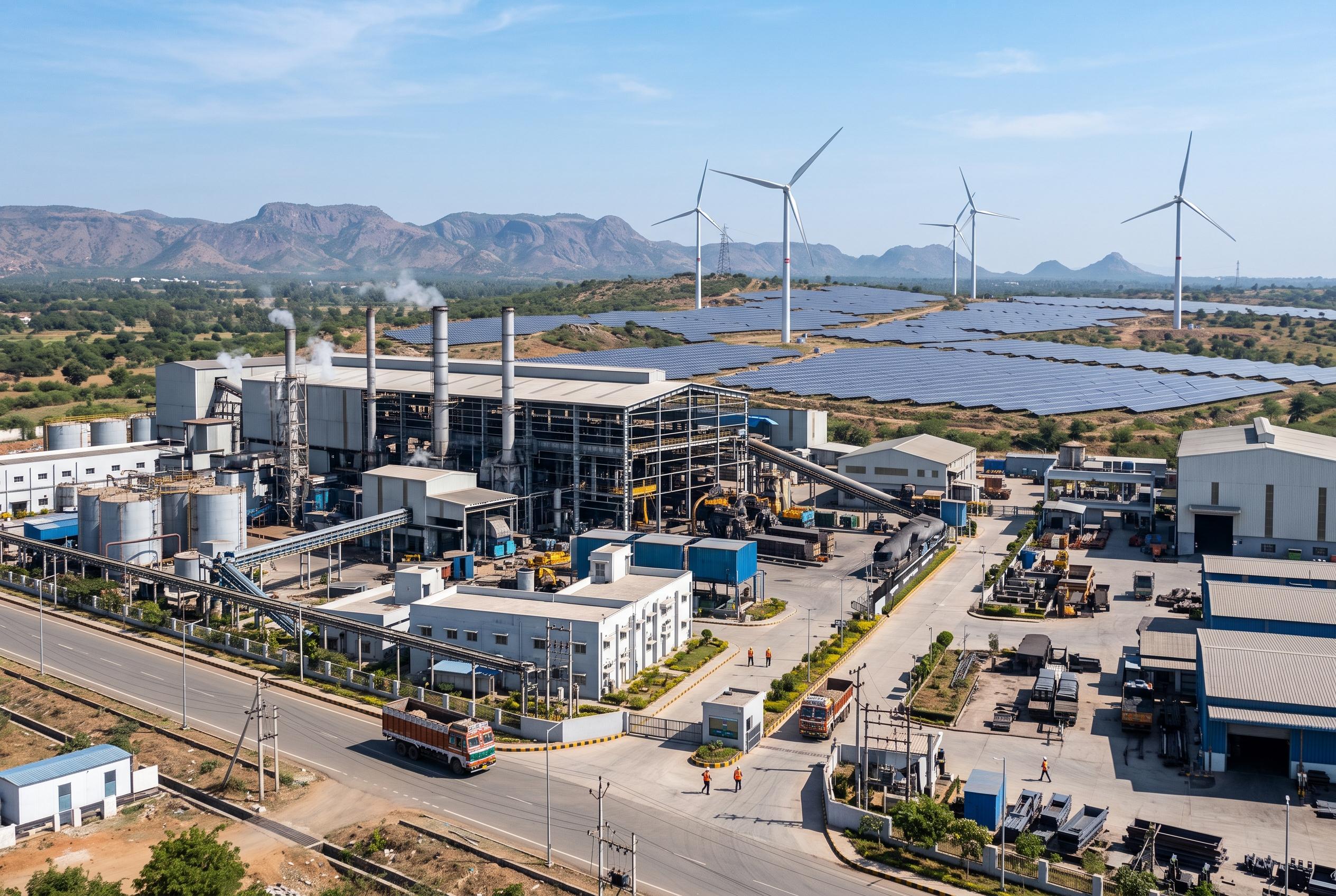

India’s energy security strategy now hinges on boosting manufacturing in heavy industries and renewables, as Union Minister H.D. Kumaraswamy urges a shift from reliance on imports to domestic production to meet long-term climate and economic goals by 2047.
India’s energy security will depend as much on factories as on fuel, Union Steel and Heavy Industries Minister H.D. Kumaraswamy said in New Delhi, arguing that the country must build deeper manufacturing strength if it wants to lead the clean energy transition. Speaking at the 7th CII International Energy Conference & Exhibition, he said recent geopolitical tensions, supply chain shocks and competition for critical minerals have made industrial capability a matter of national security as well as economic policy.
Kumaraswamy said India should aim to be more than a large buyer of clean energy equipment and should instead become a major producer of the systems, materials and technologies behind the shift to low-carbon power. He pointed to the role of steel and heavy industry in renewable energy infrastructure, batteries, electric vehicles, power equipment and green hydrogen, all of which will require a strong domestic industrial base. The minister also said India is targeting 300 million tonnes of steelmaking capacity by 2030 while pushing greener production methods and wider use of green steel technologies.
The government is backing that ambition with a set of manufacturing and localisation schemes, according to the ministry. These include the ₹10,900 crore PM E-DRIVE scheme, the ₹18,100 crore production-linked incentive programme for advanced chemistry cell batteries and the ₹7,280 crore scheme to promote manufacturing of sintered rare earth permanent magnets. Officials say the measures are designed to cut import dependence and strengthen supply chains for sectors seen as essential to the clean energy economy. Kumaraswamy also urged closer cooperation between government, industry, universities and research bodies, saying resilient supply chains require a broader ecosystem that creates jobs and value at home.
His remarks fit into the wider policy push behind Viksit Bharat 2047, the government’s long-term vision for India as a developed economy by the centenary of independence. A NITI Aayog study cited by the India Brand Equity Foundation says India can reach developed-economy status by 2047 while still meeting a net zero target by 2070, with gains from electrification, higher non-fossil fuel use, energy efficiency and a circular economy. Other policy and industry analyses have similarly argued that manufacturing reform, productivity gains and cleaner industrial systems will be central to that goal.
Disclaimer: This article is intended to inform and educate, not to recommend or endorse any financial product, investment or strategy. Please consider your own financial circumstances and seek professional advice where appropriate before making financial decisions.