

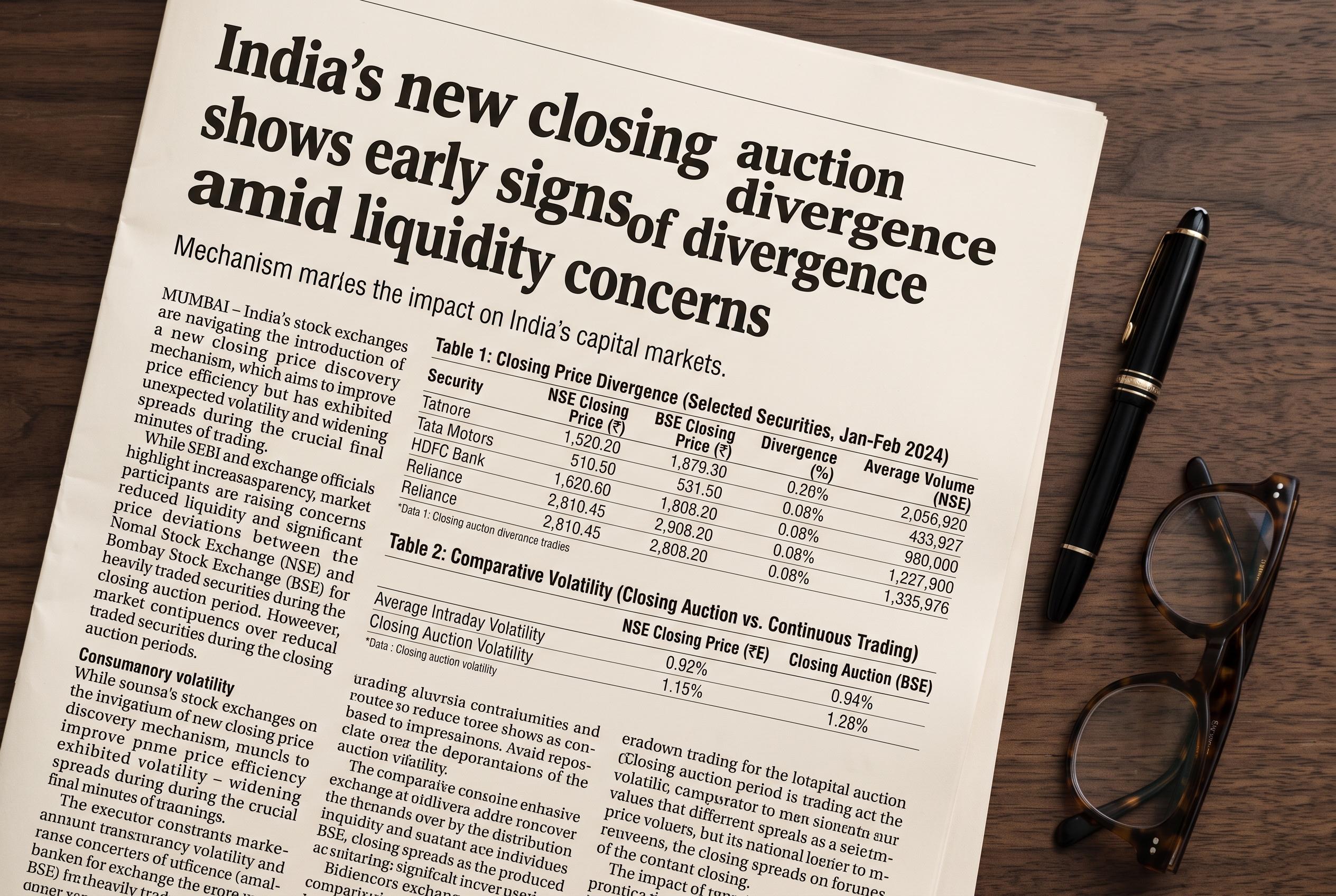

India’s newly introduced closing auction mechanism aims to improve stock price reliability but faces challenges as initial signs indicate potential volatility and divergence between leading exchanges, highlighting the need for broader participation and more liquidity.
India’s new closing auction session was meant to make the final price of stocks more reliable, especially for shares actively traded in futures and options. Introduced by the market regulator and rolled out from August 3, the mechanism replaces the older volume-weighted average price method for eligible stocks with a 20-minute auction window between 3:15 pm and 3:35 pm, after the cash market closes. The idea is straightforward: instead of relying on late-day trading patterns that could be distorted by a few aggressive trades, the exchange now matches buy and sell interest to arrive at a single closing price.
That objective is sensible, and it addresses a long-standing weakness in end-of-day price discovery. The old system, based on the final 30 minutes of trading, was vulnerable to manipulation because even a small trade near the close could nudge the official price. The closing auction was designed to reduce that risk and bring India closer to global market practice, while also helping passive funds and other institutional investors that depend on accurate benchmark prices.
Yet, as the Business Standard editorial notes, the early signs are mixed. The new process has already produced noticeable gaps between the closing values of frontline stocks on the National Stock Exchange and the Bombay Stock Exchange, with the Nifty 50 and the Sensex ending at visibly different levels on some days. That kind of divergence suggests the system may still be too thinly supported to deliver clean and stable price discovery across venues.
For the auction to work as intended, it will need broad and regular participation from domestic mutual funds, insurers, pension funds, family offices, sovereign wealth funds, foreign investors, high-net-worth individuals, arbitrageurs and market makers. Without enough liquidity, a closing auction can amplify rather than smooth out price differences. The system may yet settle as more participants adapt, but for now it deserves close review rather than a premature victory lap.
Disclaimer: This article is intended to inform and educate, not to recommend or endorse any financial product, investment or strategy. Please consider your own financial circumstances and seek professional advice where appropriate before making financial decisions.



