

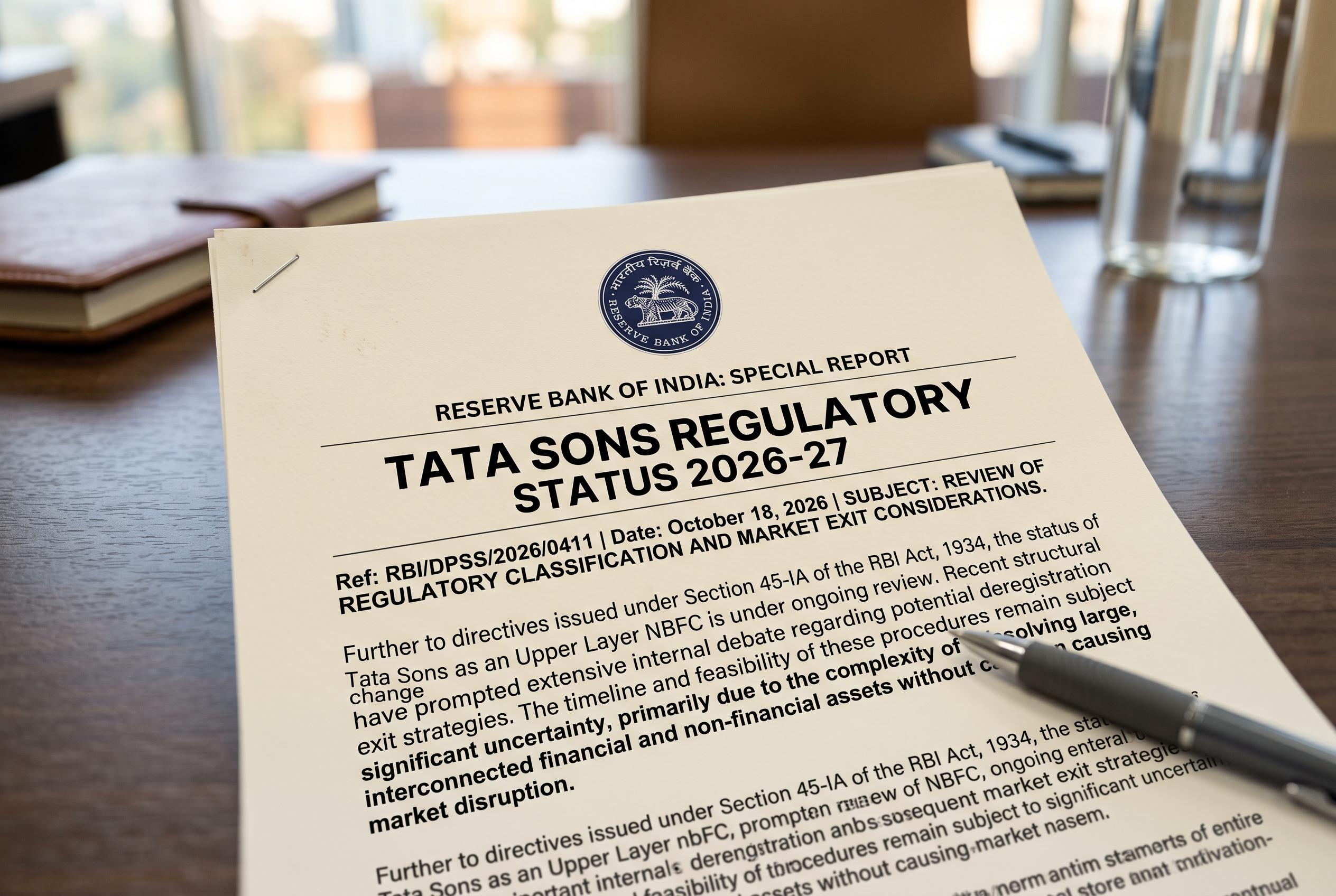

The Reserve Bank of India retains Tata Sons in the upper non-banking financial company layer for 2026-27, leaving the future of its market exit uncertain while the company seeks deregistration amid regulatory changes.
The Reserve Bank of India has once again kept Tata Sons at the centre of a long-running regulatory debate, after retaining the company in the upper layer of its non-banking financial company list for 2026-27 while noting that the placement is without prejudice to its pending de-registration plea. The move leaves open the question of whether the Tata Group holding company must eventually come to market or whether it can win relief and stay outside the stock exchange route altogether.
According to previous reporting by Business Standard and The New Indian Express, Tata Sons has been trying to exit the NBFC framework for some time, arguing that it functions chiefly as the group’s investment and philanthropic holding vehicle rather than as a finance company in the usual sense. The company has also been working to tidy up its balance sheet, with The New Indian Express reporting that it cleared debt of more than ₹22,000 crore by March 2024 before seeking RBI approval to deregister as a core investment company in August 2024.
The RBI’s newer scale-based regime has sharpened the stakes. Business Standard reported in April that experts expected Tata Sons to remain in the upper layer under the revised framework, which uses an asset-size threshold of ₹1 trillion in place of the earlier composite scoring system. Tata Sons’ assets are understood to be well above that level, which is why analysts say the company remains vulnerable to the enhanced compliance regime that can include listing-related obligations.
Legal specialists quoted in The Hindu BusinessLine said the regulator’s decision on de-registration will be decisive. Nazneen Ichhaporia of ANB Legal said the application predates the new norms and could still offer the strongest route for Tata Sons, while Sonam Chandwani of KS Legal & Associates said the listing question flows from the company’s regulatory classification, not the other way round. Chandwani also warned that if the RBI leaves Tata Sons in the upper layer but grants an exemption from a core requirement, it would need a clear legal justification to avoid accusations of uneven treatment.
For now, the RBI has not removed Tata Sons from the upper-layer list, and that alone keeps the possibility of a public listing in play. LiveMint reported earlier this year that the classification could carry a stock-market deadline unless the company secures an exemption or succeeds in its deregistration bid, while another report in June said the new threshold may leave little room for manoeuvre. The broader issue now is whether the RBI’s handling of Tata Sons becomes a one-off exception or a precedent for how far the central bank can bend a rules-based framework in individual cases.
Disclaimer: This article is intended to inform and educate, not to recommend or endorse any financial product, investment or strategy. Please consider your own financial circumstances and seek professional advice where appropriate before making financial decisions.



