

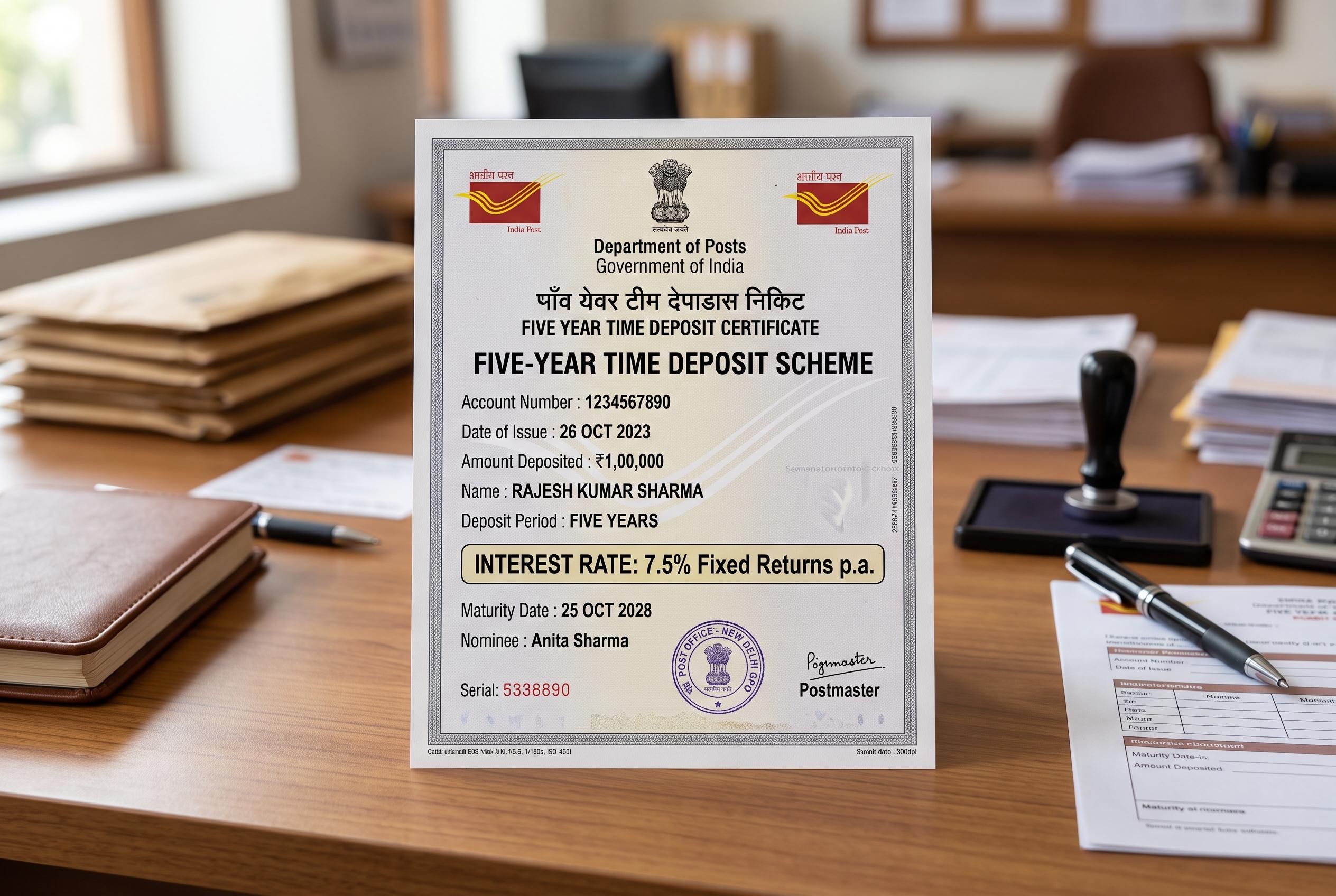

India Post’s government-backed five-year time deposit scheme promises predictable returns at 7.5%, providing an accessible, low-risk savings option in a fluctuating interest rate environment.
India Post’s time deposit scheme is being pitched as a low-risk way to turn a single lump sum into a sizeable interest payout over five years, with some promotions claiming investors can earn more than ₹5 lakh in interest alone. The appeal is straightforward: the scheme is backed by the government, offers fixed tenures and is available through the postal network, which makes it accessible to a wide range of savers. India Post says the product can be opened with a minimum deposit of ₹1,000 and held for periods of 1, 2, 3 or 5 years.
The five-year version carries the highest return, with the interest rate currently set at 7.5%, according to India Post and recent financial services coverage of the April-June 2026 quarter. Upstox reported that the government left post office time deposit rates unchanged for that period, keeping the top rate at 7.5% and leaving the scheme competitive with fixed deposits offered by major private banks. Policybazaar also notes that shorter tenures pay less, with the rate rising as the lock-in period gets longer.
The scheme’s structure is simple: savers deposit money once and receive interest at maturity, with the option of single or joint accounts. India Post says the deposit can be held for the chosen term without needing regular top-ups, which distinguishes it from recurring savings products. Fincash and ClearTax both list the time deposit alongside other post office savings options such as recurring deposits, monthly income schemes, the Public Provident Fund and the Senior Citizen Savings Scheme, all of which are designed for people looking for government-backed savings rather than market-linked returns.
For investors, the main attraction is certainty rather than high growth. The time deposit is not designed to beat equity markets, but it does offer predictable returns, sovereign backing and a relatively low entry point. That combination has helped it remain a popular option for households seeking capital preservation, especially at a time when rates across some bank deposits have softened and savers are still looking for dependable fixed-income products.
Disclaimer: This article is intended to inform and educate, not to recommend or endorse any financial product, investment or strategy. Please consider your own financial circumstances and seek professional advice where appropriate before making financial decisions.



