

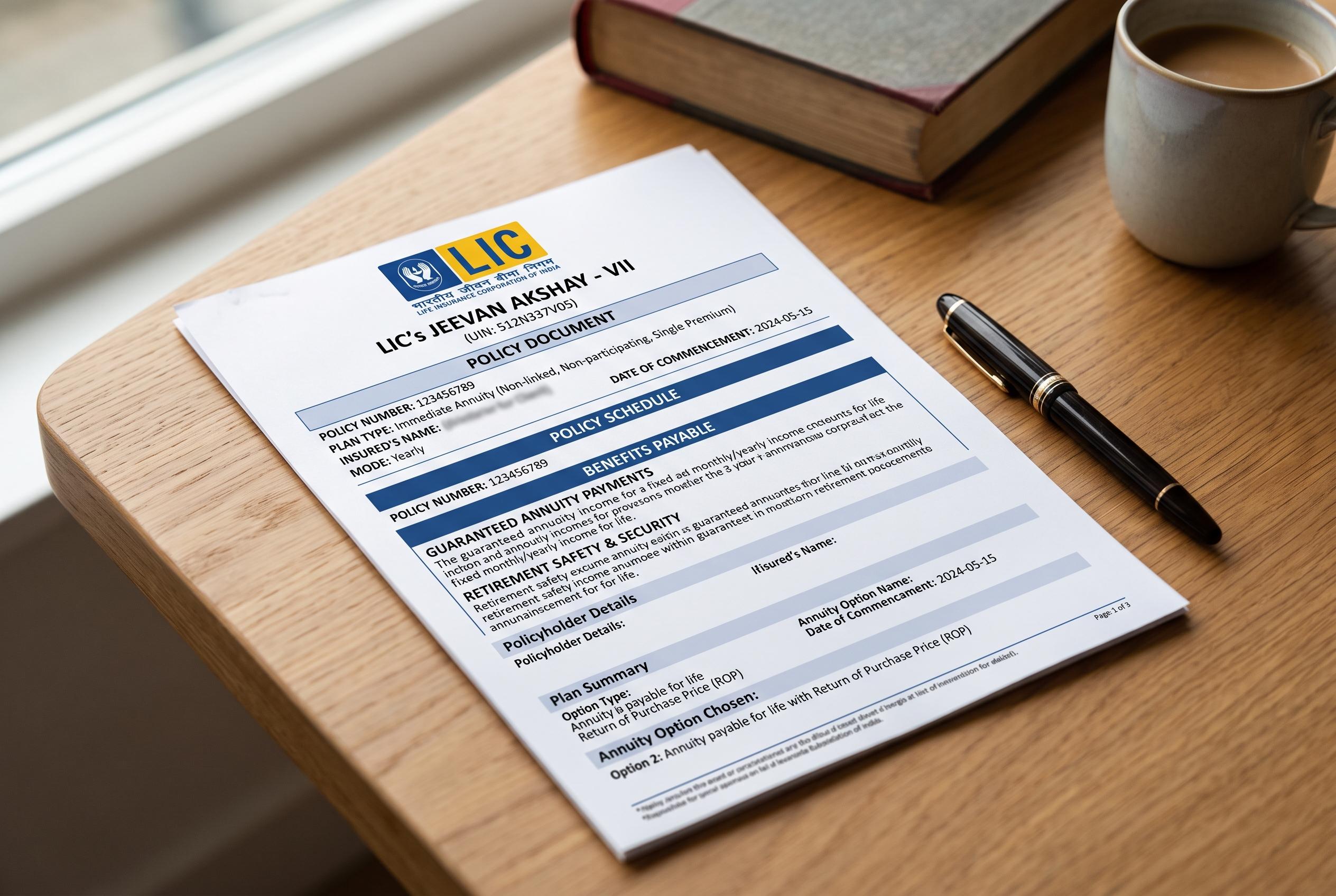

LIC’s new Jeevan Akshay VII plan presents customised pension options for retirees seeking certainty, though with reduced payouts and limited inflation protection, highlighting a shift towards safety over growth in retirement income solutions.
Life Insurance Corporation of India’s Jeevan Akshay VII is aimed at retirees who want certainty rather than growth. The single-premium immediate annuity converts a one-time payment into a guaranteed pension for life, with choices that let buyers tailor the payout to their own needs or to a spouse’s financial security. LIC says the plan can be bought with monthly, quarterly, half-yearly or yearly income payments and does not require a medical examination.
The policy is built around 10 annuity choices. Some are designed for people who want the highest possible pension while they are alive, while others protect heirs by returning the purchase price after death or extending payments to a surviving spouse. According to LIC, the options also include fixed periods of guarantee, such as 5, 10, 15 or 20 years, after which payments continue for life. One variant raises the pension by 3% a year on a simple basis, a modest attempt to offset inflation, though most options still leave buyers exposed to rising living costs over time.
For couples, the joint-life arrangements are among the plan’s main selling points. Under one structure, the second annuitant receives half the original pension after the first death; under another, the survivor continues to get the full amount. LIC’s materials and third-party reviews also note that the surviving annuitant must meet the insurer’s relationship rules, which can include a spouse, child, parent, grandparent, sibling or grandchild. That makes the plan especially relevant for households where one retirement income has to support two lives.
The trade-off is that flexibility comes at the cost of lower payouts. As the Ditto review notes, options that return capital to nominees or continue income for a spouse generally pay less at the outset than plain lifetime annuities. Its illustration, based on a ₹10 lakh purchase at age 60, shows annual income ranging from ₹86,100 under the plain lifetime option to ₹63,300 under the joint-life version with return of purchase price. The review also argues that this should be viewed as a safety product, not a wealth-building one, because returns can be modest unless the annuitant lives for many years.
That makes comparison essential before handing over a retirement corpus. The same review compares Jeevan Akshay VII with the Senior Citizen Savings Scheme, fixed deposits, RBI floating-rate savings bonds and systematic withdrawal plans from debt mutual funds, each of which offers a different mix of income, liquidity and inheritance value. LIC’s own page and independent reviews agree on the core appeal: the plan can reduce the risk of outliving savings. But for buyers who may need access to capital later, or who want income that can keep pace more closely with inflation, the plan’s guarantees may come with too much rigidity.
Disclaimer: This article is intended to inform and educate, not to recommend or endorse any financial product, investment or strategy. Please consider your own financial circumstances and seek professional advice where appropriate before making financial decisions.



