

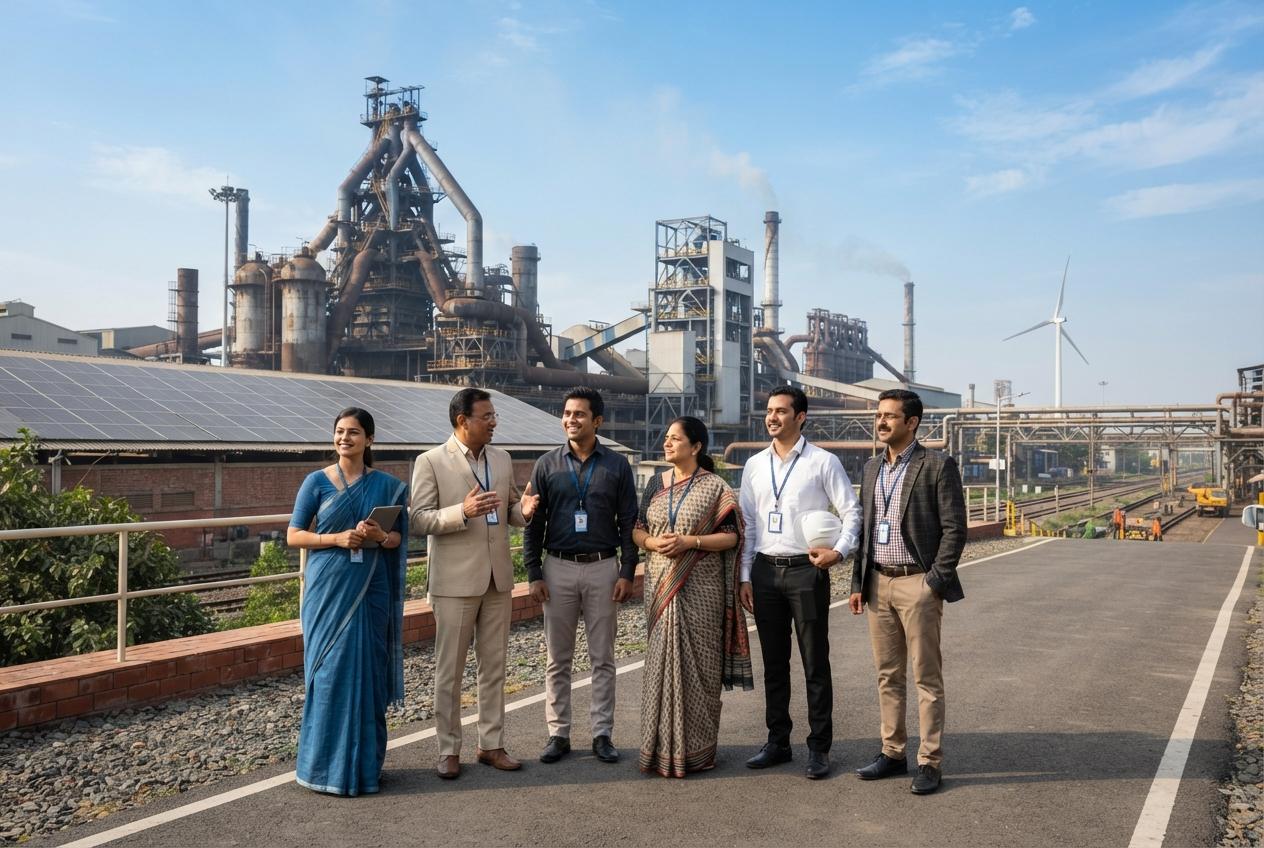

Union Minister H.D. Kumaraswamy highlights India’s shift towards self-reliance in clean energy technology production, emphasising steel, rare earths, and industrial collaboration as key to future growth and energy security.
Union Minister for Steel and Heavy Industries H.D. Kumaraswamy has said India’s energy strategy is now inseparable from its manufacturing strength, arguing that supply chain resilience, industrial capability and innovation matter as much as access to power itself. Speaking at the 7th CII International Energy Conference & Exhibition in New Delhi, he said recent geopolitical tensions and disruptions in global trade have pushed critical minerals, advanced materials and industrial self-reliance to the centre of energy policy.
Kumaraswamy said India’s response lies in the wider Aatmanirbhar Bharat push, with the aim of becoming not just a major consumer of clean energy technologies but a leading producer of them. According to his remarks, the government wants domestic industry to play a larger role across the clean energy value chain, from equipment and materials to batteries, transformers, electric mobility and heavy engineering. He said collaboration between government, industry, academia and finance would be essential if India is to build complete manufacturing ecosystems rather than rely on piecemeal interventions.
He placed particular emphasis on steel, describing it as the backbone of the transition to cleaner energy systems. Renewable energy installations, transmission lines, battery plants, ports and green hydrogen projects all depend on steel, he said, adding that India’s position as the world’s second-largest steel producer gives it an advantage. The minister reiterated the government’s target of lifting steelmaking capacity to 300 million tonnes by 2030, while stressing that future growth must be cleaner, more efficient and more competitive.
The minister also linked India’s electric vehicle ambitions to industrial policy, not just consumer adoption. LiveMint reported that he backed domestic manufacturing of cell components to cut import dependence in the battery sector, while the government’s PM E-DRIVE scheme carries an outlay of ₹10,900 crore. He also pointed to the Production Linked Incentive programme for advanced chemistry cell batteries, which has a commitment of ₹18,100 crore and is intended to create 50 GWh of domestic battery capacity. The Economic Times has separately reported that the broader PLI push for automobiles and components has an outlay of ₹45,938 crore.
Rare earths and critical minerals were another major theme of his address. Kumaraswamy highlighted the government’s ₹7,280 crore scheme to promote manufacturing of sintered rare earth permanent magnets, which are used in electric vehicles, wind turbines, defence systems and electronics. The Economic Times reported that the plan is designed to create a self-reliant and globally competitive ecosystem, with incentives for domestic production and capital support for new facilities. Kumaraswamy said the wider goal is to secure supply chains for the technologies that will shape India’s energy future and support the country’s broader development goals by 2047.
Disclaimer: This article is intended to inform and educate, not to recommend or endorse any financial product, investment or strategy. Please consider your own financial circumstances and seek professional advice where appropriate before making financial decisions.



