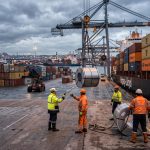
India’s commerce minister Piyush Goyal has accused Brussels of undermining its own competitiveness with the Carbon Border Adjustment Mechanism, as research shows the levy is already reshaping Indian steel exports.
India’s commerce and industry minister, Piyush Goyal, used a speech in Berlin on Thursday to mount a sharp attack on the European Union’s carbon border levy, arguing that Brussels is adding unnecessary costs to its own economy and making itself less competitive. Speaking at the Berlin Global Dialogue, Goyal said the bloc was “inviting disaster” by imposing carbon-related charges on steel and layering more regulation on top of that. He argued that higher compliance costs would feed through into infrastructure spending, transport networks and utilities, pushing up prices for consumers and businesses alike.
The EU’s Carbon Border Adjustment Mechanism, known as CBAM, began taking effect on January 1, 2026, and applies carbon costs to imports of steel, aluminium, cement and other heavy industrial goods. The policy is designed to prevent so-called carbon leakage, where production shifts to countries with looser climate rules, but it has also fuelled accusations of protectionism from trading partners outside the bloc. In Goyal’s telling, the measure is becoming a de facto trade barrier that could make it harder for Indian exporters to compete in the European market.
Recent research suggests the policy is already influencing trade flows. A study published in Nature found that higher-emitting Indian steel producers have cut back exports to the EU, while lower-emission firms have largely held their ground, indicating that CBAM is beginning to reward cleaner production methods. At the same time, reporting by Livemint has noted that Indian steel and aluminium exporters are bracing for weaker demand from Europe as the carbon charge raises the cost of access to the market, even as New Delhi and Brussels continue to negotiate a broader trade agreement.
Goyal linked the EU’s climate-related trade rules to a wider complaint that Europe is over-regulating itself and, in the process, raising costs across its economy. He also pointed to India’s relatively low share of global emissions, saying the country accounts for only a small fraction of the total despite representing a much larger share of the world’s population. India has repeatedly raised concerns about CBAM and the EU’s deforestation rules, which it sees as non-tariff barriers, while the government continues to pursue trade deals it says are fair, balanced and based on mutual competitiveness.
Disclaimer: This article is intended to inform and educate, not to recommend or endorse any financial product, investment or strategy. Please consider your own financial circumstances and seek professional advice where appropriate before making financial decisions.