

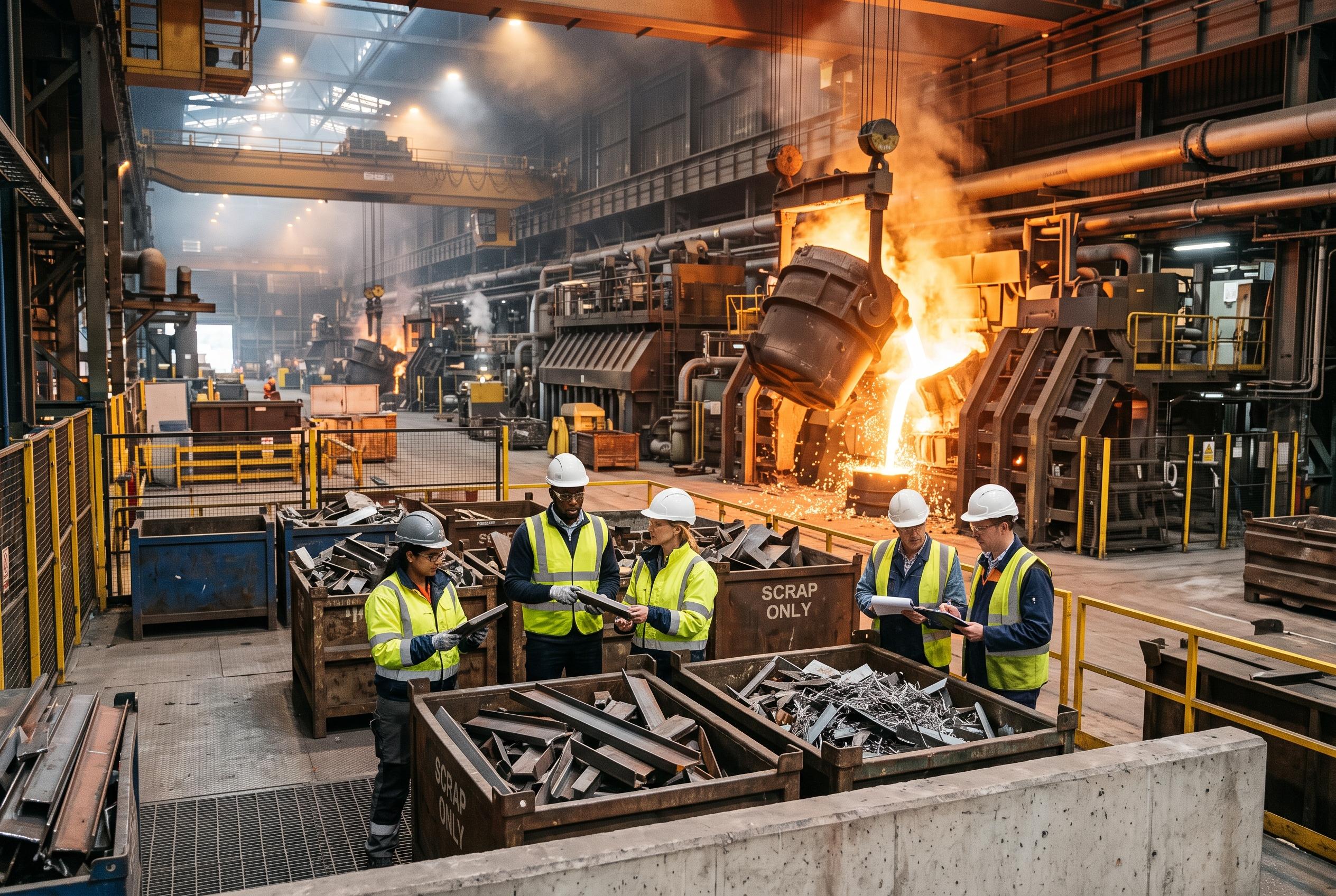

The draft National Steel Policy sets out an expansion path to 2047 while making scrap-based production, domestic value addition and lower-carbon manufacturing central to the sector’s future.
India’s proposed National Steel Policy is being pitched as more than a capacity plan: industry stakeholders say it could push the sector towards a circular economy, support higher-value production at home and speed up the shift to lower-carbon manufacturing. The draft policy, which sets out a roadmap to 2027 and looks further ahead to 2047, also places decarbonisation at the centre of the industry’s next phase of growth.
According to the draft, India wants crude steel capacity to reach 604 million tonnes by 2047, while finished steel demand is expected to rise to 505 million tonnes, per-capita consumption to 302 kg and exports to 45 million tonnes. The policy, as reported by PTI, also aims to improve industry competitiveness and reduce the country’s dependence on imported materials and products. In parallel, the OECD has argued that circular economy measures such as recycling and material efficiency can materially cut emissions from steelmaking, while warning that the transition will require better policy incentives and stronger recycling infrastructure.
Industry figures have broadly welcomed the direction of the draft. Pankaj Malhan, managing director and chief executive of RHI Magnesita India, said the inclusion of refractory recovery and magnesite security showed a more comprehensive effort to build a resilient steel ecosystem. Harsh Bansal, managing director of BMW Industries, said the policy appeared to address the full chain of production, with particular emphasis on value-added and coated steel. Rajib Maitra of Deloitte India said the draft envisions cutting average carbon emission intensity in the sector over four phases by 2047.
Other executives said the plan could strengthen both large producers and smaller manufacturers if it is backed by execution. Satish Kumar Agarwal, chairman and managing director of Kamdhenu Group, said capacity expansion, raw-material security, technology upgrades, speciality steel and decarbonisation could create opportunities across the industry. Deepak Kumar of PS Raj Steels said support for manufacturing clusters and micro, small and medium-sized enterprises would be especially important for downstream producers, which account for a large share of flat stainless steel capacity. The broader message from the sector, according to reporting by Circular Wire and other industry publications, is that scrap-based production, domestic value addition and support for recycled steel streams are becoming central to how India wants to frame its steel future.
Disclaimer: This article is intended to inform and educate, not to recommend or endorse any financial product, investment or strategy. Please consider your own financial circumstances and seek professional advice where appropriate before making financial decisions.



