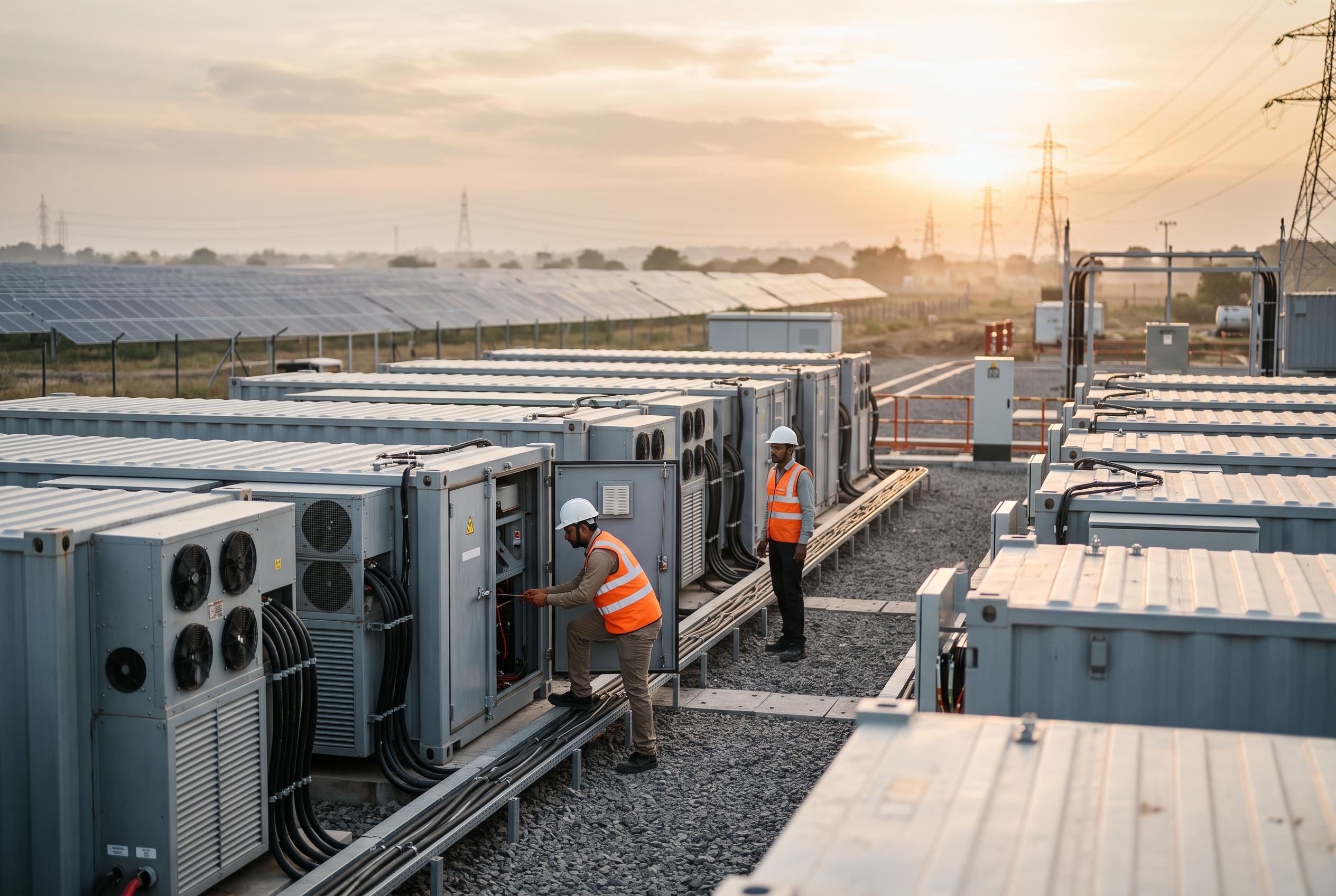

India’s battery storage sector is poised for rapid expansion, with demand expected to reach 236.22GWh by 2032. The shift is supported by significant investments, policy incentives, and a move towards large-scale power storage to bolster the country’s renewable energy ambitions.
India’s battery storage market is set for a dramatic scale-up over the next few years, with demand projected to rise to 236.22GWh by FY2031-32, according to a report by Rubix Data Sciences. The research suggests the expansion will require as much as Rs 3.49 trillion in investment, underscoring how central large-scale storage is becoming to India’s power transition.
Deployment has already quickened sharply. Rubix said 8.2GWh of battery energy storage system capacity was added between January and June 2026, a leap from less than 100MWh in the same period a year earlier. That pace of growth points to a market moving from early-stage adoption towards large infrastructure build-out, even though much of the pipeline is still some distance from being connected to the grid.
As of August 2026, the report said 9.08GWh was operational, while 176.66GWh had either been built, awarded or placed under tender. The Central Electricity Authority’s project pipeline is scheduled to come on stream through FY2029-30, giving India a sizeable base of planned capacity, though Rubix noted that much of it remains at different stages of development rather than fully operational.
The report said battery storage is expected to account for a larger share of India’s overall energy storage needs, rising from about 42% in FY2026-27 to around 57% by FY2031-32. It also estimated that the wider storage sector could attract Rs 4.79 trillion by 2032. The outlook is being supported by domestic battery manufacturing investment, a deep project pipeline and policy measures designed to improve project economics, including viability gap funding, the National Programme on Advanced Chemistry Cell battery storage and waivers of interstate transmission system charges.
The government has also stepped up its backing through the Rs 1.86 trillion PM-DHARA scheme, which includes Rs 500 billion for deploying 50GWh of battery storage capacity by FY2032-33, according to the report. Together, those measures suggest India is trying to build not just more renewable generation, but the storage needed to make that power more reliable and usable at scale.
Disclaimer: This article is intended to inform and educate, not to recommend or endorse any financial product, investment or strategy. Please consider your own financial circumstances and seek professional advice where appropriate before making financial decisions.