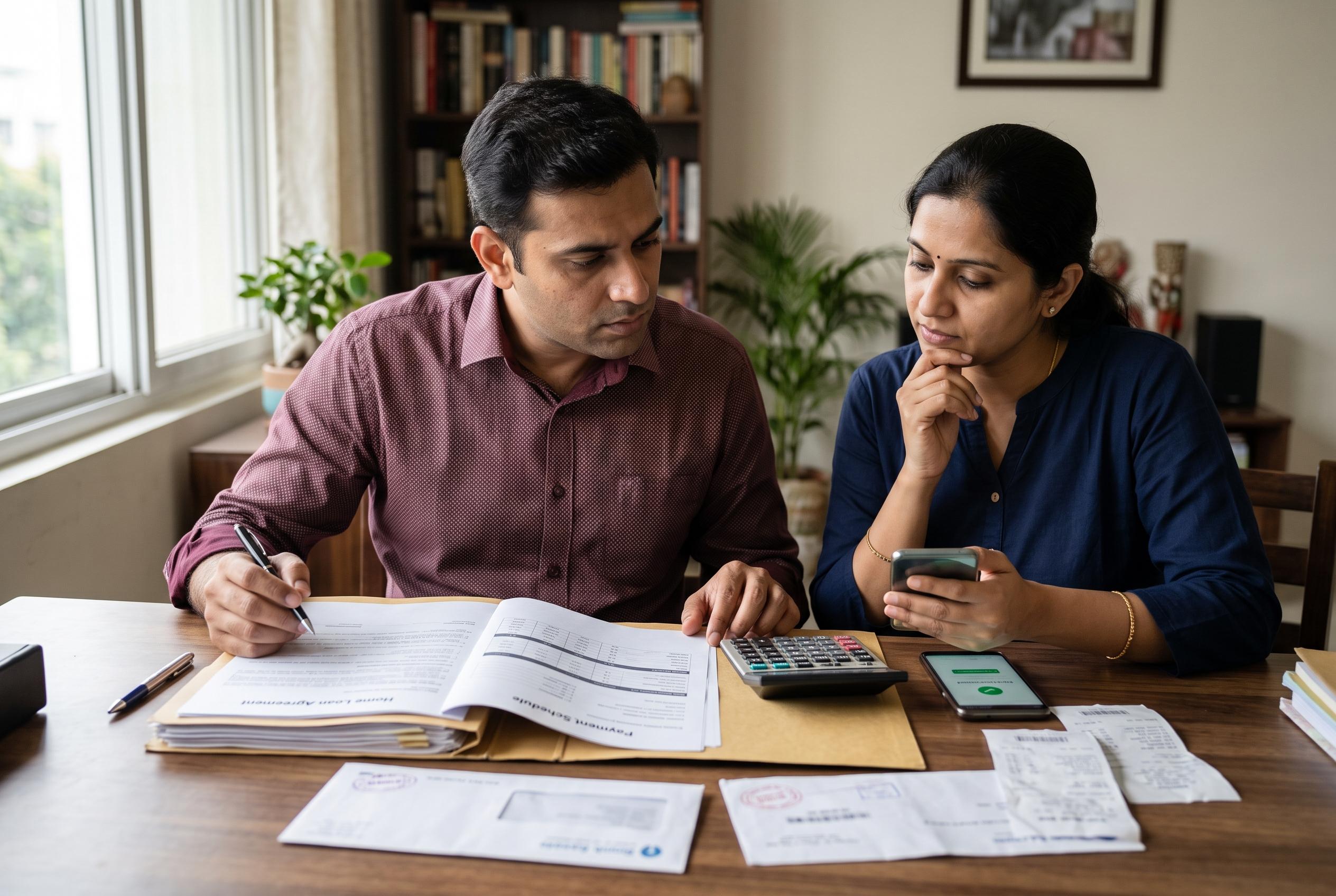

Tax experts clarify that in India, only the spouse who makes actual EMI payments can claim tax benefits on a joint home loan, highlighting the importance of clear documentation and payment trails for couples sharing property.
When a salaried couple buys a home together, it is common for both names to appear on the sale deed and the loan agreement. But if only one spouse is actually paying every monthly instalment, tax experts say the deduction does not automatically belong to both. In the scenario described by Moneycontrol, the spouse who makes the repayment is the one who can generally claim the benefit, while the other partner cannot claim a share merely because her name appears on the paperwork.
That is because home loan tax relief in India is tied to more than just ownership on paper. According to EMI.me, Easy-EMI and BookMyCA, a taxpayer usually needs three things to be in place before claiming deductions: co-ownership of the property, co-borrowing on the loan, and an actual financial contribution towards the equated monthly instalments. Without proof that money has been paid from the claimant’s own account, the tax claim is vulnerable to challenge.
The crucial point is that being a co-owner or co-borrower is not, by itself, enough. Economic Times has reported that ownership rights remain central to the deduction claim, while the repayment burden also matters. In practice, tax officers can ask for bank statements and other records to check who really serviced the debt. If one spouse paid nothing towards the EMI, the deduction is likely to stay with the spouse who bore the cost.
For couples who both work and want to split the tax advantage, the key is to divide the EMI in a way that is visible in the banking trail. EMI.me says spouses can route payments in agreed proportions, such as 50:50 or 70:30, and keep clear records if the instalment comes from a joint account. Under the old tax regime, each eligible borrower may claim up to Rs2 lakh on home loan interest under Section 24(b) and up to Rs1.5 lakh on principal repayment under Section 80C, subject to the applicable ownership and payment structure.
The choice of tax regime is just as important as the repayment arrangement. According to Easy-EMI, BookMyCA and other tax guides, the new tax regime does not allow the standard deductions on interest and principal for a self-occupied home that are available under the old regime. That means households hoping to use home loan tax relief need to check whether the old system still offers a better outcome, especially where one spouse has little or no taxable income. Clear documentation, matching cash flows and a realistic division of the loan are what determine whether the deduction survives scrutiny.
Disclaimer: This article is intended to inform and educate, not to recommend or endorse any financial product, investment or strategy. Please consider your own financial circumstances and seek professional advice where appropriate before making financial decisions.