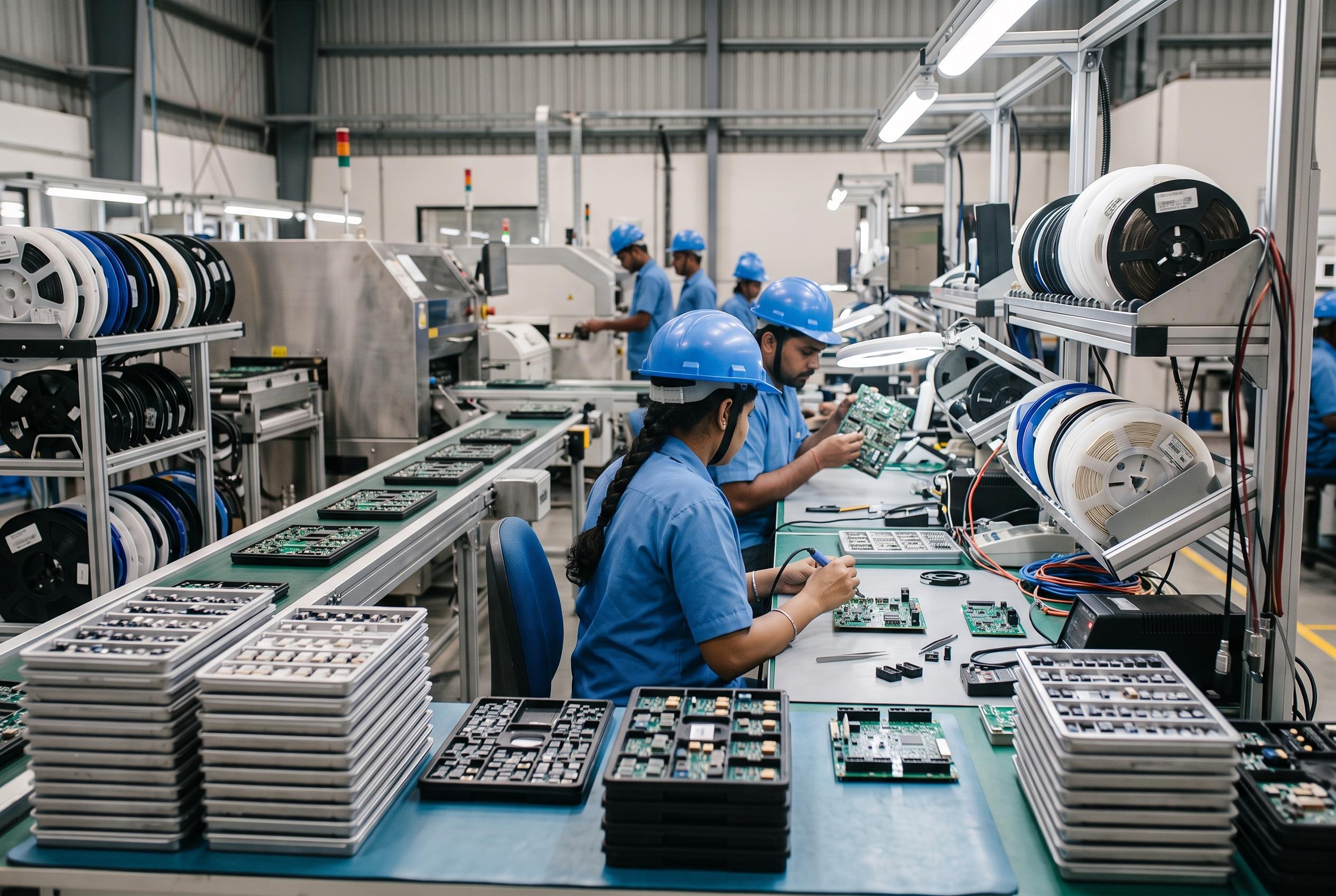

India is set to overhaul its telecom production-linked incentive scheme, shifting focus from final assembly to manufacturing key components and fostering a more resilient domestic supply chain, with a comprehensive plan expected in early 2028.
India is preparing to reshape its telecom manufacturing incentives with a successor to the current production-linked incentive scheme that would move the country beyond final assembly and into the more difficult business of making components. According to Communications Today and LiveMint, the new programme is expected to replace the existing Rs 12,195 crore scheme when it ends in March, with a proposed outlay of about Rs 6,000 crore to Rs 7,000 crore and a sharper focus on local parts production. The Department of Telecommunications has already sent the plan to the finance ministry, and a decision is expected soon. The five-year proposal is understood to aim for 9,000 direct jobs, Rs 3 trillion in sales and another Rs 1.5 trillion in exports.
The change comes as the government leans harder on industrial policy to strengthen domestic supply chains. Moneycontrol reported that the new telecom package has received in-principle approval on the spending side and is being processed by the Expenditure Finance Committee, with officials targeting a rollout in the first quarter of fiscal 2028. The broader context is a national push to localise production in sectors treated as strategically important, especially after supply shocks exposed the risks of depending too heavily on imports for critical hardware.
Officials and industry participants say the next version is meant to go further down the value chain than the scheme now being phased out. As Communications Today reported, manufacturers want support not just for finished equipment but also for semiconductors, printed circuit boards, optical parts and photonic components, along with greater backing for research, development and intellectual property owned in India. The aim is to build a more resilient ecosystem that can serve both the domestic market and exports, rather than simply expanding assembly lines.
That ambition is informed by the mixed record of the current scheme. The programme, launched in February 2021, has approved 42 applicants, but government data presented in Parliament showed that 19 have not yet claimed or received any incentive. Among the companies that have participated are Tejas Networks, VVDN Technologies, Nokia Solutions and Networks India, Jabil Circuit India, Flextronics Technologies India and Dixon Electro Appliances. Samsung Electronics exited the telecom equipment scheme, while Netweb Technologies did not join it. By late November, 23 companies had claimed Rs 1,984 crore in incentives, although only Rs 1,850 crore had been disbursed. Through August 31, participants had committed Rs 5,950 crore of investment, generated Rs 1.28 trillion in sales, recorded Rs 31,645 crore in exports and created 36,575 jobs.
Industry groups say the weaker parts of the scheme were not simply about production capacity, but about demand and working capital. VoICE has argued that smaller and mid-sized makers were squeezed by global shortages, especially in semiconductors, while telecom operators continued to buy from established foreign vendors based on technical requirements and commercial terms, not on whether a supplier qualified for incentives. The group wants the successor scheme to set lower entry thresholds for component categories such as oscillators, radio-frequency power amplifiers and optical sub-assemblies, while introducing a staged payment structure so smaller firms are not all-or-nothing losers if they come close to target. The next phase will need to balance localisation goals with those procurement realities if it is to do more than repeat the limits of the current framework.
Disclaimer: This article is intended to inform and educate, not to recommend or endorse any financial product, investment or strategy. Please consider your own financial circumstances and seek professional advice where appropriate before making financial decisions.