

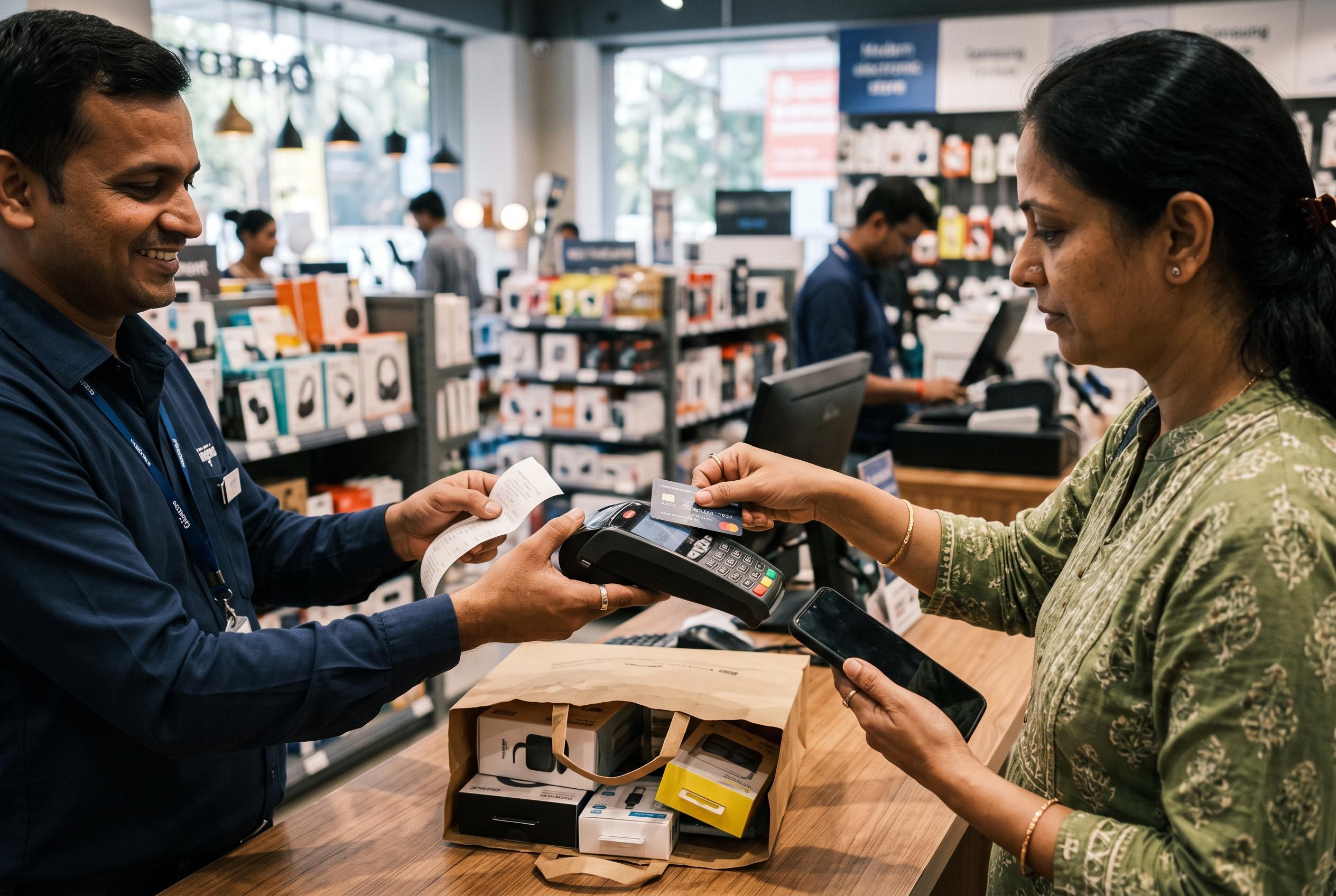

India’s retail credit market is shifting towards financing embedded in purchases, with point-of-sale lending poised to reshape borrowing behaviour amidst a backdrop of rapid credit growth and a surge in secured lending segments.
India’s consumer credit market is expanding quickly, but the next phase of growth may be driven less by stand-alone loan applications than by financing built directly into the act of buying. The argument made by Finextra is that point-of-sale lending, where credit is offered at checkout, could become one of the most important distribution channels in Indian retail finance because it links borrowing to a specific purchase, a clear price and an immediate financing need. That makes the transaction itself the trigger for credit, rather than a separate application journey.
The broader backdrop is still one of strong credit expansion. CRIF High Mark data reported by Business Standard showed retail loans outstanding reached ₹170.2 lakh crore in March 2026, up 16.6% from a year earlier, with consumer-durable lending rising 20.8% and consumption loans reaching ₹118.6 lakh crore. Another CRIF High Mark report covered by Moneycontrol said the MSME credit portfolio climbed to ₹46 lakh crore in April 2026, a 12.8% annual increase, although growth slowed as geopolitical uncertainty started to weigh on manufacturing, trade and micro-enterprises. Together, those figures suggest a credit market that remains active but is becoming more selective about where lenders see durable demand.
One of the clearest signs of that shift has been the rapid rise of secured lending, especially gold loans. Business Standard reported that gold loans were the fastest-growing retail credit segment, rising 50.4% year on year, while Moneylife said the segment had become the second-largest retail lending product after home loans, reaching ₹18.6 trillion by March 2026. The growth reflects both high gold prices and stronger borrowing capacity among households pledging jewellery, underscoring how Indian borrowers are increasingly gravitating towards loans tied to assets or identifiable purchases. That makes embedded credit at the point of sale look less like a niche product and more like part of a wider reordering of borrowing behaviour.
For lenders, the attraction is not simply speed. Finextra’s analysis argues that transaction context can improve credit decisions because category, basket size and merchant information offer useful signals about demand. But it also warns that those signals are no substitute for a proper affordability check. In practice, a lender still needs to judge whether the borrower can repay, not merely whether the purchase is attractive or the approval can be automated. Artificial intelligence may help with fraud detection and underwriting, yet the real test is portfolio performance over time, not the volume of instant approvals.
That is also where regulation matters. India’s digital lending framework has already pushed lenders towards more transparent disclosure, including clearer presentation of annual percentage rates and standardised key information statements, alongside rules on consent, data use and the role of lending service providers. Finextra’s central point is that this transparency is not just a compliance issue; it is part of the commercial case for point-of-sale lending. If credit is easier to access but harder to understand, the model will be vulnerable. If lenders can combine merchant reach, disciplined underwriting, clear pricing and strong repayment outcomes, checkout financing could evolve from a convenience feature into a lasting pillar of consumer credit.
Disclaimer: This article is intended to inform and educate, not to recommend or endorse any financial product, investment or strategy. Please consider your own financial circumstances and seek professional advice where appropriate before making financial decisions.



